THE STUDENT OF PRAGUE;
Today German cinema of the silent era is known for it's iconic works of Expressionist Horror such as "Nosferatu", "The Cabinet Of Dr Caligari", "Metropolis" and "Der Golem". In fact the Germans were rather late in producing film works of any note. The early decades of film from the 1890's to just before World War One belonged to the Americans, French, Italians, Danes, Swedes and to lesser extent the Russians while German films were mostly non-nondescript comedies, ribald burlesques and crime stories including several adaptations of Sherlock Holmes. German audiences were also quite happy to devour foreign films like the westerns of Bronco Billy, William S Hart and Tom Mix and the French comedies of Max Linder rather than demand any particularly distinctive homegrown product unlike the Italians and Russians who produced "Art Films" based on historical epics or the Danes and Swedes who produced films based on Nordic folklore and literary themes. These last films came to fascinate many German writers, stage directors and actors who felt a common Nordic kinship known as Expressionism.
Expressionism was a post-impressionist art movement influenced by the Dutch artist Van Gogh and more especially the Norwegian painter Edvard Munch and the playwrite Ibsen which would inspire Germans who strongly identified with their themes of deep emotional turmoil constrained by bourgeois convention, a strong connection with nature and a shared Nordic heritage. They would make these themes their own with a passionate intensity and thoroughness adding to them philosophical strains from Goethe, Schiller, Nietzche and Freud and a willingness to experiment quite lacking in previous German film-makers. This ambitious vision came from stage directors and playwrites like Max Reinhardt and Frank Wedekind who produced ground-breaking plays which attacked bourgeois values as well as challenging conventional stage designs with minimalist sets influenced by constructionist and cubist art, impressionist lighting and dramatic and physical acting styles influenced by modern dance. Previously the Expressionist theatre world had not taken film very seriously as a medium thinking it fit only for low-brow entertainment but the Scandinavian films (which were quite popular in Germany, especially those of actress Asta Nielsen) convinced them of the artistic possibilities.
Max Reinhardt's theatre troupe contained many figures who would become crucial figures in Expressionist films including actors Conrad Veidt, Werner Krause, Emil Jannings, Paul Wegener, Max Shreck, John Gottowt, Lil Dagover ("Caligari"), Greta Schroder ("Nosferatu") and Lyda Salmonova ("Der Golem") along with directors Ernest Lubitsch and Paul Leni and set designer Ernest Stern. Reinhardt's own attempts at film direction starting with "Sumuran" in 1910 were failures. Reinhardt simply did not understand the new medium and merely shot his films with static cameras as if they were simply plays. This sort of approach had already gone out of style in America and France by this time and audiences in Germany, who were by then used to foreign films were bored by such a dull, out-of-touch approach. However some of his younger actors and directors learned these lessons and soldiered on.
The first to successfully make his mark was Paul Wegener with his 1913 film "The Student Of Prague". Wegener was one of Reinhardt's stage actors who had been considering the possibilities of film as dramatic medium capable of portrayal of fantasy after seeing an exhibition of trick photographs featuring a man fencing and playing cards with himself. Clearly the stage would not be up to such effects but film-makers such as George Melies and Segundo De Chomon had already shown how film could be used to create an unreal fantasy world. Melies and other fantasy film-makers were content to engage in childlike magic, however Wegener's aim was to use fantasy to explore expressionist themes of psychological horror. Working with a script written by Hanns Heinz Ewers, a novelist of Gothic horror already known for the novel "Alarune", they came up with a story about a young man selling his soul and revealing his inner demon. The story was based on the iconic (especially in Germany) story of Faust and the Devil along with Robert Louis Stevenson's "Dr Jekyll And Mr Hyde", Oscar Wilde's "Dorian Gray", Edgar Allan Poe's "William Wilson", Joseph Conrad's "Secret Sharer" Fyodor Dostoyevsky's "The Double" and a touch of Bram Stoker's "Dracula". Two other novels now forgotten but popular in Victorian times and thus possibly known to the writers might have been the trashy English Gothic potboilers "The Monk" by Mathew Lewis and "Memoth The Wanderer" by the Irish writer Charles Robert Maturin about characters selling their souls.
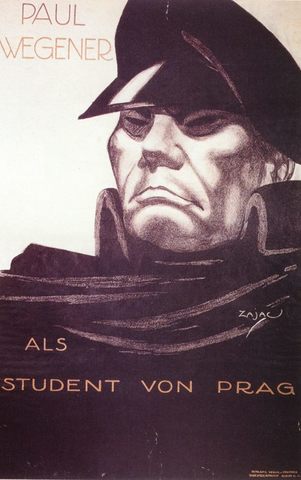
Wegener brought in director Stellan Rye and one of Germany's best cameramen Guido Seeber along with some other Reinhardt actors including John Gottowt and Lyda Salmonova, who would also be one of Wegener's many wives. The resulting film caused a sensation not only in Germany but also internationally becoming the first German film to do so aside from 1912 "Night And Ice", a well done but conventional docudrama about the Titanic sinking. With it's dark themes of obsession, guilt, greed, lust, betrayal and death the film exposed the hidden tormented soul behind the sober, conformist, respectable German bourgeois in the false dawn before the nightmare of The Great War and became the catalyst for the growth of German Expressionist film after the war.
"THE STUDENT OF PRAGUE" ~ 1913;
CAST;
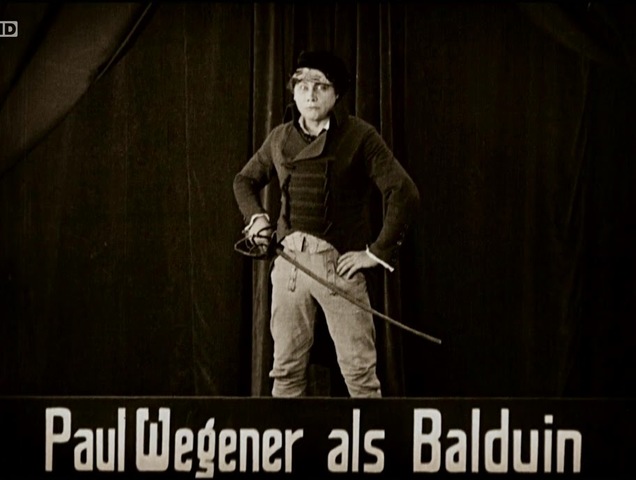
Paul Wegener ~ Balduin, The Student
John Gottowt ~ Prof. Scapinelli, The Magician
Grete Berger ~ Countess Margit Von Schwarzenberg
Lyda Salmonova ~ Lyduschka, The Servant Girl
Lothar Korner ~ Count Von Schwarzenberg
Fritz Weidermann ~ Baron Waldis-Schwarzenberg
Directed by Stellan Rye
PLOT SYNOPSIS (SPOILER ALERT!);
In 1821 Prague Balduin is a young university student of limited means. He is socially ambitious but rather decadent, preferring to drink, dance and gamble. He is also a champion fencer. Lyduschka is a pretty and flirtatious servant girl at the pub he frequents. She longs for Balduin but he is hoping to find a rich wife. Scapinelli is a magician who makes a deal to find Balduin a likely target. Countess Margit is a wealthy heiress who is already engaged to her cousin Baron Waldis-Schwarzenberg as per her father's wishes although she does not love him. As the Countess and the Baron go off on fox hunt she rides off on her own and falls into a lake where she is rescued by Balduin who has been walking by with Scapinelli. Balduin returns to his small apartment to change and practice fencing where he is met by Lyduschka who gives him a bunch of flowers and flirts with him only to have him ignore her and take the flowers to give to the Countess whose estate he visits. She is there with her father the Count. She is happy to see Balduin but then Baron Waldis shows up with a much larger bouquet of flowers. The Baron is rude to Balduin and the Count quickly ushers him out. A dejected Balduin sheepishly returns home, still with his pathetic bunch of flowers. Scapinelli visits him and makes a proposal; he will pay Balduin one-hundred thousand pieces of gold in exchange for which Scapinelli may take any one item he wants from the room. As Balduin has nothing of value he readily agrees and signs a contract. Scapinelli gestures to a large full-length mirror Balduin uses for fencing practice and states that he will purchase Balduin's reflection. Balduin is dismissive until much to his shock his reflection does indeed step out of the mirror and walk slowly and silently towards the door before simply vanishing. Scapinelli laughs before exiting as well. Balduin is even more shocked to discover that he no longer has a refection in the mirror, although at the time he is inclined to laugh it off and enjoy his new found wealth.
The newly respectable Balduin is invited to a fancy ball where he pursues Countess Margit. He passes her a note asking her to meet him later even though she is to be married. Baron Waldis shows up and angrily pulls her away. Lyduschka has been spying on Balduin and witnesses this. As Balduin leaves he runs into his Doppelganger who mocks him before once again vanishing. Balduin is frightened at first but assumes he has been having a hallucination and laughs it off. Lyduschka has followed Countess Margit home and found the note Balduin gave Margit, she steals it and runs off. Balduin and Margit are having their tryst in a cemetery when the Doppelganger shows up and scares her away before disappearing. Balduin is now frightened.
Lyduschka goes to Baron Waldris' house and gives him the tryst note from Balduin to Margit. Waldris is outraged. He dismissively offers to pay her for the note but she indignantly refuses any money and gives him the note anyway before marching out. Baron Waldris calls on Balduin and challenges him to a duel which Balduin accepts. Count Von Schwarzenberg begs Waldris to call off the duel since Balduin is the finest fencer in Prague but Waldris arrogantly refuses. The Count then calls on Balduin and begs him to spare Waldris as he is the superior fencer and Waldris is both his proposed son-in-law and heir. Reluctantly Balduin agrees. Passing through a forest on his way to the duel Balduin is met by his Doppelganger who tells him he has already fought the duel and killed Waldris. The horrified Balduin runs to the spot of the duel where a crowd is gathering around the body of Waldris. He then rides to speak to the Count who refuses to see him. Balduin tries to forget his troubles by going to a fancy party and drinking alone. Lyduschka is at the party and flirts with him but he rejects her and leaves. Balduin attends a high-stakes card game where he wins until the other players quit and he is left alone. The Doppelganger then enters and sits down and invites Balduin to play him. The terrified Balduin runs away and tries to visit Margit, climbing over the fence of her estate. He climbs a latter into her room where he begs her forgiveness, crying in her lap. She is at first resistant but then relents. They kiss but when they parade together in front of a full length mirror and she discovers he has no reflection she is frightened. Before the distraught Balduin can explain the Doppelganger appears and Margit faints. The terrified Balduin flees out the window.
Balduin attempts to run away but at every turn he finds the Doppelganger impassively waiting for him. Eventually he flags down a coach and flees the city. When he exits the coach he discovers the coachman is in fact the Doppelganger. Balduin runs home, bars the door and arms himself with a dueling pistol. In his room Balduin sits at his desk to write a note (or confession?) when the Doppelganger appears. Balduin shoots him only to have the Doppelganger vanish. Balduin searches the room and finding no sign of his tormentor decides he is dead, especially when he grabs a mirror and discovers his reflection has returned to where it belongs. Balduin is overjoyed until he feels a pain in his chest. Checking it he discovers a bullet hole and crumples to the floor dead. Scapinelli enters the room and seeing Balduin's body takes the contract he had signed from his pocket and laughingly tears it up. Then he gives an elaborate bow before vanishing. Finis.
~~~~~~~~~~~~~~~~~~~~~~~~~~~~~~~~~~~~~~~~~~~~
The Gothic literary references in this clever story are obvious but ingenious. The "Faust" influence is overt, especially to a German audience, as when Balduin sold his reflection he was actually selling his soul and Scapinelli is obviously the Devil or at least one of his minions. The "Dr Jekyll And Mr Hyde" influence is shown as the Doppelganger also reflects (so to speak) Balduin's dark side. The issue of a doppelganger had also been raised in Poes' "William Wilson", Dostoyevsky's "The Double" and Conrad's "Secret Sharer". As the reflection is destroyed Balduin also dies as had Dorian Gray with his portrait. That the soulless Balduin has no reflection is a convention taken from "Dracula". There is a notable difference though in that when Balduin makes his deal with the Devil he does not know who he is dealing with nor does he know he is selling his soul. By comparison Faust, Dr Jekyll, Dorian Gray and even Dracula knew exactly what deals they were making and made them anyway thinking they could handle the consequences. Balduin does not understand what he has sold until it is far too late. This changes the moral dynamic of the fable. Those characters had free-will and chose unwisely because of pride and ambition (Faust), intellectual arrogance (Jekyll), vanity (Dorian Gray) or the promise of immortality and power (Dracula). Balduin is certainly a selfish social climber but since he did not make even a somewhat informed choice he was in effect denied free will which makes him more of a victim than the others. There is no way of knowing if the film-makers Wegener and Ewers considered the ramifications of this change or not when they wrote the script. Were they dismissing or making a mockery of the very idea of free will as Sophocles had done in "Oedipus Rex"? Or did they not notice this at all?
A common theme that would later run through Expressionist film as identified by such influential critics as Fredrich Krakauer (in his landmark book "From Caligari To Hitler") and Lotte Eisner (the equally important "The Haunted Screen") is seen here in the manipulative figures who lead characters astray or control their minds. Characters such as Scapinelli, Dr Caligari, Dr Mabuse, Nosferatu, Lulu ("Pandora's Box"), Lola Lola ("Blue Angel") the mad scientists and magicians in "Der Golem", "Metropolis", "Aralune", "Homonculus", "Genuine" and "Warning Shadows" not to mention the film versions of "Faust" and "The Pied Piper" all show this was a real trend. Krackuer and Eisner saw this as a reflection of the innate German need to follow a strong leader that would later lead to Hitler. It's worth pointing out here that Hanns Heinz Ewers, who wrote the main script (as well as the novel "Alarune" which featured a beautiful, artificially created young (Briget Helm) was also made into a movie twice), would later become an enthusiastic Nazi including writing scripts for Nazi propaganda films and plays including one glorifying the notorious Storm Trooper Horst Wessel.
In fact the film is notable for it's time in having no really sympathetic characters at all. Let alone a hero. Balduin may be a victim but he is also a decadent wastrel, an utterly shameless social climber who makes it clear that he is after the Countess for her money and social position even though the Countess is not even especially attractive compared to the younger, prettier and more flirtatious Lyduschka. The servant girl actually really does love him although it's hard to see why since he consistently ignores her. She is not even motivated by money since when Waldris offers to pay her she indignantly refuses. That's not to forget that Lyduschka is still sneaky, possessive and vengeful as she spies on him and squeals to Waldris which she had to know would end in a duel. Waldris is an arrogant snob who is also marrying Margit for money and status even though she has openly told him she does not love him and is going through with the arranged marriage due to family loyalty which Waldris obviously has no problems with. Neither does her father who is marrying her off to a cousin she does not love to keep the title in the family. Accordingly Margit is more of a victim but she is still cheating on her fiance and quickly forgives Balduin for killing him, although under the circumstances we can probably give her a pass on some of that. Balduin is not a villain as he is not without conscience since he does agree to call off the duel (or at least not kill Waldris) and feels some guilt over his death. Or is that just fear? We don't really know. And Scapinelli is of course the Devil. So that leaves us with no heroes, a strange position for a film of the time but one German intellectuals at least found revelatory. Or liberating.
BALDUIN CONFRONTED BY HIS DOUBLE;
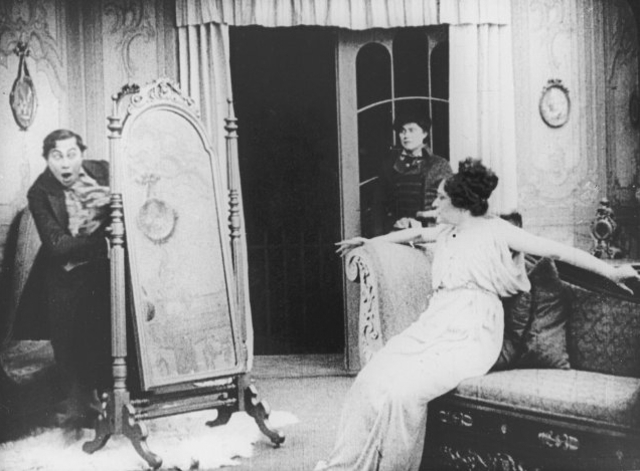
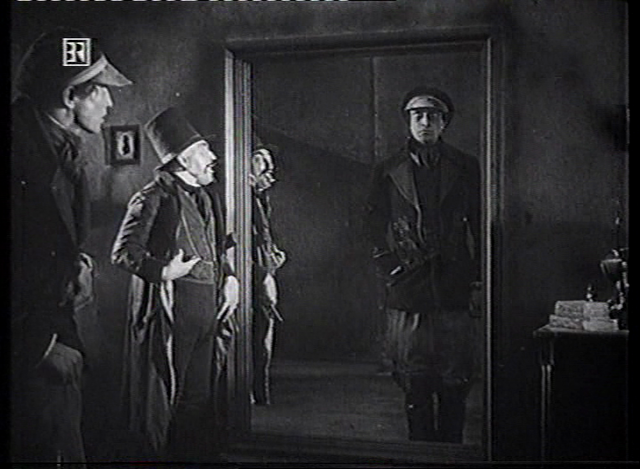
As for the actual film-making, it is pretty conventional and shows little of the innovative camera work or set design that would become the trademarks of Expressionist film after 1919. The direction is perfectly competent and efficient and moves at a quick pace, however there are even some archaic touches such when characters gesture towards the camera as if on stage, by 1913 the Scandinavians and American directors like DW Griffith were discouraging this sort of thing, although it was still common in French films. The rather clunky need to formally introduce each character was also on it's way out although still common in Italian and Russian films. There are some Expressionist touches in the filming however such as in the gambling scene which is shown surrounded by darkness, and the placing of Balduin in settings were he is dwarfed by architecture as the story progresses in contrast with the beginning where he is shown in sunshine and in settings where he seems more imposing. One later trademark of Expressionist film was it's use of elaborately constructed indoor sets which allowed film-makers to control every aspect of design and lighting as well to the extent of sometimes creating fantasy worlds as in "Caligari" and "Metropolis". Wegener would later pioneer this approach with his second version of "Der Golem" (1920) but in 1913 he was still working with natural settings as the Scandinavians had done. Wegener had in fact chosen Prague as a setting for both films because he felt the city's old quarter would be have suitable atmosphere, especially for a scene in a Jewish graveyard with some large primal looking tombstones. While Wegener was giving some thought to setting a proper atmosphere he was not yet taking control of his environments yet to set the mood. Ironically the Rabbis denied permission to film in the graveyard so he had to build a fake one. By the time he was making the second version of "Der Golem" he was building an entire town as a set. The double exposures where Balduin is confronted by the Doppelganger were not really a new process but they are well done and must have impressed audiences at the time. Such trick shots would also become a standard feature in German films.
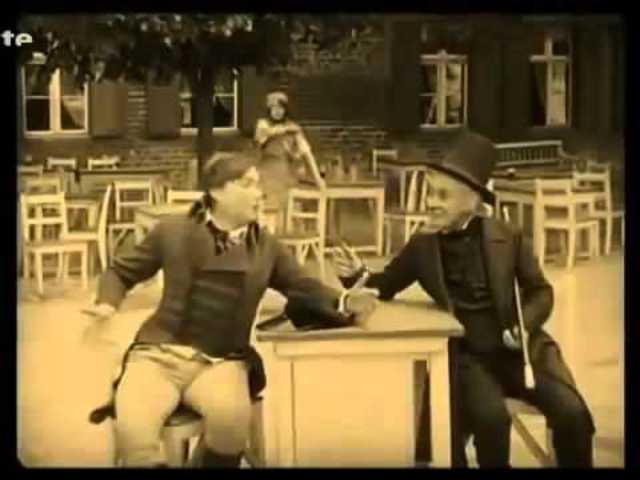
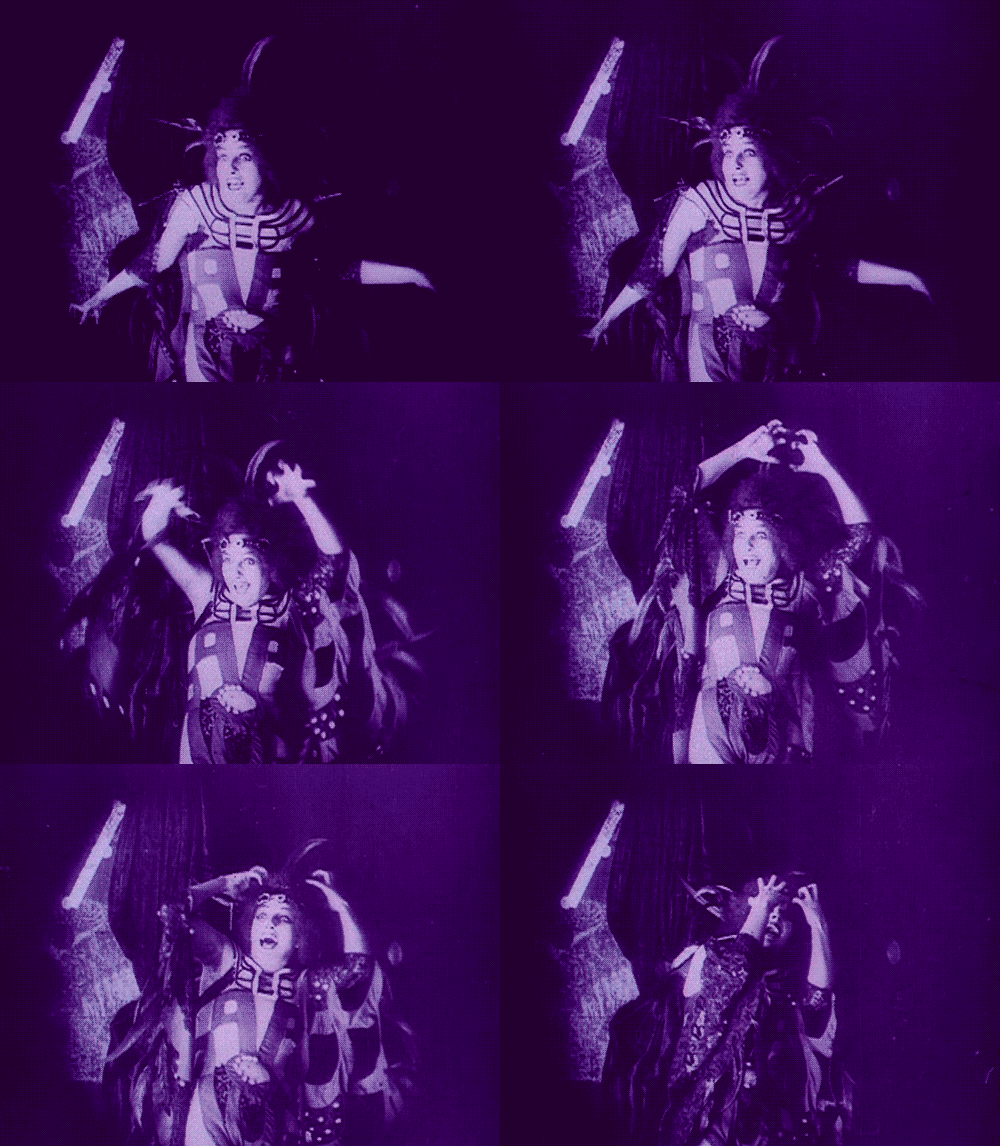
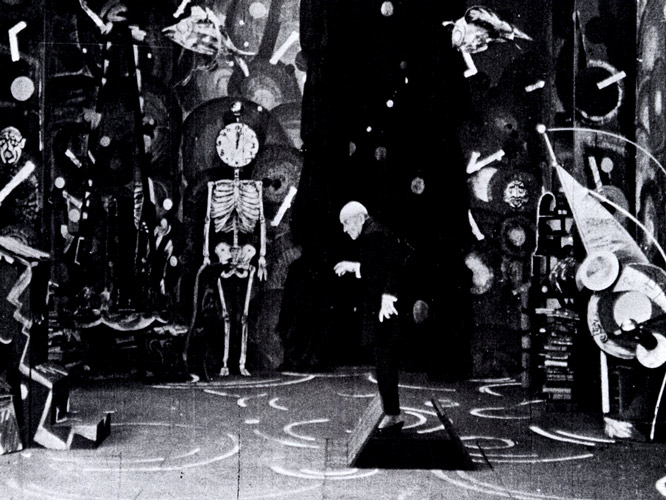
Wegener would normally be an odd choice for the role of the student, he is a stocky, even bulky man, with heavy features and although he is actually more physically gracefull than he appears as when he fences, scurries up and down ladders and scampers over a high fence with evident ease, he is still clearly too old to be a student. One suspects that if he had not been in charge of the project he would not have been cast in the lead role. Still he was a thoughtful actor who had given much consideration to the new medium (he would also give lectures on the subject of film acting) and he is a confident presence who can display some subtlety. This is important since he is able to convey the two distinct but identical characters successfully even though he would have actually be acting to a blank wall at the time. His skill compares well to the actress playing the Countess who is still bound by the conventions of the stage. By contrast Lyda Salmonova as Lyduschka, is pretty, lively and flirtatious and comfortable on film. The most impressive performance is John Gottowt as Scapinelli, he gets the best costume; dressed in a frock coat, top hat, drape pants and spats with a bald vulture head. He minces with birdlike movements and perches on Balduin's desk like a vulture. If he were more chubby he could be the model for the Batman villain The Penguin. His appearance and style would be shown again in the 1919 film "The Cabinet Of Dr Caligari" (although the actor himself was not) as both Werner Krause's title character as well as the sneering clerk perched on his impossibly high desk. Gottowt would become an excellent character actor and would play another similar looking devious old man in "Genuine" as well as the Renfield character in "Nosferatu" and yet another creepy old clerk in "Waxworks".
BALDUIN MEETS SCAPINELLI;
Paul Wegener would become one of the founders of Expressionist Horror following up the next year with the influential "Der Golem" (now unfortunately lost aside from the last few scenes) which he would remake (as both actor and director) in 1920 as one of the most important horror films of all time. He would also fire off a critically acclaimed version of "The Pied Piper Of Hamlin" which has also been lost, and a version of Hanns Ewers mad scientist novel "Alarune" in 1928 among many other film credits. He would cast his then wife Lyda Salmonova as the female lead in both versions of "Der Golem" and "The Pied Piper" although they would later divorce and he would marry six times, once to Greta Schroder from "Nosferatu". He had a short career in Hollywood playing mad scientists before returning home when sound films came in. After that the rather rotund actor's days as a leading man were clearly over but he continued to act as a supporting player into the sound era even after the Nazi's took over. Unlike many other Expressionist artists and film-makers he did not flee Germany and continued to work including in some notorious propaganda films, including "Kolberg", generally seen as one of the most expensive disasters in film history. Unlike Hanns Ewers, Wegener was no Nazi though, (he had of course already used a Jewish story and characters with respect in "Der Golem") he reportedly gave money and some assistance to the underground although how much is impossible to know. He managed to avoid being swept up by the Gestapo purges after 1944 so they obviously did not see him as a real threat although his celebrity may have given him some protection. At any rate the post war West German government had no problems with him and he continued to play an elder statesman role in German film and stage including reviving a Jewish play in Berlin and doing charitable work until his death after having a heart attack on stage while acting in a play. He died two months later in 1948 aged 78.
Besides the movies Lyda Salmonova, a former stage actress and dancer originally from Czechoslovakia, made with Wegener she also appeared in a now lost if minor FW Murnau horror movie "The Hunchback & The Lady" with Werner Krause (of "The Cabinet Of Dr Caligari" and the 1926 "Student Of Prague" remake) and John Gottowt. She also appeared in some big budget historical epics like Lucrezia Borgia (1922) (starring Wegener and Conrad Veidt) and "The Loves Of The Pharaoh" (directed by Ernst Lubicsh and starring Emil Jannings)as well as in "The Pied Piper Og Hamlin" with Wegener. However she and Wegener divorced in 1924 and she retired to become an acting teacher. After the war she returned to Czechoslovakia and died in 1968.
John Gottowt's fate was considerably darker. He did appear in a few other important films horror including as the Renfield character in FW Murnau's iconic "Nosferatu" along with Robert Weine's "Genuine" and Paul Leni's "Waxworks" as well as Murnau's "The Hunchback & The Lady". However the rise of the Nazis led to his fleeing Germany as he was Jewish. He fled first to Denmark but then to Warsaw (which had a thriving Yiddish theatre and film community) which turned out to provide little shelter after the Nazi tanks rolled in. He was murdered in 1942 by the Nazis.
~~~~~~~~~~~~~~~~~~~~~~~~~~~~~~~~~~~~~~~~~~~~~
THE 1926 REMAKE;
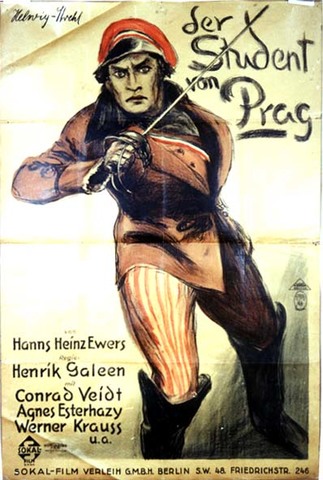
In the aftermath of World War One German film developed (to coin a phrase) with surprising speed, taking up the themes explored by Wegener's early films. He had followed up "The Student Of Prague" with other supernatural stories "The Pied Piper Of Hamlin", "The Yogi" and "The Golem" (1917). Unfortunately none of these films survive aside from a few stills and the last few minutes of "The Golem" which surfaced a few years ago. These films would inspire even darker films with more imaginative direction, lighting, and set design starting with Robert Wiene's "Cabinet Of Dr Caligari" in 1919 and his followups "Genuine" and "Rashkoliov" (AKA "Crime And Punishment"), FW Murnau's "Nosferatu" (1920) and Wegener's own remake of "The Golem" in 1920. These films would establish the Expressionist template; harsh contrasts in lighting and jagged editing to set a world of dreams and nightmares, elaborate and often fantastic sets, deeply emotional and sometimes stylized acting and story-lines that probed the darkness of the human psyche with themes of alienation, fear and guilt. It was inevitable that the film that effectively started the genre would be remade using proper expressionist techniques although it's a little surprising that Wegener himself didn't do it. Perhaps by 1926 the now 52 year old no longer had the clout to helm his own projects, he was certainly too old to play Balduin.
The film would be directed by Henrik Galeen who had previously worked with Wegener on as writer on "The Golem" and with Murnau on "Nosferatu". In the cast would be two iconic figures of Expressionist Horror, Conrad Veidt as Balduin and Werner Krause as Scapinelli. Veidt had played Cesare the Sleepwalker in "The Cabinet Of Dr Caligari" as well as Orlock in "The Hands Of Orlock", Ivan The Terrible in "Waxworks" and numerous other films. Krause had also been in "Caligari", as the title role and later in "Waxworks" as Jack The Ripper. The film would show that they had fully absorbed the lessons of expressionism in full flower.
"THE STUDENT OF PRAGUE" (1926);
CAST;
Conrad Veidt ~ Balduin
Werner Krause ~ Scapinelli
Elizza La Porta ~ Lyduschka, A Flower Girl
Agnes Esterhazy ~ Countess Margit Von Schwarzenberg
Fritz Alberti ~ Count Von Schwarzenberg
Ferdinand Von Alten ~ Baron Waldis
Leni Reiefenstahl ~ Unknown
Host Wessel ~ Unknown
Directed By Henrik Galeen
PLOT SYNOPSIS (SPOILER ALERT!);
The basic story in the changes little from the first film however the later film is twice as long as the first which gives Galeen more time to flesh out the story and characters. The story opens with foreboding with a shot of a tombstone in a Jewish cemetery with the epitaph "Here lies Balduin; He challenged the devil and lost. Since the German audience was already quite familiar with the story from the first film this would not have seen as a spoiler. There is a longer sequence introducing Balduin as student, drinking and fencing with his happy-go-lucky mates at a pub. Balduin himself is a dour, somber loner worried about his poor prospects. Lyduschka is once again carrying a torch for Balduin. After he rudely snubs her she publicly responds him with a song mocking his lack of money. Scapinelli is at the same pub and witnesses this. He offers Balduin a loan by Balduin brushes him of saying he needs a wealthy heiress to wed. Scapinelli vows to find him one. Balduin fences with a fellow student who had been laughing at him and wins
Meanwhile Countess Margit is shown at a fancy party and heading off with Baron Waldis on a fox hunt. As they ride Scapinelli watches from a hill top. He appears to command the fox to lead the riders through obstacles which cause Margit to fall from her horse in front of Balduin who runs to her rescue. She is smitten by him and gives him her cross pendant which had been knocked off. Baron Waldis rides up and fetches her. Balduin returns home a practices his fencing before storming out just Lyduschka has come to visit giving him a flower. He takes them and walks off. She sneaks into his room and begins cleaning up and polishing his boots. Balduin has gone to visit Countess Margit and her father the count. She is happy to see him and he is about to give her his solitary flower when Waldis shows up with a large bouquet to be welcomed by the Count. Balduin sheepishly shoves his own flower in his pocket and leaves. He arrives home in a bad mood to find Lyduschka still there. She tries to comfort him but he rebuffs her. She leaves dejected after she finds the flower he gave her tossed in the gutter. Scapinelli enters and makes the offer of 600,000 florins in exchange for anything he wishes from the room. Balduin laughingly agrees and signs the contract. When Balduin demands the money Scapinelli produces a small purse from which a seemingly endless rain of coins falls on the table. Balduin is shocked but accepts the money. Scapinelli then gestures to the full length mirror and invites Balduin's reflection to step out of the mirror which it slowly does.
A now wealthy Balduin is hosting a party at his lavish new house. While dressing he discovers he has no reflection in the mirror. He orders a massive bouquet of flowers and sends it to Countess Margit with and invite to his party which she accepts. Balduin enters the party while Margit is playing the piano, he gives her a flower. Baron Waldis is also in attendance, he angrily grabs the flower from Margit and crumples it. She storms off. Standing on a balcony she discovers a note from Balduin asking her to meet him and she agrees. Lyduschka sneaks into the party and witnesses this. Scapinelli also creeps in, in shadow form, and seizes the note without Balduin or Margit noticing and tosses it to Lyduschka who runs off. After Margit returns to the party and Balduin is left alone he is confronted with his Doppelganger who slowly stalks off with out speaking to the horrified Balduin. Margit and Balduin have a clandestine meeting in a cemetery during which he begs her not to marry Waldis and pledges his love. While they are embracing the Doppelganger arrives frightening Balduin but not Margit who does not see him. Lyduschka confronts Waldis and gives him the note from Baldin to Margit. Waldis angrily rides off to find Balduin and strikes him his sword. Balduin challenges him to a duel which Waldis accepts. Count Von Schwarzenberg implores Waldis to cancel the duel as Balduin is the finest fencer in Prague. Waldis refuses but allows Count Von Schwarzenberg to intercede with Balduin who he begs to spare Waldis. Balduin reluctantly agrees. Margit finds out about the deal but is assured Balduin will spare Waldis. At the duel site Balduin is late because his carriage has lost a wheel in a ditch so he sets off on foot. He meets his Doppelganger who informs him that the duel has taken place and Waldis is dead. Balduin is terrified and runs to the scene to find a crowd around Waldis' dead body. A depressed Balduin returns to see the Count and Countess but they refuse to see him. Balduin goes to a pub and drinks heavily while Lyduschka watches. He grabs and kisses her and becomes more rowdy throwing items around the pub and encouraging the other patrons to further debauchery finally trashing the pub. As the revels get out of hand Balduin becomes upset and leaves. The next day he is expelled from university. Balduin is winning money gambling with is friends when the news of his expulsion arrives and they all walk out. A dejected Balduin returns to his home and climbs into bed. Lyduschka enters and climbs into bed with him. At first he allows her to embrace him but when she asks him for Margit's cross pendant which he is still wearing he throws her out. Balduin leaves and wanders out in a stormy night to visit Margit. He tells her about his Doppelganger and shows her his lack of reflection. She is horrified and faints. The Doppelganger appears and confronts Balduin who runs away. The Doppelganger follows as Balduin first attempts to kill him with a club the Doppelganger simply vanishes. Balduin runs home through the storm but at every turn the Doppelganger is waiting for him. When Balduin gets home he locks himself in and arms himself with a dueling pistol. The Doppelganger appears and dares Balduin to shoot him which he does. The Doppelganger disappears while a full length mirror he had been standing in front of shatters. Balduin looks in the remaining shards of the mirror and discovers his reflection has returned. He is overjoyed but then feels a pain in his chest and finds a bullet hole. He collapses and dies. The film cuts to the opening shot of Balduin's tombstone again.
~~~~~~~~~~~~~~~~~~~~~~~~~~~~~~~~~~~~~~~~~~~~~~
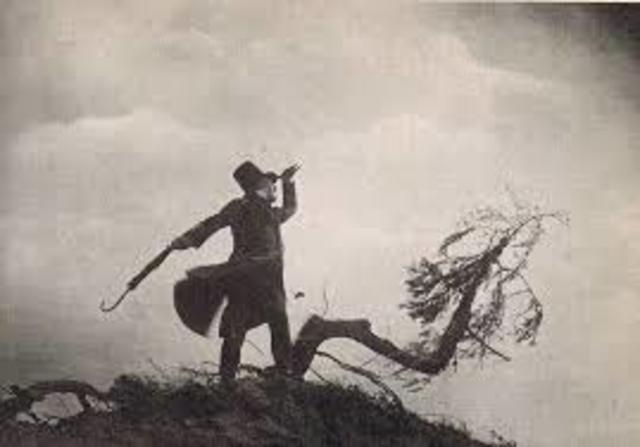
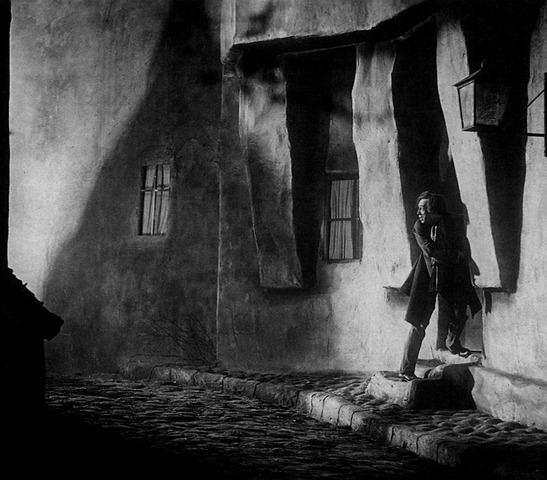
By the time of the remake's filming in 1926 Expressionism was an established style with a visual language of it's own some which is used here to good effect. The entire final section where Balduin staggers and later flees through a raging storm past barren trees is almost perfectly Expressionist. Likewise the scene of Balduin crouching to see and finally caressing the reflection in the broken mirror and the final appearance of the Doppelganger in front of a now broken window pane with billowing curtains. There is also the scene where Scapinelli takes control of the fox hunt. He is shown on a hill-top silhouetted against a stormy sky with a twisted tree stump wearing a frock coat and top hat and umbrella looking distinctly demonic. In fact this version makes Scapinelli's demonic nature more explicit in this scene where he appears to have power over the fox and hounds as well as the elements. In the first film Margit simply falls off her horse into a pond but it is not made clear that any magic was involved. Similarly when Scapinelli dumps his endless shower of coins from his purse it should be obvious that this is magic since no small purse could possibly hold so many coins. Balduin seems to notice this but is overcome by greed as his only comment is; "Is that all for me?". On the other hand Galeen passes up two obvious chances for supernatural horror from the first film. One is when the Doppelganger steps out of the mirror for the first time. In the Wegener film the double strides around the room before the shocked Balduin before disappearing while in the second the scene simply ends as soon as he steps out. A bigger omission is the scene in the first film where the Doppelganger appears at the poker game to challenge Balduin to a game. Since a similar scene had also turned up in Fritz Lang's "Dr Mabuse, The Gambler" Galeen may have decided the audience would see it as derivative but it's still a glaring loss.
SCAPINELLI STALKS THE HUNT;
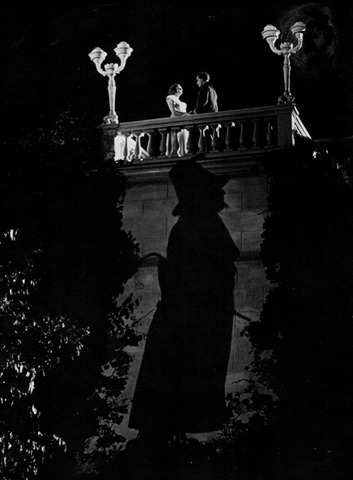
Notwithstanding any such minor reservations Galeen does a good job here and there are some good Expressionist effects using a moving camera following Balduin as he flees down the desolate road (that shot should have really gone on longer), a spinning camera during Balduin's drunken revels at the pub to show his disorientation and a later brilliant shot directly after where a shot of wildly sawing blade is superimposed over his head. The film also makes use of another expressionist standard, the symbolism of inanimate objects, Scapinelli's umbrella is a stand-in for a magic wand, the flowers which are given, refused and finally discarded, and of course Balduin's sword which allows for a clearly sensual subtext when Lyduschka caresses it lovingly while cleaning his room. The art direction was by Hermann Warm who had worked on the iconic Expressionist film "The Cabinet of Dr. Caligari", Fritz Lang's 1921 film "Destiny" and later the 1931 Danish horror classic "Vampyr".
SCAPINELLI'S SHADOW STALKS BALDUIN;
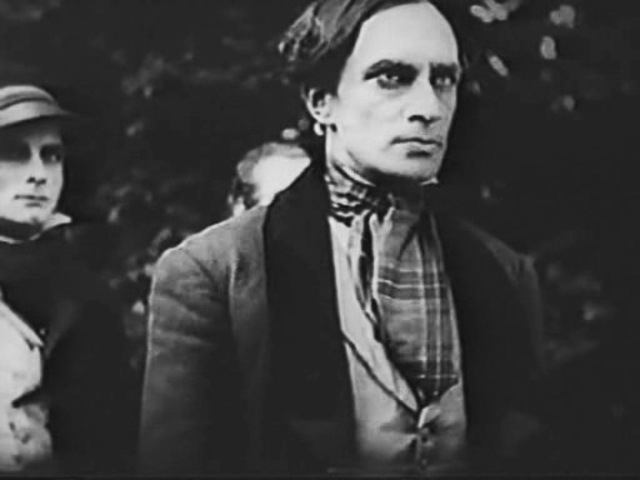
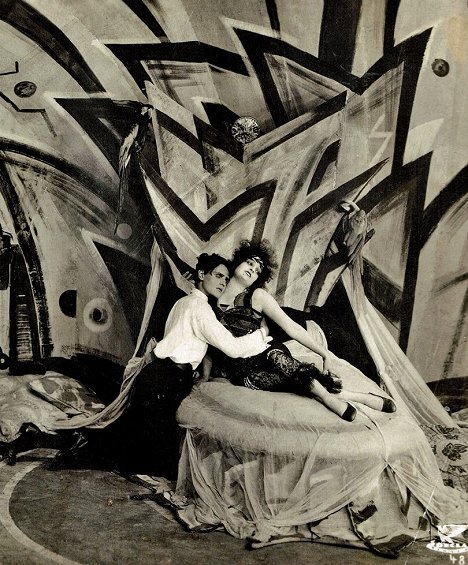
The biggest change from the first film is really the acting however. Paul Wegener was solid enough but by 1926 Conrad Veidt was one of the finest actors in Germany if not the world. His sensitive portrayals of tortured souls like Cesare (from "Dr Caligari"), Orlock ("Orlack's Hands"), Ivan The Terrible ("Waxworks") and numerous others helped set the standard for the doomed expressionist hero. He wears his emotions on his sleeve; guilt, terror, dejection, frightened relief, desperation all come off him in waves. His face, with his oddly high domed forehead, wild shock of hair, enormous eyes and nervous shark-like grin is is highly expressive and the opposite of Wegener's impassive glower. He also has great physical grace as he had already displayed in his earlier films. When he is terrified or dejected it seems to rock or drag down his entire body. Such emotional physicality had become a standard motif of Expressionist film as seen in scenes where Balduin kneels in front of Margit begging forgiveness and placing his head in her lap while she caresses his hair, a common image in German film of the era. Veidt's wonderfully expressive face is shown to full effect (as for that matter are Werner Krause, Elizza La Porta and Grete Berger) by the films use of closeups, something lacking in the first film.
CONRAD VEIDT;
Werner Krauss as Scapinelli was the other well known star here having appeared as Dr Caligari as well as Jack The Ripper in "Waxworks". He is suitably menacing here but does not have the hunched, crab-like posture of Dr Caligari. He is actually more naturalistic than the lesser known John Gottowt from the earlier film both in his manner and his wardrobe. Eliza La Porta as Lyduschka actually looks like Lyda Salmonova from the first film and behaves in much the same flirtatious way although she is more given more to do here and her obsession with Balduin is made more explicit. Similarly Agnes Esterhazy is given slightly more to do than Grete Berger as Margit. She is also younger and more attractive although I'm not sure that is an improvement since Balduin's attraction to her as opposed to the prettier Lyduschka is clearly due to her having money and social status.
A note that two other actors reportedly appear in minor roles, perhaps little more than extras, who would later go on to greater fame or infamy. Leni Reiefenstahl, later the documentary director of Nazi propaganda films "The Triumph Of The Will" and "Olympia" was at this point an ambitious and strikingly attractive up-and-coming actress who had already appeared as little more than a model of physical perfection in one other movie documentary, with her first starring role later that year, she is presumably one of the women at one of the parties. Horst Wessel was at this point a university student and member of various far-right groups, while he was not an actor he was an amateur musician and poet who was also a member of fencing and boxing clubs and could be one of the group of rowdy students or musicians. In another year he would join the Nazi party's Brownshirts and take part in their street brawls until 1930 when he would be murdered in one of them. A song he wrote for the Brownshirts would then become their anthem as "The Horst Wessel Song".
BALDUIN MEETS HIS DOUBLE;
An additional note here is that while both films have clearly Jewish characters they are in no way anti-Semitic. In fact it's worth pointing out that while Balduin, and presumably the other main characters, are not only Jews but respectable members of the lower aristocracy and no different than any proper German junkers. Lest this be seen today as odd coming from a German film of the era it should be noted as well that Wegener also dealt with even more explicitly Jewish characters and settings in "Der Golem" (where the Imperial Austrians are the actually the villains) and Veidt would do the same in the 1936 British version of "Jud Suss" (as opposed to the hateful 1940 Nazi version) and he would also play sympathetic gay characters in a few films. Veidt's wife was also Jewish as was one of Wegener's six wives wives That Weimar culture could allow for such openness while Hollywood was still trading in racist stereotypes of all sorts is worth remembering.
Conrad Veidt would continue to make successful films in Germany until he was lured away by German director Paul Leni when he moved to Hollywood. Leni cast Veidt in the Gothic horror film "The Man Who Laughs" in 1928 and when Leni was given the job of bringing Dracula to the screen he immediately saw Veidt in the title role. Unfortunately Leni died suddenly in 1929 and with his patron and fellow countryman dead, Veidt, speaking little English and worried about typecasting dropped out and returned to Germany. After much searching the role of course went to Bela Lugosi leaving us to wonder what kind of brooding intensity Veidt might have brought to the role. In Germany he continued his career until the Nazis took power in 1933 and Veidt, whose wife was Jewish, fled back to Hollywood. He learned English and returned to the screen in films like "Jud Suss" and "Under The Robe" (as Cardinal Richelieu) before scoring the most famous sound roles as evil Nazis including the major in "Casablanca". His career seemed assured when he suddenly dropped dead of a heart attack while playing golf in 1943. He was only 50 years old.
Director Henrik Galeen would finally work with Paul Wegener in "Aralune" (1928) another horror film about a mad scientist creating artificial life also starring Brigitte Helm of "Metropolis" fame. However he as also a Jew and like Gottowt had to flee Germany after the Nazi takeover. He fled first to Sweden, then Britain before finally landing in Hollywood but did nothing of note before dying in 1949.
Werner Krauss would have very different career, and one far less honorable. Unlike Veidt and other German film-makers and actors such as Marlene Dietrich, Fritz Lang, Paul Weine, Douglas Sirk, Briggitte Helm, Asta Neilson and Hans Richter, he stayed in Germany after Hitler came to power. Also unlike some who also stayed, like Paul Wegener, Krauss became an avowed Nazi. Thus he had no problem finding work during the Hitler years. In fact he was named as Reichskulturkammer theatre department and a "Cultural Ambassador" for Nazi Germany. However none of the many movies the Nazis made were of much note and it mostly as the iconic Dr Caligari he is remembered today. After the war he spent some years in disgrace due to his Nazi past but was eventually considered rehabilitated enough to rejoin the German film community, more as a respected figure of the past than as a real creative force. He died in 1959.
BALDUIN TRIES TO FLEE THROUGH A TYPICAL EXPRESSIONIST URBAN SET;
"The Student Of Prague" would get a German sound remake in 1935 directed by Arthur Robison and starring Anton Walbrook.

_poster.jpg)
.jpg)
.jpg)