Showing posts with label Animation. Show all posts

Monday, 17 March 2014

Adventures In Animation; Winsor McCay


winsor photo winsor_zpsfb2a8d2c.jpg

Winsor McCay (1867? ~ 1934) is known as the Father Of Animation. He did not actually invent animation, experiments in bringing drawings to life had been done since the days of magic lanterns in the 17th century and wasted little time once the film era began. By 1906 the British film-maker and illustrator J. Stuart Blackburn, the Frenchman Emile Cohl and the Spaniard (working in France) Segundo de Chomon had made some rudimentary animated shorts. They were very crude with halting and jerky movements that would barely qualify as animation at all by later standards and it would take a serious cartoonist to bring the new art form to life.

Winsor McCay's background was a mystery even to himself; he gave various different dates and locations for his birth. His background is clear enough however. His family were of Scottish background and lived in Woodstock, Ontario, Canada and they immigrated to America around 1868. American census reports from 1870 and 1880 show a Zenas Winsor McCay (his full name) born in Canada in 1867, living in Spring Lake, Michigan. However no birth or baptism record has ever been found on either side of the border. He would later claim to have been born in 1871 in America, but that date (if not the location) is impossible according to the 1870 census report, and Winsor himself would admit that he didn't really know the truth.

 photo winsoryoung_zps33282575.gif

FROM ILLUSTRATOR TO CARTOONIST;
At any rate the young Winsor (not surprisingly he quickly dropped the "Zenus") was drawn to art as a child and was encouraged by his parents to take art lessons which included illustration, etching and stained glass, all useful skills for a future animator. By 1889 he had moved to Chicago to further his art studies and become a commercial illustrator. He would then get a steady gig as cartoonist for Cincinnati newspapers while working a side gig as an entertainer drawing caricatures in rapid time in front of audiences. He would develop a distinct stamp moving past the dense Victorian look of Thomas Nast and Richard Outcault to a more open and flowing style more influenced by the newer Art Nouveau school out of Europe. By 1903 he had made enough of a name for himself that he got a high profile job with the "New York Herald" as an editorial cartoonist. Richard Outcault, who was the most succesful cartoonist in America also worked at the Herald. Outcault is considered the first modern cartoonist having developed the idea of using panels to tell a story instead if using a single stand-alone drawing as Thomas Nast had done. He also made use of dialog bubbles to better show which character was speaking. This enabled Outcault to have serial stories and introduce the first regular characters starting with the hugely popular "Yellow Kid" and later "Buster Brown" strips. Outcault and the younger McCay did not get along however and would become rivals as the younger artist became more popular. McCay would later move to William Randolph Hearst's "New York Journal" and "Evening Telegram". McCay would later have a contentious relationship with Hearst over the rest of his life.

 photo winsormccaydayart_zps76c35741.jpg

Working for Hearst McCay started out as an editorial cartoonist but he also tried to develop a strip of his own. After several abortive experiments with names like "Sister Little's Sister's Beau" and "Phoolish Phunny Phrolics", McCay got a gig as illustrator for a comedic series called "Percival Slathers" about a meek, elderly gent and his hopeless attempts to make his way in high society. This was not an actual comic strip but a series of illustrated short stories. Little is known about this series including the identity of the writer but it is probably not McCay given that it's writing style is unlike anything McCay ever did. Nor did he ever mention it in later years and in fact copies were only recently discovered. The artwork for "Percival Slathers" is competent but not particularly noteworthy although it may have helped him finally get a strip of his own with "Mr. Goodenough" in 1904. "Mr. Goodenough" was variation on "Percival Slathers" with another upper-class twit, in this case an indolent millionaire, and his lackluster attempts to become sociable. The short run strip is largely forgettable although it does show flashes of a more individual visual style.

winsor 1


After these abortive attempts McCay developed a popular character strip called "Little Sammy Sneeze" in 1904. As a character "Sammy Sneeze" was simple in the extreme. Sammy was a small boy who in every strip would try to stifle a sneeze which would in the final frame explode with catastrophic results; bricks would fall from buildings, animals would stampede, crowds would flee in panic. And that was it, Sammy had no dialog or even a real personality, he was just a force of nature. But if the strip had little of substance it had a striking visual sense that surpassed Outcault's. McCay was an superior draftsman combining a very realistic view of human figures and the way they moved along with clean and uncluttered backgrounds. At a time when Victorian illustrators were fond of excessive detail McCay experimented with minimal backgrounds, including some that used only stark black or white, he also "broke the fourth wall" by having characters at times bust out of their panel. Even today some his "Sammy Sneeze" strips look much like the comics of the 1960's while Outcault's clearly belong to the Edwardian Era and Nast's to the Victorian.

"LITTLE SAMMY SNEEZE";
 photo sammy_zps94c41ac7.jpg

"Sammy Sneeze" was popular but it was aimed at kids and it's lack of a real story must have been somewhat limiting since McCay also developed another strip (under the pen name of Silas) called "A Pilgrim's Progress" which had a continuing story about a middle-class man forever trying to free himself of a briefcase embossed with the words "Dull Care" and live a carefree life on "Easy Street" only to have the case return in the last panel. The strip was an odd allegory named after John Bunyan's Puritan religious novel (the character was named Mister Bunion) that seems quite clunky to modern audiences but once again the artwork is excellent if less elaborate than "Sammy Sneeze". Around the same time McCay had developed another even more important strip called "The Dream Of A Rarebit Fiend". This strip was truly ground breaking both for it's subject matter and it's amazing visuals.

"PILGRIM'S PROGRESS";
 photo WinsorMcCayPilgrimsProgessBunioncloseupstairs_zps69db46ad.jpg

"Rarebit Fiend" did not have a regular character and it's plot, such as it was, never changed. In every strip a character, after eating a "Welsh Rarebit" (a bun covered with melted fermented cheese) has a dream with bizarre and often terrifying hallucinations. These dreams could be incredibly complex, characters could find themselves shrinking to the size of ants or growing to such massive size that they strode through the city like King Kong, or caught in traffic which slices off various limbs, trapped in a museum chased by dinosaur bones come to life, chased by an army of their own doppelgangers, floating in space, climbing an endless staircase surrounded by inky blackness, or eaten by a giant snake while other jungle animals stroll the city streets wearing business suits. While some strips were bizarre slapsticks other were quite dark as one which showed the dreamer being buried alive in the best Edgar Allen Poe tradition while his widow flirted with his best friend. There had simply never been anything remotely like it and the strip was a sensation leading McCay to develop the idea more fully into his best known strip "Little Nemo In Slumberland".

"DREAM OF A RAREBIT FIEND";
Winsor Mc Cay Dream of the Rarebit Fiend 1913 0


"Little Nemo" was another small boy, who while he sleeps enters into a rich dream world through which he travels. "Slumberland" is a lush fantasy land with floating castles made of mirrors, mountains made of cake and ice-cream, armies of snowmen who come to life, flying cars and pirate ships, beds that sprout legs and run away and other dream sequences we have since seen repeated in more modern cartoons from Disney's "Fantasia" to Betty Boop and Bugs Bunny toons to the Simpsons.

"LITTLE NEMO IN SLUMBERLAND";
nemo


Besides Nemo the strip had other regular characters such as a Little Princes, an escaped African savage boy called "Imp" and a troublesome cigar chomping clown with a five-o'clock shadow called "Flip". The "Little Nemo" strips were the most elaborate ones yet done by McCay or anyone else. Eventually taking up an entire page in full colour, each panel was incredibly detailed and crammed with Art-Nouveau architecture and costumes. As always the characters looked realistic and showed a close attention to the human form and movement.

LITTLE NEMO"
nemo2


In 1909 McCay would try one more straight forward strip aimed at adults called "Poor Jake" about a hapless (and once again speechless) working class jack-of-all-trades who is constantly over worked by his lazy millionaire boss who in turn takes all the credit. This was an obvious political allegory and shows how McCay's focus had changed from his earlier "Mr. Goodenough", in fact Poor Jake's boss looks like Mr. Goodenough which may not be a coincidence. Other than this point the strip was decidedly minor and lacked the imagination or visual flair of his other strips and it was short lived.

McCay's strips displayed a mastery of visuals as well as a vivid imagination but they also showed his one weakness; he had some wildly creative ideas but he was a poor writer. His dialog was full of long rambling run-on sentences that seemed to be crammed into the character's word bubbles as an after thought. Sometimes they were cut off in mid-sentence as if McCay tossed off the dialog after the artwork including word bubbles were already done, which was probably the case. While McCay could come up with a visual gag he simply could not write a punchline. McCay did in fact come up with some creative and quite advanced story ideas or at least concepts but he was only interested in exploring them visually. "Sammy Sneeze" and "Rarebit Fiend" did not have proper plots or stories at all and while "Pilgrims Progress" actually did have a fairly complex idea as it's basis, the stories were episodic and again basically identical. That left "Little Nemo" as the only major McCay strip which had proper stories although again McCay's dialog is still somewhat clunky.

This brings us to McCays second weakness; character development. Almost all of McCay's characters, from Sammy Sneeze to the various Rarebit Dreamers to Poor Jake were completely passive. They took no initiative nor did they even give much reaction to any of the plights they found themselves in. The Dreamers were subjects of their hallucinations following which they then made a bemused comment while Sammy Sneeze and Poor Jake were speechless. Mr Bunion and Mr Goodenough would make occasional and fitful attempts to take some sort of action only to fail leaving them to merely shrug and comment wryly. Even Little Nemo who seems at first glance to be an explorer in a fantastical world is mostly an observer rather than taking any initiative and he has no real personality, he is not mischievous or even really curious, he never displays any particular emotion. The same is largely true of his friend the Little Princess leaving only the irascible character of Flip The Clown, and to a lessor extent the playful African Imp (who is also speechless) as the only McCay characters to have a real personality.

CARTOONIST TO ANIMATOR;
Early on in his career Winsor McCay had performed in public by doing quick caricatures while narrating his work to an audience. By 1906 as his work became famous he was lured back to vaudeville to perform in an act in which he would do quick drawings and appear to make them move and age while an orchestra played. Sometimes he shared bills with acts like jugglers, dog acts, knife throwers, accordion players, yodelers and comics like W.C.Fields, Will Rogers, Charley Case, John Bunny and the Keaton Family (featuring a young Buster). This success led to attempts to turn "Little Nemo" into a stage show with a live cast as had been done earlier by his rival Richard Outcault with his "Buster Brown" strip. McCay's backers gave him a huge budget of $100,000 to play with which allowed for an elaborate set and a score by composer Victor Herbert. The play ran for two years as a touring show to sell-out shows while McCay continued to tour with his own vaudeville act. He also continued to somehow find time to do his regular newspaper strips. In 1906 director Edwin S. Porter did a short version of "Rarebit Fiend" which included some groundbreaking double exposure special effects.

"DREAM OF A RAREBIT FIEND"


In 1911 McCay started to experiment with film. There had been some earlier attempts with animation without much success, but McCay's unique skillset of exceptional draft work, attention to detail and rapid fire drawing ability along with a vivid imagination made him the perfect pioneer to make animation truely come alive. He chose as his subjects the characters from "Little Nemo". McCays first strips were really just experiments in trying to make the sort of flipbooks used by children come alive. McCay developed the method of using thousands of painstakingly drawn pictures drawn in sequence on rice paper to show incremental movement. This early strip doesn't have a story but it must be remembered that this cartoon was not intended to be shown in theatres but was instead part of McCay's vaudeville act. McCay would stand to the side of the stage and pretend to interact with the characters getting them to jump, dance and throw objects. As such it was still groundbreaking and contemporary audiences were spellbound by the new medium. Literally every animator since has used the same methods and the strip still looks modern. In fact in it's fluidity of movement McCay's strips are easily superior to those of Hanna-Barbara, Rankin-Bass, Krantz Studios or Cambria Studios fifty years later.

"LITTLE NEMO & FRIENDS" (1920's theatrical reissue with intro);


The next year McCay left the "Herald" in a dispute over money and was hired by William Randolph Hearst for his empire. The "Herald" tried to claim copyright over McCay's characters but McCay eventually sued successfully to keep them. Still in that year he made a more elaborate strip with it's own storyline but without Nemo called "How A Mosquito Operates" which had an amazingly lifelike sequence of a giant mosquito attacking a sleeping man until it gets so full it explodes. The film was based on one of McCay's "Rarebit Fiend" strips and shows an accuracy of movement and anatomy that is still stunning, and a little creepy. This toon was also added to McCay's vaudeville act, although unlike the previous film this one had enough of a story that it could stand alone.

"HOW A MOSQUITO OPERATES";


Following this artistic triumph McCay would develop his most famous animated character; "Gertie The Dinosaur" in 1914. McCay had drawn dinosaurs in earlier newspaper strips but by adding movement and facial expressions he was able to give Gertie a real personality, rather like a hugely overgrown but playful puppy. Once again this toon was designed to be part of McCay's vaudeville act wherein McCay would introduce the shy Gertie who would be coaxed into doing tricks, dancing and playing catch. At the end McCay would appear to walk into the screen and ride off on Gertie's back. Besides Gertie the toon is notable for having full backgrounds and depth perception unlike the earlier toons. The importance of Gertie to future animators can not be overstated. McCay had created a lovable and believable animal character which could move and even show emotion. Later animators like Nat Fleischer and Walt Disney would list Gertie as one of their greatest influences. Virtually all subsequent toons for the next half century would look and move essentially like Gertie.

"GERTIE THE DINOSAUR" (EXCERPTS);


Unfortunately McCay's days a vaudeville performer would suddenly come to an end when his employer William Randolph Hearst decided that McCay was spending too much time on his animation and his live show and not enough working on the newspaper and would ban McCay from vaudeville. Hearst did however give McCay a substantial raise to cover the loss of his performing revenue and McCay was allowed to do outside work illustrating advertisements and sheet music books. "Gertie" was later re-shot for the movie theatres with a lengthy prologue added to explain the process and take the place of McCay's in person interaction with Gertie. This filmed intro (which takes up almost half of the short) starred Winsor McCay as himself and included a cameo from vaudeville comedian John Bunny. Although largely forgotten today John Bunny was the first film comedy star and was internationally famous and a large influence on WC Fields, although he isn't given much to do here. Still this is one of the few chances to see Bunny since few of his films survive. It's also the only chance to see Winsor McCay, by this time in late middle age and balding. He bills himself as "The Inventor Of Animation" which is close enough to the truth to be excusable.

"GERTIE THE DINOSAUR" (full film short);


America's entrance into World War One in 1917 gave McCay a chance to make what would become his cartoon masterpiece; "The Sinking Of The Lusitania". This toon was a piece of anti-German war propaganda which Hearst could not object to. The Lusitania was a British passenger liner (and a rival to the Titanic) which was sunk by a German U-Boat in 1915 with a heavy loss of life including many Americans and which became a cause-celeb in the run up to America's declaring war. The cartoon shows the ship leaving New York then intercepted by a U-Boat which fires a torpedo causing a vivid explosion. The rest of the strip shows the ship's sinking, a side bar naming a few celebrities who died on board, the survivors splashing in the water, and it ends with a shot of a mother holding an infant sinking beneath the waves.

 photo winsorship_zps1ec77313.jpg

Starting in 1917 and finished in 1918 the entire strip took 25,000 individual drawings each done by hand by McCay himself with a couple of assistants using a new technique he developed, drawing on clear cellophane cells instead of rice paper as before. The strip shows McCay's usual attention to detail and careful observation of form and movement. Notice the undulating waves, each done individually. Then the billowing curtains as the ship passes the Statue Of Liberty. Next the strip gains menace with the arrival of the surface running across the surface with it's crew running to battle stations, a scene that looks so real it almost looks like an actual film. Then comes the spectacular explosion scene which again looks stunningly real rather than a cartoon explosion. The ship's slow motion sinking with it's smokestacks billowing out a thick oily cloud while the passengers and crew scramble down ropes or jump overboard has a brutal beauty that belies the term "cartoon". So to the final shot of the drowning mother and child, a scene actually taken from a well-known recruiting poster by American artist Fred Spear. The only discordant note (aside from the jingoist narration at the end) is the shot of a couple of cartoonish fish speeding out of the way of the speeding torpedo, not that the shot is badly done of course but it's cutesy look doesn't really fit with the serious nature of the rest of the strip. Even taking into account that this strip is in black and white the lush detail and realism of the strip would not be equaled until the full colour features done by Walt Disney and the Superman cartoons done by the Fleischer Brothers of the late 1930's

"THE SINKING OF THE LUSITANIA" ~ 1918;


With Mcay's reputation as "The Inventor Of Animation" secure he resumed making cartoons building on the new animation cell technique which allowed him to make more detailed strips based on his fantasy comic strips "Little Nemo" and "Rarebit Fiend". By 1921 he had released three complete strips; "Bug Vaudeville" which builds on the research done for "Mosquito" to create a fantasy vaudeville act made up of giant dancing bugs. There is also an intro featuring Flip The Clown from Little Nemo strip.

"BUG VAUDEVILLE" ~ 1921


"The Pet" featured an animal that eats so much that it grows to massive size and proceeds to stomp through a terrified city like King Kong until it is killed by the air-force. The unidentified pet in question looks like a cross between a puppy and a teddy bear but for some reason it meows like a cat.

"DREAM OF A RAREBIT FIEND; THE PET" ~ 1921;


"The Flying House" was the most psychedelic toon yet in which a man attaches wings to his house and flies away to escape from creditors.

"THE FLYING HOUSE" ~ 1921;


After his animation career was abruptly stopped there were a few unfinshed projects such as this lush fragment of some centaurs in a Art Nouveau forest.

"THE CENTAURS";


LATER CAREER:

In 1921 Hearst once again invoked his exclusive contract to ban McCay from further animation work. Since 1918 Hearst had allowed McCay to do animation presumably because of the increased publicity and prestige and on the assumption that since these cartoons were done to be shown in movie theatres rather than on the vaudeville stage they would still leave McCay to continue to do his work for Hearst's papers. However hand drawn animation is extremely time consuming, especially if it's done with McCay's painstaking attention to detail and so Hearst once again ordered McCay to drop his animation work and concentrate solely on his newspaper work which included his weekly strips as well as editorial cartoons. As before Hearst promised McCay a bonus which he apparently did not pay however and when McCay's contract ended in 1924 McCay quit and moved to a rival paper, taking Nemo with him. Hearst tried to continue the Nemo strip under a different name with artist Mel Cummin but was not successful and McCay was lured back in 1927. Besides his usual strip work on of the noteworty jobs done for Hearst in later years was sketching the scenes from the Lindburgh kidnapping in 1932. Winsor McCay suffered a massive stroke and died in 1934 aged about 55. After his death Hearst once again tried briefly to keep "Little Nemo" alive with the hapless Mel Cummin, with the same lack of result.

fiend


INFLUENCES AND LEGACY:

Besides being massively influential for their artwork, strips like "Little Nemo" and "Rarebit Fiend" are fascinating for their subject matter. In his exploration of dreams McCay seems to be channeling the theories of his contemporary Sigmund Freud although there is no evidence they were even aware of each other. McCay's fantasies also anticipate the French Symbolists and the later Surrealists and Beats although again there is no evidence they knew of his work. McCay seems to occupy his own unique space, reaching similar conclusions to the avant-garde without being in anyway a part of it. In this he resembles another American contemporary, the composer Charles Ives, who was experimenting with musical rule breaking at the same time Arnold Schoenberg was shocking Europe in spite of the two men being quite unaware of each other's work. When Schoenberg was much later exposed to Ives's work he was shocked to find there had been a like-thinking contemporary in conservative middle America. One wonders what Salvador Dali, Marcell Duchamp, Andre Breton or Man Ray would have made of this American newspaper cartoonist's work.

McCay himself never listed any influences leaving to much speculation as to where he took his ideas. Possible artistic influences include earlier newspaper cartoonists Thomas Nast, Joseph Keppler, and especially Fredrick Burr Opper, Gustave Verbeek, Ralph Barton, James Mongomery Flag, Charles Dana Gibson and Richard Outcault. Impressionists Alfonse Mucha and Toulouse-Lautrec, Art Nouveau illustrators Aubrey Beardsley and especially Arthur Rackham. French Symbolist painter Gusatve Moreau, European artists Gustave Dore and eccentric French fanatsy illustrators Isadore Grandville and Albert Robida. A later influence may have been the dream-like films of George Melies.

winsormccaytweaked 620x802


As for the thematic ideas behind McCay's fantasy strips like "Rarebit Fiend" and "Little Nemo" with their explorations of dreams and the subconscious influences aside from Freud (who McCay never mentioned as having read) included Lewis Carroll ("Alice In Wonderland"), J.M. Barrie ("Peter Pan"), Washington Irving ("Rip Van Winkle"), Oscar Wilde, Edward Lear, Charles Baudelaire, Robert Louis Stevenson ("Dr.Jekyll & Mr Hyde"), Arthur Conan Doyle ("The Devil's Paw"), H.G.Wells, Jules Verne, Bram Stoker, William Blake, Mark Twain ("A Connecticut Yankee In King Arthur's Court"), Ambrose Bierce, O.Henry and of course Edgar Allen Poe. Another obvious but lesser known writer was Harle Oren Cummins who wrote a series of short stories called "Welsh Rarebit Tales" in 1902 which involved characters having hallucinations after eating Welsh Rarebit. An even more obscure known writer was Edward S. Ellis a popular author of dime novels who wrote "The Steam Man Of The Prairies" about a giant robot (with appropriately striking cover art by an unknown illustrator) in 1865. Although not especially well educated formally McCay was quite well read and known to be a fan of Shakespeare, Yeats and the Romantic Poets Shelly, Keats and Byron who he could quote from memory, along with the Bible.

As an animator McCay's importance simply can not be overestimated. McCay did not actually "invent animation" but he developed, or at least perfected the basic technique of drawing on layers of clear cellophane cells which gave him the ability to make his cartoons far more elaborate, multi-layered and lifelike as well as longer than was possible using the older rice paper flipbook method. It is no exaggeration to say that all subsequent animation used the cell method until computer animation was invented. Unfortunately it turned out that while McCay himself did get the credit he deserved he not get the money he should have from his invention of cell animation. McCay had a lackadaisical attitude towards money and business and did not bother to patent his invention even when urged to do so. He was at first happy to let other share his invention for free until a rival cartoonist named John Randolph Bray went behind McCay's back and filed patents himself on McCay's various animation and camera inventions and then had the colossal gall to turn around and sue McCay for copyright infringement! The no doubt outraged McCay counter-sued and eventually won a settlement which forced Bray to pay royalties to McCay.

winsor 3


Artists and animators who have paid tribute to McCay's influence have included Walt Disney, Nat and Dave Fleischer ("Betty Boop" & "Popeye"), Tex Avery ("Droopy"), Chuck Jones & Friz Freling (Warner Brothers cartoons including Bugs Bunny & Daffy Duck), Ub Iwerks ("Flip The Frog"), Walter Lantz ("Woody Woodpecker"), Ralph Bakshi ("Fritz The Cat", "Spiderman" & "Rocket Robin Hood"), Peter Max ("Sgt.Pepper") and Matt Groening ("The Simpsons").

Cartoonists and Comic Artists include George Harriman ("Krazy Kat"), Al Capp ("Lil Abner"), Nick Cardy ("Tarzan"), Hal Foster ("Prince Valiant"), Chester Gould ("Dick Tracy"), Bud Fishe ("Mutt & Jeff"), George McManus ("Bringing Up Father" & "Rosie's Beau"), Joe Shuster ("Superman"), Bob Kane & Jerry Robinson ("Batman") and of course Dr. Seuss. Modern comic artists include Art Spiegelman and R.Crumb. Non comic artists include Muarice Sendak ("Where The Wild Things Are") and Scf-Fi illustrator Frank Paul. Film makers include Fredrico Fellini, Terry Gilliam and Tim Burton.

Perhaps the greatest tribute came from Walt Disney who in 1955 did a TV special on the history of animation which included a section on Winsor McCay. Disney invited McCay's son Bob (also an artist) down to Disney Studios and told him "Bob; All this should have been your dad's".

thanks


Friday, 12 July 2013

"A Trip To The Planets" ~ 1920's Silent Doc

A Trip To The Planets ~ 1920's Silent Doc;

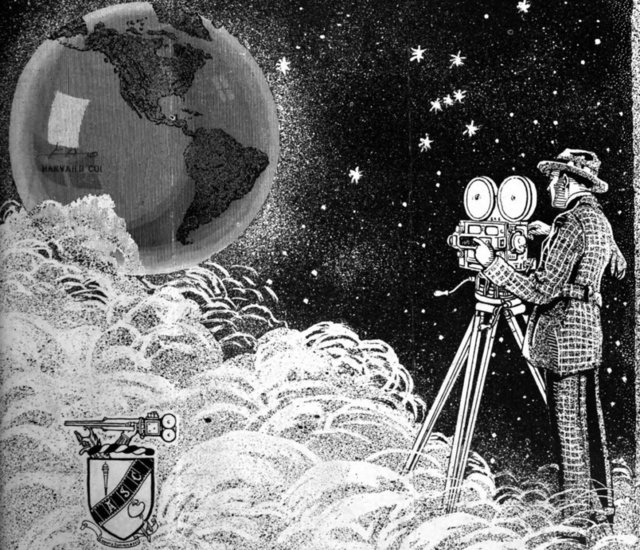
American-Cinematographer-cvr-Jan23-1024x880

This is an odd little film. I haven't been able to find any info about it at all, including who made it, or were, or when. It's not even listed on IMDB and they usually have even the most obscure films. Judging by the look it probably dates to the mid twenties at the latest. The rest is a guess though.

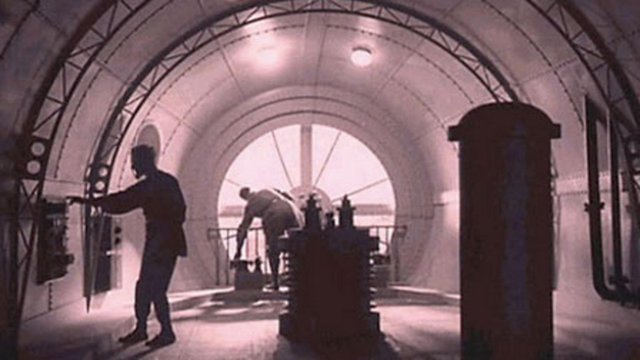
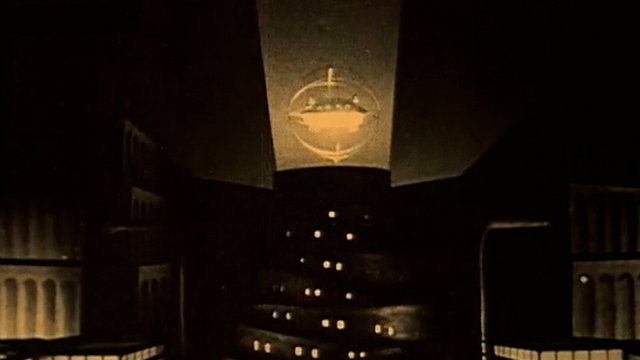
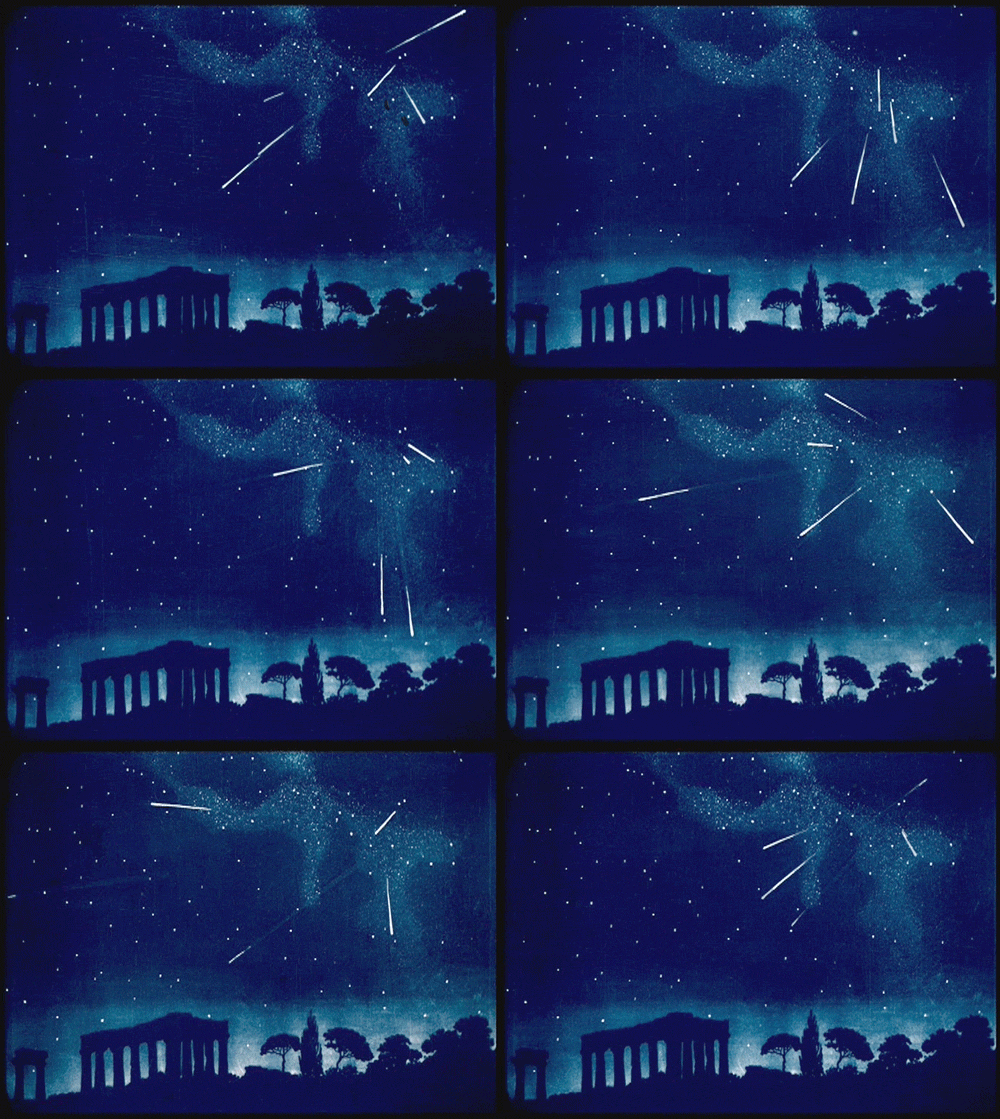
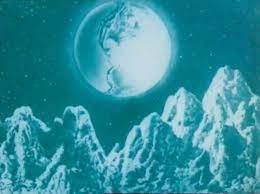
The film is a straight forward exploration of the solar system as it was known in the twenties, that is before Pluto was discovered. There are quick explanations of the planets and moons, there is also a quick rundown of the Zodiac. What makes the film standout are the cutaways to a fantasy spaceship as it journeys through the universe, along with a stunning shot of a futuristic city that is obviously inspired by Fritz Lang's 1927 classic "Metropolis". The city has all the skyscrapers, domes and elevated trains as flashy as any seen in any bigger budget film for the next twenty years. The spaceship cabin looks more like the cabin of a Zeppelin. This makes me assume the film was made after films like Lang's "Metropolis" (1927) and "The Woman In The Moon" (1929) the Russian film "Aelita, Queen Of Mars" (1924) and the American "Mysterious Island" (1929). The spaceship and space city footage are alone worth seeing for any sci-fi fan. In these sequences the film has some of the look of classic Futurist Expressionism but not obviously it's themes.

our-heavenly-bodies

In fact these shots seem so out of place in such a bare bones educational doc that I wonder if they were in fact lifted from another sci-fi movie, or movies, that have since been lost and forgotten. It is actually quite possible that this film was edited together in such a fashion by taking a few scenes from an earlier sci-fi film and splicing in the basic footage of the planets which do appear to have been filmed separately. For further evidence of this note the differences in the title cards between the straight forward exploration of the planets and the more mystical visit through the Zodiac. This film might have been assembled using footage from different countries, the fantasy footage may have indeed come from a forgotten European film (it does look German) while the other footage is probably American since the planets are obviously labeled in English. The footage of the cockpit/bridge actually bears a strong resemblance to an illustration from an obscure 1911 German sci-fi novel called "Wunderwelton" by F.W. Maler with illustrations by D. Herrfurth. Unfortunately this book is so obscure (at least in English) that I can't find anymore info about it aside from a brief mention in a book on Sci-Fi so I don't know how popular it was in 1920's Germany and Austria.

images-1

In the silent film days these sort of editing jobs were not that difficult since the lack of sound and the episodic nature of silent film story telling made it possible to to completely rearrange a film into a completely different plot. Given the rather lackadaisical attitude towards copyright in those days, especially international, there was little to stop an unscrupulous American distributors from taking some European footage and making a new film. In fact "Metropolis" was seriously re-edited for it's American release, not only shortening it but also removing some characters and subplots that some Americans might object to. Other characters were seriously changed, including the mad scientist who creates the female robot, to make him less evil. This also explains why some films of the era exist with wildly varied running times for different copies of the same title including DW Griffith's "Birth Of A Nation" and "Intolerance".

One wonders what the audience for this film was. It's obviously not designed for theatrical release but I don't know what kind of venue there would have been for such a doc.

A TRIP TO THE PLANETS;


=============================================================

October 2021 Update; At the time I wrote this article in 2013 I didn't know the history of this film or where it came from and couldn't find any info anywhere but recently someone contacted me with some correct info (thanks BTW) and then I did a little more digging so I'm doing an update/correction although I will leave the original article above here in the interest of transparency.

download-2

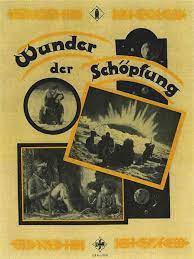
It turns out that some of my original semi-educated guesses were correct; I assumed this was an edited version of an European, most likely German film for release in America and it was. The original film was called "Wunder der Schopfung" (literally "Wonders Of Creation") also known under the more prosaic title as "Heavenly Bodies" made in Germany in 1925. This film was actually a full-length documentary as part of genre referred to in Germany as "Kulturefilmen" made in the early to mid twenties in the belief that film could be used to only for art and entertainment but also to educate. Most of these films covered topics such as health and fitness (always a German preoccupation), and exploring exotic cultures and locales. Unlike later educational films which were made for classrooms and lecture halls, these films were actually meant to be shown to the general public and were feature length with proper budgets made by major studios like the giant UFA. Several such films were released starting from about 1924 until the end of the silent era so they must have had at least some success although they have been largely forgotten about and ignored by film historians. In his classic work on Weimar Era films "From Caligari To Hitler" (1947) Siegfried Kracauer spends a couple pages discussing the genre and does mention this film but in a way that suggests he had only read about the film rather than actually seeing it while in the other classic work about the era, "The Haunted Screen" (1952) Lotte Eisner doesn't mention the film, or indeed the entire genre at all. Not surprisingly the original German film was considered lost until a copy was discovered in Finland and restored in 2008 with public showings (including in the UK in 2016) although it took a couple years for it to make its way online.

tumblr-pso4eq-WTst1qj7kyho1-500

This film was written and directed by Hanns Walter Kornblum for the giant UFA studios which in this case at least gave him a big enough budget and access to the best in their set designers which he clearly made excellent use of. As I mentioned earlier the futuristic spaceship sets and scenes of the planets are spectacular and compare nicely with those of the Fritz Lang classics "Metropolis" (1927) and "The Woman In The Moon" (1929) as well as the Russian sci-fi film "Aelita, Queen Of Mars"and the American 'Mysterious Island" (1929). Although I was correct in my guess about the basic origins of this film I was wrong about one notable thing; I assumed the sets of this film were influenced by these better known sci-fi films when in fact it is actually a few years older than all of them except the Russian "Aelita" and may therefore have instead in fact influenced Lang who must have seen it especially as it seems to have been fairly widely seen in Germany and got good reviews.

images

The full film is broken down into seven acts in which the opening ones explain the basics of astronomy in a fairly straight-forward way. These scenes have some simple animation along with some recreations of scenes with actors playing scientists like Copernicus, Galileo and Newton. Some of the animation of twinkling stars and spinning planets and moons are dazzlingly effective even today. Scientific concepts like gravity and the rotation of the planets are discussed.

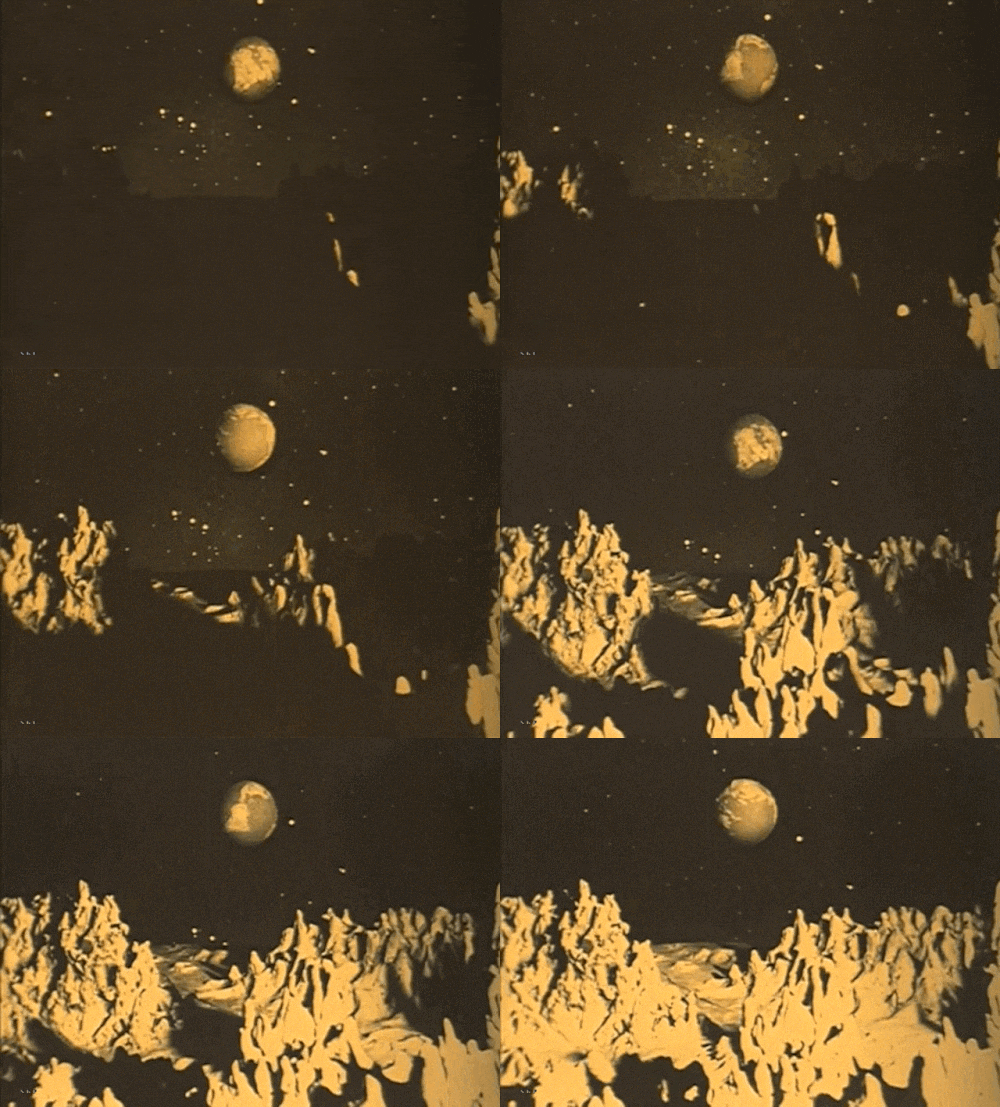
In act four the film leaves the world of dry facts and historical scenes and heads out into space with the spectacular scenes of space flight and a quick shot of a futuristic city including a Tower Of Babel ziggurat launching pad that looks suspiciously like the more elaborate sets later used by Fritz Lang and some starkly beautiful moonscapes. The moonscapes are realistic enough but as our space travellers move further away they become more fantastical. Kornblum's Mars looks more like the deserts of Egypt and somewhat inhabitable, as would the later moonscape of Fritz Lang's "Woman In The Moon". By the time we get to Saturn we encounter a race of desert-dwelling Lilliputians while Jupiter has a race of primitive (but friendly) giants. While these scenes are delightful by this point the film ignores some basic science in portraying these planets as equally habitable. While the film does focus on the different effects of gravity, including scenes of weightlessness, it completely ignores the different atmospheres, some extremely toxic, which make life impossible although scientists by this point understood or at least suspected this. None of our space travelers are required to wear space suits or breathing gear. The film can however be excused to not understanding that such craft would have to be powered through atomic power as this was a new concept understood by only a few scientists and instead has them run by some sort of extra powerful electric generator. This is at least more realistic than the giant cannon used by Jules Verne and George Melies.

imageedit-99-8617734962

While the film is broadly factual it does have a more mystical theme as implied by the title (every act opens with quotes from philosophers like Goethe and Kant) which becomes more obvious as by the final act we are discussing the end of life on planet earth either through a global ice age (showing our travelers stranded in an Arctic wasteland) or an asteroid crashing into the earth in a sequence apparently inspired by Italian films like "The Last Days Of Pompeii" (1908 & 1913) and various Biblical epics. Viewing the full version of this film reminds one less of the later dry documentaries we are familiar with than the notorious "Haxan, Witchcraft Through The Ages", a 1922 Danish film which Kornblum was almost certainly aware of. Both films are structured in the same way with the early scenes being straight-forward, even dry descriptions of facts and historical recreations before giving rein in later scenes to dramatic fantasy scenes with spectacular special effects.

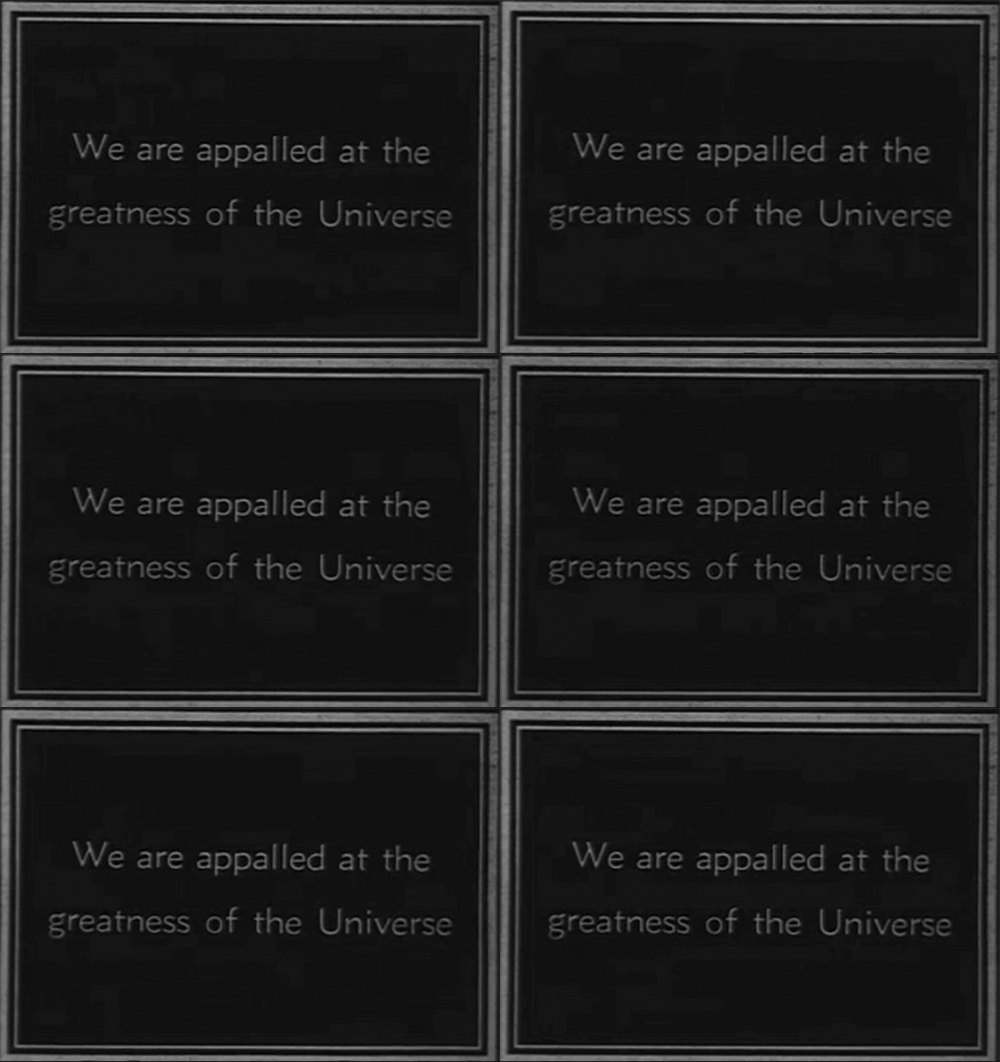
As for the shorter film "A Trip To The Planets" I originally posted and wrote about; much of it's still a mystery as to exactly who was responsible or exactly when it was done but it seems my original assumptions were correct, it was probably an edited version made in America for educational purposes some time in the late twenties. The English intertitles make it obvious it was done in America and the different typefaces used in some them suggests it may have passed through a few hands. The greatly reduced run time not only cuts out the historical recreations from the early part of the film which slow things down (most educational films were only about twenty minutes long) but also eliminates everything after the visit to Mars, much of which is more speculative and fantastical then the early parts of the film and perhaps not really appropriate for a purely educational film anyway. While the American version takes out the philosophical elements from the original German film it does add in some of it's own as it takes pains to insist that it's science is compatible with the Bible and the Book Of Genesis. It must be remembered that the 1920's was the era of the Scopes Trial in 1925 and laws banning the teaching of evolution in many states so equating science with Christianity would avoid getting the film banned in parts of America.

tumblr-oslcq1l-Dg-W1rpduwho1-500

Since my original 2013 article more research has been done on this intriguing little film which seems to fascinate people. The only known copy has been held by the fine folks at Prelinger Archives who included it in a 2012 DVD of "Orphan Films" meaning films about which little or nothing is known about their creators. By this time the original German film had been found and restored and had been shown in Germany although this news had apparently not yet reached Prelinger in America. By this year (2021) Prelinger had been informed about the existence of the original film and likely relationship to the short in their archives and presented this with some further research in a February panel discussion and blog article.

354f8502d345205b7be5f1ee77e214f9

The original German film was produced by the giant UFA film studios who exported films world wide however this one does not seem to have been shown much outside the German speaking world although since the surviving copy was found in Finland it must have been exported at least to Scandinavia. Films of the Weimar often made their way there as well to Russia and Holland where copies sometimes turn up. UFA also had an export office in America and USA distribution contracts with MGM and Paramount and a search through UFA records (which being German still exist thankfully) do not show any copies being shown in America nor have any press reviews surfaced. However in 1927 MGM does indeed list a one reel "UFA oddity" named "Heavenly Bodies" which is also an alternative title the German original was sometimes known by. As this is a one reel short however it can not be the original so the assumption Prelinger makes is that it's the short version we now have which had been edited down to be used as an educational short which may be true but it might also be another related short I will mention below. Some of these films, if well made and attractive, which this one was, were actually shown as opening shorts to feature films and weekend matinees along with the usual comedy shorts and cartoons before being sold or rented to schools, universities, libraries, church groups etc depending on the subject matter. These rentals were not done by a major studio like MGM however, once MGM was done showing the film in theaters they then sold the rights to smaller distributors who specialized in educational shorts in this case the rights to a company called the Mogull Brothers who probably redited it and made some changes. It's possible that some of the still footage of the surface of the moon was was actually lifted from an American short "If We Lived On The Moon" which we will explore shortly. At this point the title card was changed to "A Trip To The Planets". This would explain the obviously different typefaces used in the film, they may also have added the Bible references to make the film sellable in the Bible Belt. This particular one is listed in school and library rental catalogues until 1945 after which it disappears. Such films often sat in dusty shelves and cabinets in schools and libraries for decades forgotten by film historians before getting purged in the 1980's when schools moved to VCRs. Prelinger Archives, working with the Library of Congress bought the surviving copy of this film along with hundreds of others from the Mogull Bros collection in 2009 but at the time nobody was aware of the film's complicated past.

It turned out that once Prelinger found out the history of this film they discovered there were not one but at least two educational shorts made from the original and they actually had both in their archives the whole time. The other short was billed as "Heavenly Bodies" and must have been assembled around the same time and may be the film mentioned in the above MGM press release although this film seems a little too dry to be worth plugging for a general release compared to "A Trip To The Planets" if that film had been renamed at some point. At any rate this edit discusses gravity by taking the Issac Newton scene from the original along with the comedy scene with a man grabbing a tree to avoid being shot into space. The second half of the film deals with astronomy. This short is fine for it's purpose and is actually more coherent than "A Trip To The Planets" which is more jumbled but lacks entirely it's sense of style and wonder. It's also a poor quality print.

"HEAVENLY BODIES";


The genre of Kulturefilmen petered out with the coming of sound and a desire of audiences for more escapist entertainment meant a big studio like UFA would have little interest in big budget docs and film houses even less interest on showing them. At any rate with the Nazis coming to power such high-minded educational fare would give way to an entirely different and far more sinister type of film as propaganda. There is not much information on director Hanns Kornblum who died in Germany in 1970. He could have continued to make obscure educational or industrial film shorts which have been long forgotten and not listed on IMDB or worked on other films as an editor but we do know he would make at least one more film a year later about Einstein's new Theory Of Relativity which did not survive (the Nazis would have definitely banned it) but once again it would make its way to America where another edited version would be cut.

"THE EINSTEIN THEORY OF RELATIVITY" (1923);


While we don't have much info on who adapted "A Trip To The Planets" we do have know who is responsible for this film as it was assembled by none other than famed animators Dave and Max Fleischer, later creators of the iconic Betty Boop, Popeye and Superman cartoons. Brothers Max and Dave Fleischer had been working as ground breaking animators since 1918 having previously worked as film editors for Pathe Films and making educational short films for the US Army in World War One and afterwards for a company named Bray Pictures who made educational shorts. By 1922 they had established their own studio. They were given the assignment of adapting Kornblum's original film for America to explain Einstein's new, controversial and complicated theory. Since we don't have the original we don't know how they much they changed or cut out or how long the original was but reportedly they did add a few animated sequences themselves and at least some of the filmed footage since the city shown is clearly New York. Possibly they only used a small part of the original Kornblum film now lost. Compared to the previous film with it's spectacular futuristic sets and dramatic recreations this film is very dry and no-nonsense with plenty of title cards and doesn't really compare with the dreamy charm of Kornblum's previous film or for that matter the well known cartoons that make up the huge and beloved library of the Fleischer Bros Studios for which this merely an odd curio.

Bray Studios was founded by John Bray in 1912 and would make a name for itself as a producer of early cartoons employing some later famous animators like the Fleischer Bros, Walter Lanz ("Woody Woodpecker") and Paul Terry ("Terrytunes"). John Bray himself had been an early animator and was heavily influenced by the brilliant pioneer animator Winsor McCay and his groundbreaking shorts of the 1910's like "Gertie The Dinosaur" with McCay himself teaching him some of his methods only to have Bray go behind his back and try to patent them (which McCay had at first generously chosen not to do being happy to encourage other cartoonists) and then had the nerve to sue McCay for violating the patents on his own inventions! McCay would end up winning those suits but it set a patern of Bray's hard driving, not to mention greedy business attitudes. Besides cartoon Bray also tried his hand at making comedy shorts and branched out into the lower profile but lucrative genre of educational, promotional and industrial films including for clients like the auto industry and the US Army. Bray would spend less time on animation to focus on running the business including cutting a deal with Sam Goldwyn in 1920 which gained Bray Studios more money and major distribution but also a heavier workload which along with Bray's penny-pinching would lead his best animators, the Fleischers, Lantz and Terry to leave and found their own studios. Bray's lucrative ad contracts including those for the automotive industry were managed by producer and former Olympic swimmer Jam Handy would eventually leave as well in the 1930's to start his own studios as well taking most of his clients.

While working at Bray Pictures the Fleischer Bros also worked on another educational space short around 1920 to 21, since by 1922 they had their own studios, called "If We Lived On The Moon" which exists in two seperate but obviously related shorts, one uses mostly animated footage and minatures while the other uses live action and painted stills, there are a few shots that are the same in both shorts (namely a sequence using miniatures to show the difference in temperature between night and day on a lake) and given the brief length of both (three and a half minutes for one and four minutes for the other) it's likely they were originally edited as together as one longer film but it's hard to see why they were cut into two.

"IF WE LIVED ON THE MOON" pt.1 (crica 1921);


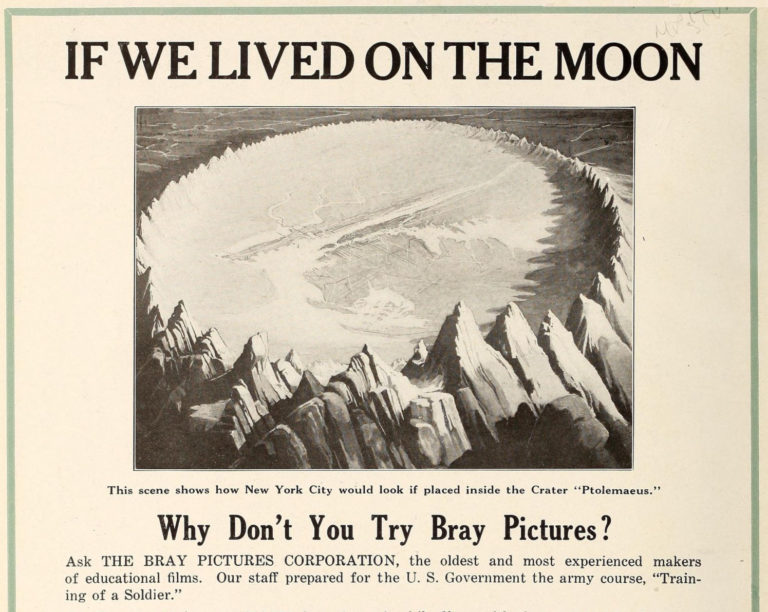
Another clue that the two shorter films must have been part of a longer one is a promo poster put out by Bray Studios that shows a striking illustration of New York City inside a giant moon crater which does not appear in either of the two fragments we have left so given the usual length of such films there must be at least ten minutes of lost footage. Although as we shall see while the full length version of this film may have been lost for some reason this tiny part of it would find itself recycled.

"IF WE LIVED ON THE MOON" pt.2 (animated);


The animated version shows the Fleischer Bros fine draughtmanship, attention to detail and Art Deco influence that would later be seen in their iconic "Superman" cartoons of the 1940's. This is also the only one of these films to aknowledge that there is no atmosphere in space and man can not breathe although their solution of a heavy fur coat, hat and World War One gasmask is more appropriate to a high flying Zeppelin on an Arctic journey than space travel.

"TIDES & THE MOON";


Little is known about this short including when it was made although it appears to be of the same vintage judging by the Bray logos used so it may have been done at the same time as the other Bray space shorts however the workmanlike animation has none of the stylishness of the Fleischer Bros though so it's impossible to know who worked on it. As the title suggests it's not about space travel itself although it does have some sequences showing the orbits of the Earth and the Moon.

Moon-1920-movingpictureage04unse-0008-scaled-e1613574111643-768x612

Bray Studios shut down it's commercial animation and it's not terribly successful comedy series with the advent of sound in 1928 to focus on documentary and educational films into the 1960's when they scaled back continuing to distribute into the 1980's. Bray himself died in 1978 aged 99. ~~~~~~~~~~~~~~~~~~~~~~~~~~~~~~~~~~~~~~~~~~~~~~~~~~~~~~~~~~~~~~

download-4

By comparison to these films here we have two contemporary American educational films dealing with some of the same subjects in a more straight-forward and far less artistic way showing again the difference between the German feature, which was made for a general audience by craftsmen who had some sort of artistic vision and even the playful Fleischer Bros short to the more workmanlike films made for purely educational purposes. Unfortunately no names of any actual people involved in these films such as directors are listed.

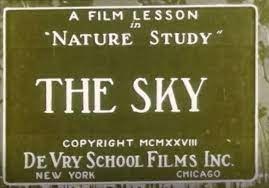
"THE SKY" (1928);


This film was made by DeVry School Films who were a major producer of educational films in the twenties, a look at 1926 guide book for educators listing films available for schools and libraries from numorous companies (including US government departments) has dozens of films from DeVry on various subjects. Founder Herman DeVry was a German immigrant and an inventor and friend of fellow inventor the notorious Lee Deforest who claimed to have invented radio and television (he did not). He was one of the pioneers of educational films and later went on to found the well known DeVry Universities as a chain of private technical colleges across the country which still exist. He died in 1941.

download-1

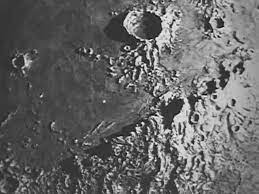
This one has some good photography including some nicely moody shots of a youth looking at the stars, shots of an observatory and the usual fine shots of stars and planets, including a spacey shot of a window shade opening itself to reveal the stars. A more interesting thing I noticed is a shot of New York City sitting in a crater that is clearly the same as the one on the poster from the Bray Studios "If We Lived On The Moon" a half dozen years earlier so DeVry must have bought the now lost footage from Bray Studios and recycled it as the shots of the moon's surface are also the same. Also interesting is that some of the intertitles seem to be identical to some of those from "A Trip To The Planets" and since we know that film is a few years older that confirms the impression given by the rather choppy nature of that film and the wildly different typefaces used throughout that it must have been redited more than once over the years. Perhaps by Mogull Bros when the bought the rights from MGM. As for "The Sky"; it may not have the artistic and philosophical ambitions of the German films or even the Fleischer Bros but it is more consistantly coherant in telling its narrative and quite watchable.

"THE EARTH" (1928)


Our next one was made in 1928 by a studio named the Neighborhood Motion Picture Service who specialized in educational short films. At least one more of their films survives and it's a bland film about nutrition made for public schools and a listing I found of film copyrights for 1927 shows them as a New York based studio with four other nature and gardening documentaries. The guide book for educators lists a few more on from this company on citizenship and American history although no more on science (at least at that time) making them a respectable but minor player in the business. Only the first half of this film is actually about space although it does have some nice shots of a solar eclipse. Once again the shot of New York City sitting in a crater from Bray Studios is back. The rest of the film is normal live action and illustrations about the earth's surface along with a scene showing how to view an eclipse by looking at the sun from behind a grapefruit (note; Do Not Try This) and footage of what appears to be the grand canyon. While this film is low budget and much of it was probably patched together from existing footage it is once again efficient and on topic with some good visuals.

"A TRIP TO THE MOON" (circa 1926);


We know even less about this film. The company, Service Pictures, has such an anodyne name that trying to track down any info seems pointless as does any attempts to chase down the equally bland title. Given the fly-by-night nature of some of these tiny studios it's possible it operated under other equally forgettable names. Nonetheless this film does have it's charms as it's story gives some fanciful history of some pre-modern claims of space travel. This animation is very crude consisting of merely sliding paper spaceships across a backdrop and barely qualifies as animation at all but they do have a childlike sense of fun. The drawing of a futuristic spacecraft (in the year 1999) actually looks more realistic than the better drawn Fleischer rocket and was probably based on a diving bell. The shot of the spacecraft leaving a futuristic city and floating in space shows a likely infuence from the 1925 German film albeit done on a much smaller budget and looks almost like an amateur Kubrick with the cratered moonscape looking more gritty and harsh than the other films although it does not explain the moon's lack of atmosphere. This film also makes no attempt to explain how the spacecraft might work and seems quite unaware about the rock experiments Robert Goddard was even then working on. A sequence showing the passing of time starts in 1926 suggesting that was when it was made but that's just a guess although it's clearly not made after that date. While this film actually has precious little actual scientific information it is quite watchable unfortunately we know nothing about those who made it.

mm

"A SOLAR ECLIPSE OVER NEW YORK" (circa 1920's)


Our last film is a fragment from an unknown longer film showing a solar eclipse over New York state as we track it from Buffalo to Poughkeepsie to New York City. The eclipse is shown using a combination of actual footage and simple animation over skyline footage and looks fairly effective. We also see footage of an early observatory telescope outside Buffalo. There's no other inforation about this film including exactly who made it, when, or how long the entire film was. This fragment was found in Holland so the intertitles are in Dutch but's almost certainally an American film and says Universal across the bottom on the intertitles.

Note that by this point talkie films were starting to be made in Hollywood although that would have had no effect on the targeted audience for films for schools and libraries which would have still have been using silent projectors for several more years especially once the Great Depression hit and school budgets got cut. Some of these films were likely still in use into the 1960's.

tumblr-aced0a069cd400e81f6d6586e424892f-3a2eec8c-500