Showing posts with label Winsor McCay. Show all posts

Monday, 20 April 2015

Adventures In Animation; George Harriman's "Krazy Kat"


16

George Harriman (1880 - 1944) is, along with Winsor McKay and Richard Outcault, one of the founding figures in cartooning and animation in the twentieth century. It was they who established the look and approach of all modern cartoons in the Edwardian Era. Previously the archetypal cartoonist was Thomas Nast with his carefully detailed drawings, densely packed with details, he was the apex of Victorian cartoonists. Starting in the 1890's a new style emerged, more open and flowing and less literal minded, led first by Richard Outcault whose newspaper strips "Gasoline Alley" (with it's "Yellow Kid" character) and "Buster Brown" established many of the conventions followed by most cartoon strips to this day; recurring characters, dialogue bubbles and muti-pannelled strips that told a story. He favoured simpler backgrounds and a cleaner, less detailed look. Outcault's wildly popular strips were followed by Winsor McCay's refinements in such classic strips as "Litle Nemo", "Dream Of A Rarebit Fiend", "Little Sammy Sneeze" and "A Pilgrim's Progress". McCay, a better and more imaginative illustrator than Outcault, introduced a cleaner, more flowing style that looks strikingly modern and more in tune with contemporary art movements such as Art Nouveau, Futurism, Expressionism and Cubism. George Harriman would complete the evolution of the modern comic strip. (note; I've already written extensively about Winsor McCay here).

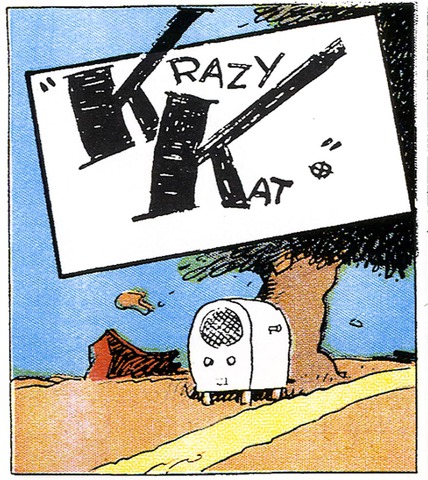
Winsor McCay, for all his brilliance and imagination, was still literal in his visual style, although not in his themes. His human characters still look exactly like human characters, only slightly exaggerated. His animal characters look and act like animals, they do not (usually) talk or wear clothes like people. By contrast in "Krazy Kat" George Harriman's characters were animals who walked upright, talked, wore clothes and acted like humans. They also did not look like literal illustrations of animals, as McCay would have done, but rather as crudely stylized versions. They were symbols of human characters rather than literal representations. In fact there were no humans at all in "Krazy Kat". The background scenery in "Krazy Kat" was equally stylized, usually made up of flat featureless plains with an occasional oddly shaped tree, cactus or mesa in the distance and angular clouds in a starless night sky. Nast's backgrounds were full of meticulous and literal detail. Outcault's were less densely packed but still literal minded portrayal of contemporary scenes. McCay experimented with fantastical and bizarre backgrounds but they were always presented as the character's visiting a fantasy or dream world and readers would accept them as such. McCay's strips always started and ended with the characters in the "real world" before sending them to the fantasy world. Harriman's "Karzy Kat" however was a self contained world were everything was strange and talking animals ran free, there was no "normal world" with regular humans to return to.
George-Herriman

Since the heyday of McCay and Harriman in the 1900's all cartoons and animation fall into one of two schools; either McCay or Harriman. McCay's influence is shown in all the superhero, horror and western comics from the 1930's to today, strips like "Doonesbury", "Bloom County", "Blondie", "Denis The Menace", "Henry", "Andy Capp", "Scooby Doo", "Dick Tracy", the epic animated features from Walt Disney, the Fleischer Brothers classic "Superman" toons and the (much) lower budget toons of the 1960's television such as "Spider Man", "Rocket Robin Hood", "Captain America", "Thor" (all from the same Krantz Studios) and "Space Angel", "Captain Fathom", "Clutch Cargo" (all from Cambria Studios) and modern toons like "Beetlejuice", "Inspector Gadget" (both from Nelvana) and parodies like "Space Angel" ending ultimately with Anime. The Harriman influence is shown in the early Disney Mickey Mouse toons, the Warner Bros toons of Chuck Jones, Friz Freling and Tex Avery (especially "The Roadrunner" and "The Pink Panther"), Ub Iwerks "Flip The Frog", the Fleischer Bros "Betty Boop" and "Popeye" toons, "Peanuts", "Broom Hilda", "B.C.", "The Wizard Of Id", "Felix The Cat", "Fritz The Cat" and modern abstract and absurdest toons such as "South Park", "Ren & Stimpy" and "Sponge Bob Square Pants". "The Simpsons" and "Family Guy" manage to combine both schools.

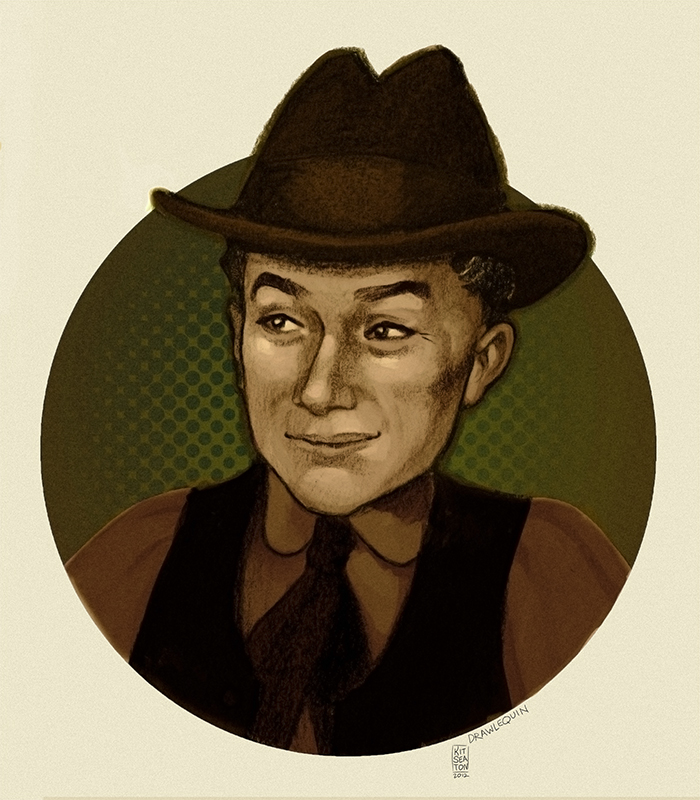
Unlike Winsor McCay, whose early work already showed an individual style, George Harriman did not start out as an especially noteworthy artist, let alone a groundbreaker. Born in 1880 in New Orleans, Harriman's background has always been something of a mystery. Possibly even to him. It is believed that he was of Creole background. Creoles had a different tradition from Southern blacks; they had never been slaves, they were educated, middle class bilingual and Catholic. However in the Jim Crow south Creoles were officially considered black and as such there was little opportunity for them to advance. Accordingly his parents immigrated to Los Angeles when he was about ten years old. In later years Harriman (who had a dark complexion and dark curly hair) would tell people his background was a mixture of Spanish, Cuban, Greek and Turkish although it's firmly established his family had been in New Orleans for many years. He did not have any particular art training but was talented enough to land a job at seventeen at the Los Angeles Herald where he did occasional advertising and political and sports cartoons. At this point his style was quite conservative in the style of established Victorian cartoonists such as Thomas Nast, Joseph Keppler and Fredrick Burr Opper. In 1900 he hopped a freight train to New York where he eventually landed a job with humour magazine "Judge" before being picked up by the Pulitzer chain. Harriman had a regular job as a sports cartoonist (in the days before photographs could be easily reproduced sports sections relied on cartoonists) as well as doing a series of comic strips.
600px-Musical-Mose-1902-02-16-Impussanates-a-S

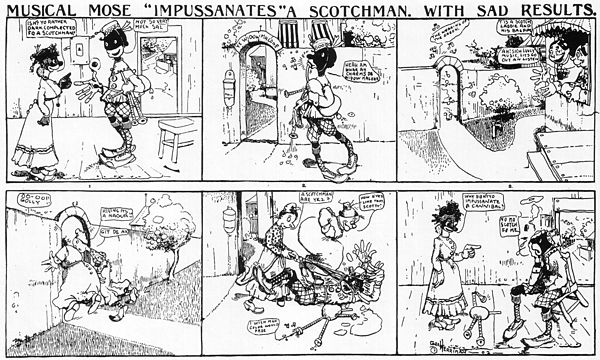
These strips started with "Musical Mose" in 1902. Mose was a character from blackface minstrel shows, a comic hustler who spoke in an exaggerated dialect. By any modern standard these strips are blatantly racist even taking in to consideration Harriman's own mixed race background, although this type of humour was quite common at the time. He also did a number of one-off strips on various subjects. By this time his style had advanced to the more free flowing and less cluttered style of Richard Outcault, then the most popular cartoonist of the day.

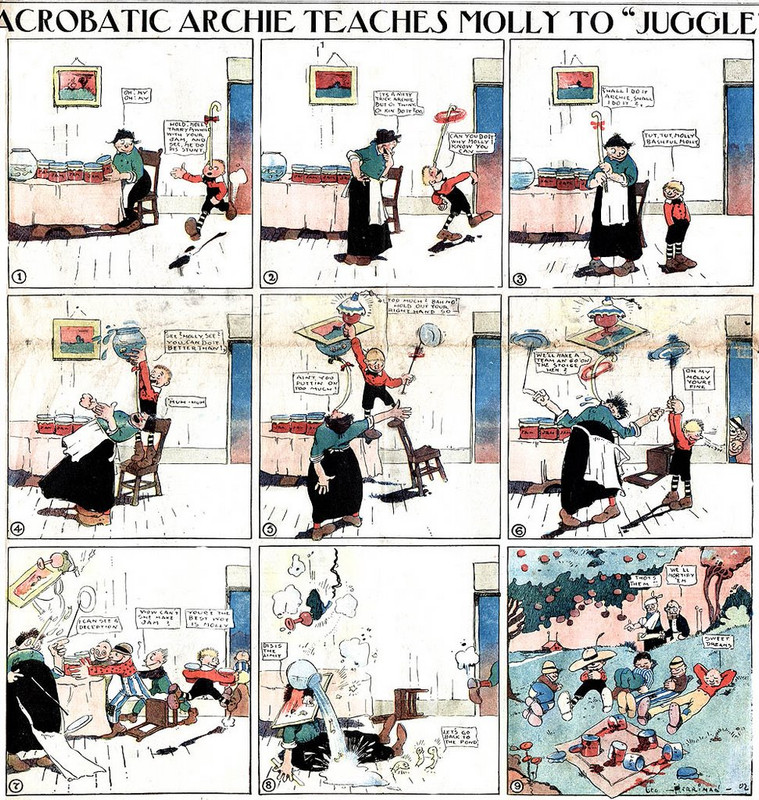
Between 1903 and 1910 Harriman developed a series of often short lived strips with titles like "Professor Otto & His Auto", "Acrobatic Archie" (about a mischievous child), "Two Jolly Jackies" (about two sailors), "Lariat Pete" (a cowboy), "Major Ozone", "Home Sweet Home", "Baron Mooch", "Mr Proones The Plumber" and a number of others. Some of these strips were popular enough and at this point his style had again evolved to resemble contemporaries strips like Bud Fisher's "Mutt & Jeff", "Bringing Up Father", and "The Katzenjammer Kids". By this time Harriman had shown himself skilled in working within the established styles of his contemporaries but he had yet to develop a style of his own.

"Acrobatic Archie"
acrobaticarchie

In 1909 Harriman developed his first all-animal strips with "Alexander The Cat", "Daniel & Patsy", "Polly & Her Pals" and "Gooseberry Sprig". In 1910 Harriman (who had moved back to Los Angeles in 1906) returned to New York and started another strip,"The Dingbats", about a wacky family. This was not a particularly noteworthy strip and would have no doubt been a short lived as the rest but that year Harriman stumbled on to his iconic characters. In one "Dingbats" strip he found some empty space at the bottom of the panels so he added in a separate strip about a cat and a mouse. The strip reversed the dynamic between cat and mouse where instead of having the cat chase the mouse, the cat was instead shown as a lazy innocent tormented by a bullying mouse. Soon the cat and mouse became popular enough to merit their own strip and by 1912 they had they had a stand-alone strip called "Krazy Kat".
201108101214

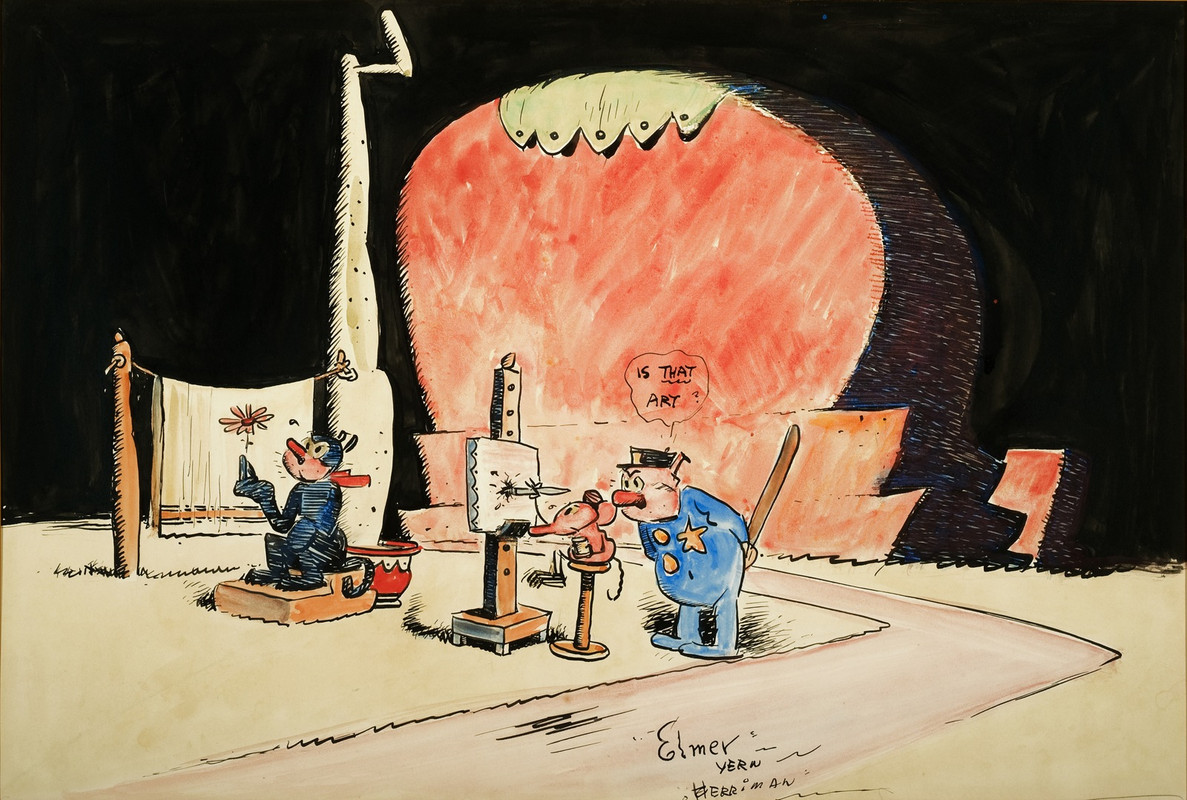
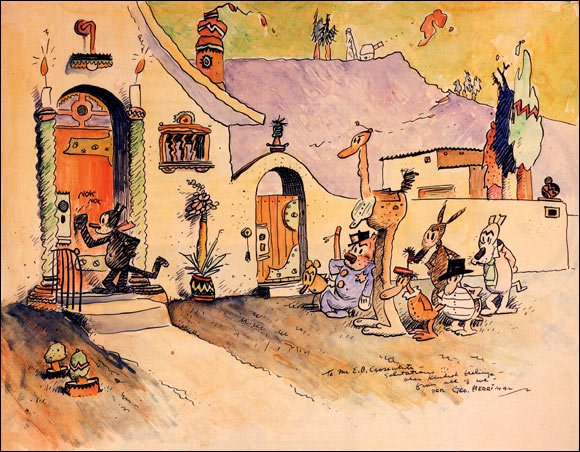
The story-lines of "Krazy Kat" were simple; Krazy was a sweet, innocent Kat who was blindly in love with Ignatz, a bad tempered mouse. Ignatz however despised Krazy and responded to Krazy's flirtations by tossing bricks at Krazy's head. This provoked another character (brought in from the earlier "Gooseberry Sprig" strip) called Offisa Pup, a squat bulldogish type wearing a policeman's uniform to intervene. Offisa Pup had a crush on Krazy (which the rather clueless Krazy never seemed to notice) and would try to protect Krazy by throwing Ignatz in jail, only to have Krazy rescue him. There were also a number of secondary characters who dropped in from time to time to cause trouble or comment on the bizarre love triangle. The sexuality of Krazy caused much debate with Harriman himself at first unsure, referring to the character as both he or she at various times. Krazy is wearing a ribbon with a bow around his/her neck but at other times the bow appears to be a men's wing collar instead. Eventually Harriman decided that Krazy was an "asexual sprite". The characters all spoke in a difficult lingo that combined street slang, black dialect from minstrel shows, Yiddish and other puns and deliberate misspellings from vaudeville "ethnic" routines that were not always easy to dis-cipher but which fascinated many poets, writers and musicians. This may have reflected Harriman's New Orleans origins and a knowledge of minstrelsy and ragtime slang. These prose flights alone might have been enough to earn Harriman a footnote as an influence with later Beatnick figures like Slim Gaillard and Lord Buckley, with Jack Keruac himself citing Krazy Kat as a favorite.

One major difference between McCay and Harriman is that while McCay was clearly a brilliant and imaginative illustrator he was no writer. His dialogue was clunky, wordy and lacking in meter. Consisting of many repetitive run-on sentences, his dialogue often had to be crammed into the word bubbles, sometimes even running out of room. This suggested that McCay worked out dialogue only after the artwork, as an afterthought. Similarly McCay's characters, however well drawn, were two dimensional, lacking any real personality and never taking any initiative in their stories. They were always mere observers; McCay would send them into some bizarre fantasy or dream world, lovingly created, which they would observe and comment on until he brought them back. End of story. The only exception to this rule was the character of Flip, an unshaven, cigar chomping, misanthropic clown from Little Nemo. The rest of McCay's characters, from Sammy Sneeze to The Pilgrim to Little Nemo were blank slates. McCay's focus was on his art work. In "Krazy Kat" however Harriman however created a stable of characters who had distinct (if limited) personalities.
original1

More groundbreaking in "Krazy Kat" was the strip's visual style. In earlier strips the animal characters were drawn in a fairly linear and detailed style. However Harriman developed a style that was more stylized and minimalistic consisting of blocky shapes and simple colours while still remaining recognizable as the animals they represented. His characters while simple also were able to show facial expressions and emotions. This style was radically different than the conventional styles but would become highly influential on future cartoonists like Walt Disney whose early "Mickey Mouse" strips and toons greatly resemble "Krazy Kat".

Besides the characters, the backgrounds were equally groundbreaking. Previous strips used backgrounds that had conventional background scenery. Winsor McCay had broken that mold with some of his dream-like fantasy backdrops but Harriman's stylized backdrops were different in their stark simplicity and beauty. Heavily influenced by the desolate plains of the Southwest in Arizona and New Mexico (where he would later move) with their flat featureless landscapes dotted with oddly shaped mesa rock formations and lonely cacti and sagebrush. Harriman's backgrounds offered an other-worldly dreamscape populated by strange characters. Once "Krazy Kat" became popular enough to score a prized spot in the colourized weekend editions his strips became even more dreamlike as Harriman would colour the starless skys jet black, orange or yellow with occasional smudgy clouds or a misshapen moon. The influence of these expressionistic backgrounds can be especially seen in those of the "Roadrunner", "Pink Panther" and "Rocket Robin Hood" cartoons and comic strips like "Broom Hilda" and "B.C." and the works of Dr Suess and Ralph Bakshi.

George-Herriman-1922-10-21-self-portrait

As with Winsor McCay, the question of where George Harriman took his influences from is an interesting one. The Expressionist and Cubist movements were contemporary but it's unknown if Harriman, with little advanced art training, had any exposure to these avant garde European schools at this time. Many have noted the resemblance of Harriman's backgrounds with the paintings of Salvador Dali, but Dali was still a child at this point. Harriman seems to have worked out his own style independent of higher art schools although his background showed he was well aware of the work of other cartoonists, including no doubt McCay. Harriman did not have the draftsmanship skills of McCay or his meticulous attention to detail but his ability to work fast on multiple projects and the rather improvised nature of the early "Krazy Kat" strips may have led him to work out a simple, uncluttered response to McCay's dream world that he then quickly expanded on. The addition of colour added to his distinctive style.
krazykat-button

The weird and unique strip became a success for Harriman, giving him at last a long-run strip. Although the strip was too weird and difficult to become hugely popular with the general public it did gain a loyal and influential following amongst artists and intellectuals. The combination of the strip's outlandish visual style, odd verse-like dialect and charming if repetitive love triangle earned the strip praise from the likes of H.L. Menken, e.e. cummings, Will Rogers, Gilbert Seldens, F.Scott Fitzgerald, Walter Lippman, Robert Benchley, Ezra Pound, Lord Buckley, E.B.White, Frank Capra and Harold Lloyd. President Woodrow Wilson was such a devoted fan that he would interrupt cabinet meetings to read the latest strip which he also had sent to him while he was in Europe in 1919. In 1921 composer John Alden Carpenter even wrote a "Krazy Kat" ballet which was actually performed. Earlier the then popular Ragtime banjoist Fred Van Epps recorded a soundtrack to a Krazy Kat cartoon (more on the Krazy Kat toons below). The most important fan (from Harriman's point of view) was publisher William Randolph Hearst who gave Harriman a lifetime contract for the strip to be carried on all papers which he honored for over twenty years until Harriman's death.

FRED VAN EPPS ~ "KRAZY KAT GOES A WOOING";


ANIMATED ADAPTATIONS;
KRAZY-7

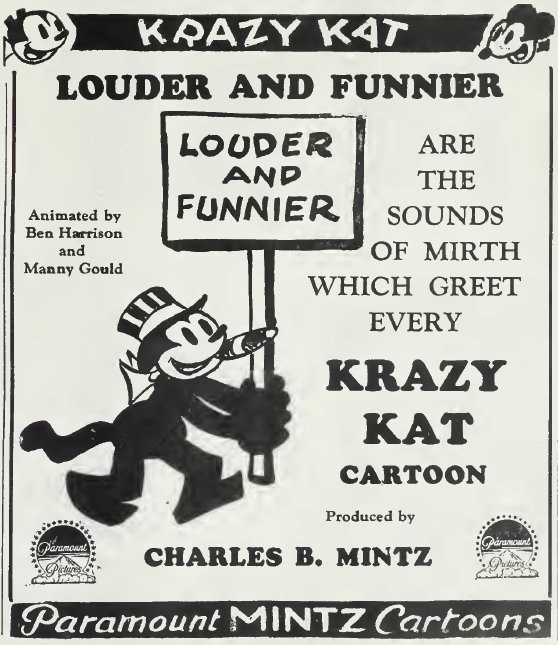
By 1909 Winsor McCay had already done pioneering work to make animation practical. There had been crude experiments in animation for years with only limited results. It was McCay who developed the basic techniques that are still essentially used today, at least until computer animation was invented. McCay's cartoons were fluid and lifelike to an amazing degree and led to the birth of a new medium which he encouraged as he happily shared his new techniques rather than seek a copyright and issue lawsuits as Edison surely would have. Accordingly in 1916 the first "Krazy Kat" cartoons were made by Hearst's Vitagraph News Pictorials, a studio that normally made newsreels. They had limited involvement from Harriman himself and were actually animated by either Frank Moser or Leon Searle. Moser was a trained artist originally from Kansas who had worked as a newspaper cartoonist in Des Moines and New York. Searle was another newspaper cartoonist who worked for Pulitzer in New York and Philadelphia. Neither had any animation experience, although at that point neither did anybody else.

"KRAZY KAT GOES A WOOING" (1916);


These cartoons kept the basic look and characters from the original strip along with the love triangle however simplified to fit in with their short (approx 3 minute) length. The characters looked exactly as they had in print. However the toons lacked the distinctive backgrounds of the strips, especially the colour strips. The toons also lacked much of Harriman's distinctive dialect verse. The stories relied mostly on slapstick which was typical of comedy shorts of the time although they did try to maintain some of the basic feel of the original strip. However the most glaring shortcoming of these strips is the animation itself. Frank Moser simply did not have the McCay's talent as an illustrator or an animator. McCay's animation is fluid and lifelike while Moser's is crude and jumpy. To be fair McCay's techniques were very new and Moser had little time to learn them, these toons were also probably done rather quickly, especially compared to McCay's exacting work. With his flowing animation and legendary attention to detail Winsor McCay took over a year to do his masterpiece "The Sinking Of The Lusitania" while Moser did the entire "Krazy Kat" series in less time. The time and work McCay spent on his toons in fact led directly to Hearst (who also employed McCay) to eventually ban McCay from further animation work as Hearst felt it was distracting him from his newspaper work, much to McCay's annoyance. While the Moser strips are clearly inferior to McCay's work it must be said that their simple visual style was more influential than McCay's more complex and difficult works at least in appearance if not animation technique. The "Felix The Cat" cartoons which appeared in 1919 produced by Pat Sullivan looked exactly like "Krazy Kat". Warner Brothers would follow with their own similar series,"Bosco" in 1927. When Walt Disney began the first Mickey Mouse cartoons a decade later the "Krazy Kat" resemblance was obvious. Frank Moser would go on to an influencial career of his own as one of the founders of the successful Terrytoons Studios in 1929 with characters like Heckle & Jeckle and Mighty Mouse. He also became a respected painter. Moser died well into the TV era in 1964. Leon Searle was less fortunate, he made over a dozen "Krazy Kat" toons before dying suddenly in 1919 aged only 38.

"KRAZY KAT; BUGOLIGIST";


In 1925 Bill Nolan, a respected animator who had worked on "Felix" took over for a new series of "Krazy Kat" toons. Unlike Moser's toons which kept true to Harriman's originals, Nolan's toons in fact resembled "Felix" both in appearance as well as in discarding the basic plot-lines and dialect in favour of a pure slapstick approach. They also dispensed with Harriman's iconic backgrounds in favour of more conventional settings. These toons were successful enough to continue (under different animators) until 1940. Some of these toons were quite imaginative visually and even surrealistic but did not have Harriman's distinctive poetic doggerel. Harriman had nothing to do with these toons and probably did not approve although he likely did appreciate the royalty cheques. Nolan would go on to work with Walter Lanz on the "Oswald The Rabbit" series. He died in 1954.

"KRAZY KAT AT THE CIRCUS";


George Harriman died in 1944 and his remaining finished strips were published for a few more weeks before the strip was discontinued. While it was not uncommon to continue strips after a cartoonists death, Hearst felt that Harriman's unique style was irreplaceable, although it's also worth recalling that the strips were not really money makers anyway. Still their influence was acknowledged. The now famous Walt Disney wrote Harriman's surviving daughter a letter in which he praised George Harriman as one of the founders of modern cartooning and animation and a personal influence. (he also did the same with Winsor McCay's son)

KRAZY KAT; "BARS & STRIPES";


In 1962 King Features made a series of "Krazy Kat" toons for television. These toons made an attempt to return to the basic appearance of the Harriman originals. They were proceeded in the fifties by a comic book series put out by Dell Publications which had little to do with the original strip and was instead a basic mainstream animal strip which Felix had also become. These comics were popular enough to stay in print until the 1960's by which time they were taken over by Gold Key Comics. These fifties and sixties versions helped to introduce "Krazy Kat" to the psychedelic generation and cartoonists like Ralph Bakshi ("Fritz The Cat"), R. Crumb and Matt Groening who's "Simpsons" would have the ultimate "Krazy Kat" parody in it's "Itchy & Scratchy" characters. While "Itchy & Scratchy" are often seen as taking the likes of "Tom & Jerry" and the likes, which they are, they also incorporate elements of the dysfunctional relationship relationship between Krazy and Ignatz. No matter how many times Itchy the mouse (note the similar name) explodes, disembowels, decapitates, immolates, etc, etc Scratchy the Cat, Scratchy still loves Itchy and stands by his mouse. Some Kats never learn.

KRAZY KAT; "THE HOT-CHA MELODY";


222062344-43cc1eeada

Monday, 17 March 2014

Adventures In Animation; Winsor McCay


winsor photo winsor_zpsfb2a8d2c.jpg

Winsor McCay (1867? ~ 1934) is known as the Father Of Animation. He did not actually invent animation, experiments in bringing drawings to life had been done since the days of magic lanterns in the 17th century and wasted little time once the film era began. By 1906 the British film-maker and illustrator J. Stuart Blackburn, the Frenchman Emile Cohl and the Spaniard (working in France) Segundo de Chomon had made some rudimentary animated shorts. They were very crude with halting and jerky movements that would barely qualify as animation at all by later standards and it would take a serious cartoonist to bring the new art form to life.

Winsor McCay's background was a mystery even to himself; he gave various different dates and locations for his birth. His background is clear enough however. His family were of Scottish background and lived in Woodstock, Ontario, Canada and they immigrated to America around 1868. American census reports from 1870 and 1880 show a Zenas Winsor McCay (his full name) born in Canada in 1867, living in Spring Lake, Michigan. However no birth or baptism record has ever been found on either side of the border. He would later claim to have been born in 1871 in America, but that date (if not the location) is impossible according to the 1870 census report, and Winsor himself would admit that he didn't really know the truth.

 photo winsoryoung_zps33282575.gif

FROM ILLUSTRATOR TO CARTOONIST;
At any rate the young Winsor (not surprisingly he quickly dropped the "Zenus") was drawn to art as a child and was encouraged by his parents to take art lessons which included illustration, etching and stained glass, all useful skills for a future animator. By 1889 he had moved to Chicago to further his art studies and become a commercial illustrator. He would then get a steady gig as cartoonist for Cincinnati newspapers while working a side gig as an entertainer drawing caricatures in rapid time in front of audiences. He would develop a distinct stamp moving past the dense Victorian look of Thomas Nast and Richard Outcault to a more open and flowing style more influenced by the newer Art Nouveau school out of Europe. By 1903 he had made enough of a name for himself that he got a high profile job with the "New York Herald" as an editorial cartoonist. Richard Outcault, who was the most succesful cartoonist in America also worked at the Herald. Outcault is considered the first modern cartoonist having developed the idea of using panels to tell a story instead if using a single stand-alone drawing as Thomas Nast had done. He also made use of dialog bubbles to better show which character was speaking. This enabled Outcault to have serial stories and introduce the first regular characters starting with the hugely popular "Yellow Kid" and later "Buster Brown" strips. Outcault and the younger McCay did not get along however and would become rivals as the younger artist became more popular. McCay would later move to William Randolph Hearst's "New York Journal" and "Evening Telegram". McCay would later have a contentious relationship with Hearst over the rest of his life.

 photo winsormccaydayart_zps76c35741.jpg

Working for Hearst McCay started out as an editorial cartoonist but he also tried to develop a strip of his own. After several abortive experiments with names like "Sister Little's Sister's Beau" and "Phoolish Phunny Phrolics", McCay got a gig as illustrator for a comedic series called "Percival Slathers" about a meek, elderly gent and his hopeless attempts to make his way in high society. This was not an actual comic strip but a series of illustrated short stories. Little is known about this series including the identity of the writer but it is probably not McCay given that it's writing style is unlike anything McCay ever did. Nor did he ever mention it in later years and in fact copies were only recently discovered. The artwork for "Percival Slathers" is competent but not particularly noteworthy although it may have helped him finally get a strip of his own with "Mr. Goodenough" in 1904. "Mr. Goodenough" was variation on "Percival Slathers" with another upper-class twit, in this case an indolent millionaire, and his lackluster attempts to become sociable. The short run strip is largely forgettable although it does show flashes of a more individual visual style.

winsor 1


After these abortive attempts McCay developed a popular character strip called "Little Sammy Sneeze" in 1904. As a character "Sammy Sneeze" was simple in the extreme. Sammy was a small boy who in every strip would try to stifle a sneeze which would in the final frame explode with catastrophic results; bricks would fall from buildings, animals would stampede, crowds would flee in panic. And that was it, Sammy had no dialog or even a real personality, he was just a force of nature. But if the strip had little of substance it had a striking visual sense that surpassed Outcault's. McCay was an superior draftsman combining a very realistic view of human figures and the way they moved along with clean and uncluttered backgrounds. At a time when Victorian illustrators were fond of excessive detail McCay experimented with minimal backgrounds, including some that used only stark black or white, he also "broke the fourth wall" by having characters at times bust out of their panel. Even today some his "Sammy Sneeze" strips look much like the comics of the 1960's while Outcault's clearly belong to the Edwardian Era and Nast's to the Victorian.

"LITTLE SAMMY SNEEZE";
 photo sammy_zps94c41ac7.jpg

"Sammy Sneeze" was popular but it was aimed at kids and it's lack of a real story must have been somewhat limiting since McCay also developed another strip (under the pen name of Silas) called "A Pilgrim's Progress" which had a continuing story about a middle-class man forever trying to free himself of a briefcase embossed with the words "Dull Care" and live a carefree life on "Easy Street" only to have the case return in the last panel. The strip was an odd allegory named after John Bunyan's Puritan religious novel (the character was named Mister Bunion) that seems quite clunky to modern audiences but once again the artwork is excellent if less elaborate than "Sammy Sneeze". Around the same time McCay had developed another even more important strip called "The Dream Of A Rarebit Fiend". This strip was truly ground breaking both for it's subject matter and it's amazing visuals.

"PILGRIM'S PROGRESS";
 photo WinsorMcCayPilgrimsProgessBunioncloseupstairs_zps69db46ad.jpg

"Rarebit Fiend" did not have a regular character and it's plot, such as it was, never changed. In every strip a character, after eating a "Welsh Rarebit" (a bun covered with melted fermented cheese) has a dream with bizarre and often terrifying hallucinations. These dreams could be incredibly complex, characters could find themselves shrinking to the size of ants or growing to such massive size that they strode through the city like King Kong, or caught in traffic which slices off various limbs, trapped in a museum chased by dinosaur bones come to life, chased by an army of their own doppelgangers, floating in space, climbing an endless staircase surrounded by inky blackness, or eaten by a giant snake while other jungle animals stroll the city streets wearing business suits. While some strips were bizarre slapsticks other were quite dark as one which showed the dreamer being buried alive in the best Edgar Allen Poe tradition while his widow flirted with his best friend. There had simply never been anything remotely like it and the strip was a sensation leading McCay to develop the idea more fully into his best known strip "Little Nemo In Slumberland".

"DREAM OF A RAREBIT FIEND";
Winsor Mc Cay Dream of the Rarebit Fiend 1913 0


"Little Nemo" was another small boy, who while he sleeps enters into a rich dream world through which he travels. "Slumberland" is a lush fantasy land with floating castles made of mirrors, mountains made of cake and ice-cream, armies of snowmen who come to life, flying cars and pirate ships, beds that sprout legs and run away and other dream sequences we have since seen repeated in more modern cartoons from Disney's "Fantasia" to Betty Boop and Bugs Bunny toons to the Simpsons.

"LITTLE NEMO IN SLUMBERLAND";
nemo


Besides Nemo the strip had other regular characters such as a Little Princes, an escaped African savage boy called "Imp" and a troublesome cigar chomping clown with a five-o'clock shadow called "Flip". The "Little Nemo" strips were the most elaborate ones yet done by McCay or anyone else. Eventually taking up an entire page in full colour, each panel was incredibly detailed and crammed with Art-Nouveau architecture and costumes. As always the characters looked realistic and showed a close attention to the human form and movement.

LITTLE NEMO"
nemo2


In 1909 McCay would try one more straight forward strip aimed at adults called "Poor Jake" about a hapless (and once again speechless) working class jack-of-all-trades who is constantly over worked by his lazy millionaire boss who in turn takes all the credit. This was an obvious political allegory and shows how McCay's focus had changed from his earlier "Mr. Goodenough", in fact Poor Jake's boss looks like Mr. Goodenough which may not be a coincidence. Other than this point the strip was decidedly minor and lacked the imagination or visual flair of his other strips and it was short lived.

McCay's strips displayed a mastery of visuals as well as a vivid imagination but they also showed his one weakness; he had some wildly creative ideas but he was a poor writer. His dialog was full of long rambling run-on sentences that seemed to be crammed into the character's word bubbles as an after thought. Sometimes they were cut off in mid-sentence as if McCay tossed off the dialog after the artwork including word bubbles were already done, which was probably the case. While McCay could come up with a visual gag he simply could not write a punchline. McCay did in fact come up with some creative and quite advanced story ideas or at least concepts but he was only interested in exploring them visually. "Sammy Sneeze" and "Rarebit Fiend" did not have proper plots or stories at all and while "Pilgrims Progress" actually did have a fairly complex idea as it's basis, the stories were episodic and again basically identical. That left "Little Nemo" as the only major McCay strip which had proper stories although again McCay's dialog is still somewhat clunky.

This brings us to McCays second weakness; character development. Almost all of McCay's characters, from Sammy Sneeze to the various Rarebit Dreamers to Poor Jake were completely passive. They took no initiative nor did they even give much reaction to any of the plights they found themselves in. The Dreamers were subjects of their hallucinations following which they then made a bemused comment while Sammy Sneeze and Poor Jake were speechless. Mr Bunion and Mr Goodenough would make occasional and fitful attempts to take some sort of action only to fail leaving them to merely shrug and comment wryly. Even Little Nemo who seems at first glance to be an explorer in a fantastical world is mostly an observer rather than taking any initiative and he has no real personality, he is not mischievous or even really curious, he never displays any particular emotion. The same is largely true of his friend the Little Princess leaving only the irascible character of Flip The Clown, and to a lessor extent the playful African Imp (who is also speechless) as the only McCay characters to have a real personality.

CARTOONIST TO ANIMATOR;
Early on in his career Winsor McCay had performed in public by doing quick caricatures while narrating his work to an audience. By 1906 as his work became famous he was lured back to vaudeville to perform in an act in which he would do quick drawings and appear to make them move and age while an orchestra played. Sometimes he shared bills with acts like jugglers, dog acts, knife throwers, accordion players, yodelers and comics like W.C.Fields, Will Rogers, Charley Case, John Bunny and the Keaton Family (featuring a young Buster). This success led to attempts to turn "Little Nemo" into a stage show with a live cast as had been done earlier by his rival Richard Outcault with his "Buster Brown" strip. McCay's backers gave him a huge budget of $100,000 to play with which allowed for an elaborate set and a score by composer Victor Herbert. The play ran for two years as a touring show to sell-out shows while McCay continued to tour with his own vaudeville act. He also continued to somehow find time to do his regular newspaper strips. In 1906 director Edwin S. Porter did a short version of "Rarebit Fiend" which included some groundbreaking double exposure special effects.

"DREAM OF A RAREBIT FIEND"


In 1911 McCay started to experiment with film. There had been some earlier attempts with animation without much success, but McCay's unique skillset of exceptional draft work, attention to detail and rapid fire drawing ability along with a vivid imagination made him the perfect pioneer to make animation truely come alive. He chose as his subjects the characters from "Little Nemo". McCays first strips were really just experiments in trying to make the sort of flipbooks used by children come alive. McCay developed the method of using thousands of painstakingly drawn pictures drawn in sequence on rice paper to show incremental movement. This early strip doesn't have a story but it must be remembered that this cartoon was not intended to be shown in theatres but was instead part of McCay's vaudeville act. McCay would stand to the side of the stage and pretend to interact with the characters getting them to jump, dance and throw objects. As such it was still groundbreaking and contemporary audiences were spellbound by the new medium. Literally every animator since has used the same methods and the strip still looks modern. In fact in it's fluidity of movement McCay's strips are easily superior to those of Hanna-Barbara, Rankin-Bass, Krantz Studios or Cambria Studios fifty years later.

"LITTLE NEMO & FRIENDS" (1920's theatrical reissue with intro);


The next year McCay left the "Herald" in a dispute over money and was hired by William Randolph Hearst for his empire. The "Herald" tried to claim copyright over McCay's characters but McCay eventually sued successfully to keep them. Still in that year he made a more elaborate strip with it's own storyline but without Nemo called "How A Mosquito Operates" which had an amazingly lifelike sequence of a giant mosquito attacking a sleeping man until it gets so full it explodes. The film was based on one of McCay's "Rarebit Fiend" strips and shows an accuracy of movement and anatomy that is still stunning, and a little creepy. This toon was also added to McCay's vaudeville act, although unlike the previous film this one had enough of a story that it could stand alone.

"HOW A MOSQUITO OPERATES";


Following this artistic triumph McCay would develop his most famous animated character; "Gertie The Dinosaur" in 1914. McCay had drawn dinosaurs in earlier newspaper strips but by adding movement and facial expressions he was able to give Gertie a real personality, rather like a hugely overgrown but playful puppy. Once again this toon was designed to be part of McCay's vaudeville act wherein McCay would introduce the shy Gertie who would be coaxed into doing tricks, dancing and playing catch. At the end McCay would appear to walk into the screen and ride off on Gertie's back. Besides Gertie the toon is notable for having full backgrounds and depth perception unlike the earlier toons. The importance of Gertie to future animators can not be overstated. McCay had created a lovable and believable animal character which could move and even show emotion. Later animators like Nat Fleischer and Walt Disney would list Gertie as one of their greatest influences. Virtually all subsequent toons for the next half century would look and move essentially like Gertie.

"GERTIE THE DINOSAUR" (EXCERPTS);


Unfortunately McCay's days a vaudeville performer would suddenly come to an end when his employer William Randolph Hearst decided that McCay was spending too much time on his animation and his live show and not enough working on the newspaper and would ban McCay from vaudeville. Hearst did however give McCay a substantial raise to cover the loss of his performing revenue and McCay was allowed to do outside work illustrating advertisements and sheet music books. "Gertie" was later re-shot for the movie theatres with a lengthy prologue added to explain the process and take the place of McCay's in person interaction with Gertie. This filmed intro (which takes up almost half of the short) starred Winsor McCay as himself and included a cameo from vaudeville comedian John Bunny. Although largely forgotten today John Bunny was the first film comedy star and was internationally famous and a large influence on WC Fields, although he isn't given much to do here. Still this is one of the few chances to see Bunny since few of his films survive. It's also the only chance to see Winsor McCay, by this time in late middle age and balding. He bills himself as "The Inventor Of Animation" which is close enough to the truth to be excusable.

"GERTIE THE DINOSAUR" (full film short);


America's entrance into World War One in 1917 gave McCay a chance to make what would become his cartoon masterpiece; "The Sinking Of The Lusitania". This toon was a piece of anti-German war propaganda which Hearst could not object to. The Lusitania was a British passenger liner (and a rival to the Titanic) which was sunk by a German U-Boat in 1915 with a heavy loss of life including many Americans and which became a cause-celeb in the run up to America's declaring war. The cartoon shows the ship leaving New York then intercepted by a U-Boat which fires a torpedo causing a vivid explosion. The rest of the strip shows the ship's sinking, a side bar naming a few celebrities who died on board, the survivors splashing in the water, and it ends with a shot of a mother holding an infant sinking beneath the waves.

 photo winsorship_zps1ec77313.jpg

Starting in 1917 and finished in 1918 the entire strip took 25,000 individual drawings each done by hand by McCay himself with a couple of assistants using a new technique he developed, drawing on clear cellophane cells instead of rice paper as before. The strip shows McCay's usual attention to detail and careful observation of form and movement. Notice the undulating waves, each done individually. Then the billowing curtains as the ship passes the Statue Of Liberty. Next the strip gains menace with the arrival of the surface running across the surface with it's crew running to battle stations, a scene that looks so real it almost looks like an actual film. Then comes the spectacular explosion scene which again looks stunningly real rather than a cartoon explosion. The ship's slow motion sinking with it's smokestacks billowing out a thick oily cloud while the passengers and crew scramble down ropes or jump overboard has a brutal beauty that belies the term "cartoon". So to the final shot of the drowning mother and child, a scene actually taken from a well-known recruiting poster by American artist Fred Spear. The only discordant note (aside from the jingoist narration at the end) is the shot of a couple of cartoonish fish speeding out of the way of the speeding torpedo, not that the shot is badly done of course but it's cutesy look doesn't really fit with the serious nature of the rest of the strip. Even taking into account that this strip is in black and white the lush detail and realism of the strip would not be equaled until the full colour features done by Walt Disney and the Superman cartoons done by the Fleischer Brothers of the late 1930's

"THE SINKING OF THE LUSITANIA" ~ 1918;


With Mcay's reputation as "The Inventor Of Animation" secure he resumed making cartoons building on the new animation cell technique which allowed him to make more detailed strips based on his fantasy comic strips "Little Nemo" and "Rarebit Fiend". By 1921 he had released three complete strips; "Bug Vaudeville" which builds on the research done for "Mosquito" to create a fantasy vaudeville act made up of giant dancing bugs. There is also an intro featuring Flip The Clown from Little Nemo strip.

"BUG VAUDEVILLE" ~ 1921


"The Pet" featured an animal that eats so much that it grows to massive size and proceeds to stomp through a terrified city like King Kong until it is killed by the air-force. The unidentified pet in question looks like a cross between a puppy and a teddy bear but for some reason it meows like a cat.

"DREAM OF A RAREBIT FIEND; THE PET" ~ 1921;


"The Flying House" was the most psychedelic toon yet in which a man attaches wings to his house and flies away to escape from creditors.

"THE FLYING HOUSE" ~ 1921;


After his animation career was abruptly stopped there were a few unfinshed projects such as this lush fragment of some centaurs in a Art Nouveau forest.

"THE CENTAURS";


LATER CAREER:

In 1921 Hearst once again invoked his exclusive contract to ban McCay from further animation work. Since 1918 Hearst had allowed McCay to do animation presumably because of the increased publicity and prestige and on the assumption that since these cartoons were done to be shown in movie theatres rather than on the vaudeville stage they would still leave McCay to continue to do his work for Hearst's papers. However hand drawn animation is extremely time consuming, especially if it's done with McCay's painstaking attention to detail and so Hearst once again ordered McCay to drop his animation work and concentrate solely on his newspaper work which included his weekly strips as well as editorial cartoons. As before Hearst promised McCay a bonus which he apparently did not pay however and when McCay's contract ended in 1924 McCay quit and moved to a rival paper, taking Nemo with him. Hearst tried to continue the Nemo strip under a different name with artist Mel Cummin but was not successful and McCay was lured back in 1927. Besides his usual strip work on of the noteworty jobs done for Hearst in later years was sketching the scenes from the Lindburgh kidnapping in 1932. Winsor McCay suffered a massive stroke and died in 1934 aged about 55. After his death Hearst once again tried briefly to keep "Little Nemo" alive with the hapless Mel Cummin, with the same lack of result.

fiend


INFLUENCES AND LEGACY:

Besides being massively influential for their artwork, strips like "Little Nemo" and "Rarebit Fiend" are fascinating for their subject matter. In his exploration of dreams McCay seems to be channeling the theories of his contemporary Sigmund Freud although there is no evidence they were even aware of each other. McCay's fantasies also anticipate the French Symbolists and the later Surrealists and Beats although again there is no evidence they knew of his work. McCay seems to occupy his own unique space, reaching similar conclusions to the avant-garde without being in anyway a part of it. In this he resembles another American contemporary, the composer Charles Ives, who was experimenting with musical rule breaking at the same time Arnold Schoenberg was shocking Europe in spite of the two men being quite unaware of each other's work. When Schoenberg was much later exposed to Ives's work he was shocked to find there had been a like-thinking contemporary in conservative middle America. One wonders what Salvador Dali, Marcell Duchamp, Andre Breton or Man Ray would have made of this American newspaper cartoonist's work.

McCay himself never listed any influences leaving to much speculation as to where he took his ideas. Possible artistic influences include earlier newspaper cartoonists Thomas Nast, Joseph Keppler, and especially Fredrick Burr Opper, Gustave Verbeek, Ralph Barton, James Mongomery Flag, Charles Dana Gibson and Richard Outcault. Impressionists Alfonse Mucha and Toulouse-Lautrec, Art Nouveau illustrators Aubrey Beardsley and especially Arthur Rackham. French Symbolist painter Gusatve Moreau, European artists Gustave Dore and eccentric French fanatsy illustrators Isadore Grandville and Albert Robida. A later influence may have been the dream-like films of George Melies.

winsormccaytweaked 620x802


As for the thematic ideas behind McCay's fantasy strips like "Rarebit Fiend" and "Little Nemo" with their explorations of dreams and the subconscious influences aside from Freud (who McCay never mentioned as having read) included Lewis Carroll ("Alice In Wonderland"), J.M. Barrie ("Peter Pan"), Washington Irving ("Rip Van Winkle"), Oscar Wilde, Edward Lear, Charles Baudelaire, Robert Louis Stevenson ("Dr.Jekyll & Mr Hyde"), Arthur Conan Doyle ("The Devil's Paw"), H.G.Wells, Jules Verne, Bram Stoker, William Blake, Mark Twain ("A Connecticut Yankee In King Arthur's Court"), Ambrose Bierce, O.Henry and of course Edgar Allen Poe. Another obvious but lesser known writer was Harle Oren Cummins who wrote a series of short stories called "Welsh Rarebit Tales" in 1902 which involved characters having hallucinations after eating Welsh Rarebit. An even more obscure known writer was Edward S. Ellis a popular author of dime novels who wrote "The Steam Man Of The Prairies" about a giant robot (with appropriately striking cover art by an unknown illustrator) in 1865. Although not especially well educated formally McCay was quite well read and known to be a fan of Shakespeare, Yeats and the Romantic Poets Shelly, Keats and Byron who he could quote from memory, along with the Bible.

As an animator McCay's importance simply can not be overestimated. McCay did not actually "invent animation" but he developed, or at least perfected the basic technique of drawing on layers of clear cellophane cells which gave him the ability to make his cartoons far more elaborate, multi-layered and lifelike as well as longer than was possible using the older rice paper flipbook method. It is no exaggeration to say that all subsequent animation used the cell method until computer animation was invented. Unfortunately it turned out that while McCay himself did get the credit he deserved he not get the money he should have from his invention of cell animation. McCay had a lackadaisical attitude towards money and business and did not bother to patent his invention even when urged to do so. He was at first happy to let other share his invention for free until a rival cartoonist named John Randolph Bray went behind McCay's back and filed patents himself on McCay's various animation and camera inventions and then had the colossal gall to turn around and sue McCay for copyright infringement! The no doubt outraged McCay counter-sued and eventually won a settlement which forced Bray to pay royalties to McCay.

winsor 3


Artists and animators who have paid tribute to McCay's influence have included Walt Disney, Nat and Dave Fleischer ("Betty Boop" & "Popeye"), Tex Avery ("Droopy"), Chuck Jones & Friz Freling (Warner Brothers cartoons including Bugs Bunny & Daffy Duck), Ub Iwerks ("Flip The Frog"), Walter Lantz ("Woody Woodpecker"), Ralph Bakshi ("Fritz The Cat", "Spiderman" & "Rocket Robin Hood"), Peter Max ("Sgt.Pepper") and Matt Groening ("The Simpsons").

Cartoonists and Comic Artists include George Harriman ("Krazy Kat"), Al Capp ("Lil Abner"), Nick Cardy ("Tarzan"), Hal Foster ("Prince Valiant"), Chester Gould ("Dick Tracy"), Bud Fishe ("Mutt & Jeff"), George McManus ("Bringing Up Father" & "Rosie's Beau"), Joe Shuster ("Superman"), Bob Kane & Jerry Robinson ("Batman") and of course Dr. Seuss. Modern comic artists include Art Spiegelman and R.Crumb. Non comic artists include Muarice Sendak ("Where The Wild Things Are") and Scf-Fi illustrator Frank Paul. Film makers include Fredrico Fellini, Terry Gilliam and Tim Burton.

Perhaps the greatest tribute came from Walt Disney who in 1955 did a TV special on the history of animation which included a section on Winsor McCay. Disney invited McCay's son Bob (also an artist) down to Disney Studios and told him "Bob; All this should have been your dad's".

thanks