Showing posts with label Rod Serling. Show all posts

Tuesday, 9 January 2024

The Many Ghosts Of Ebenezer Scooge


images-0

Two years ago for Christmas I wrote an article covering all the surviving versions of Charles Dickens' "A Christmas Carol" so this year as a somewhat belated follow up I decided to review all the black and white sound versions, at least the ones I could find or are currently available. The previous article can be found here so there's no reason to do a recap.

BRANSBY WILLIAMS;

The first sound production of "A Christmas Carol" would come as early as 1926, before sound films would even become standard releases. In fact this version was merely a short film done as a demonstration of some of the new sound film technology. The sound in this case was played on a phonograph that would be synched up to the screen, a cumbersome process that would not catch on and this film would become lost although a sound recording of what appears to be the soundtrack or at least a recreation of it does survive. Scrooge is played by Bransby Williams, a popular star of stage and radio who had played the role before. However here he is not so much playing the role as reciting the basic plot and doing a couple voices. There are no other cast members. The entire disc is only about ten minutes which is far too short and instead of presenting the various Spirits Williams merely describes them and moves on to the end. While of some historical interest this can hardly be considered a proper portrayal. Williams would later play a proper version on the BBC in 1950 which like most British TV is lost or not currently available.

BRANSBY WILLIAMS AS SCROOGE (1926);


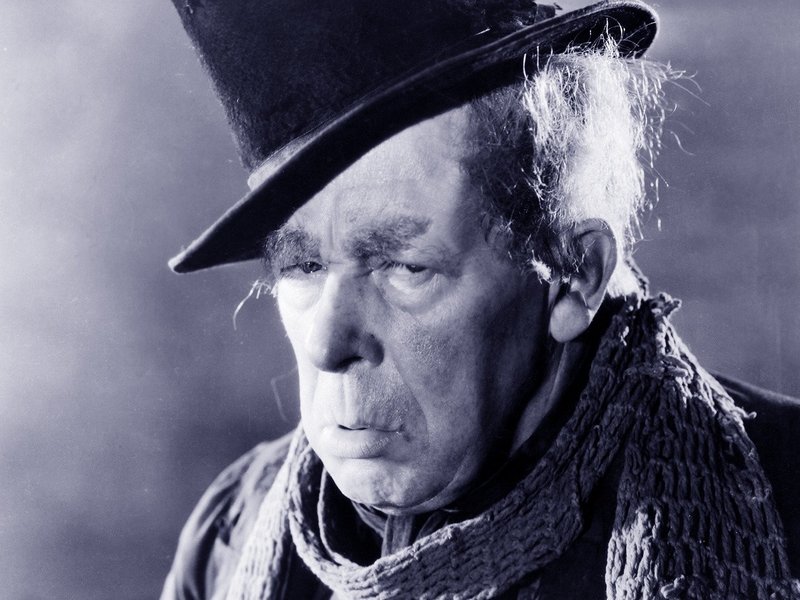
It's appropriate that the first proper sound version should come from Britain and would star possibly the most qualified actor to ever take on the role and who had already played the role on film. Sir Seymour Hicks (1871-1949) had been a major star of the London stage for years including working with stars Sir Henry Irving and Charles Frohman, when he began playing the role of Scrooge with a script he wrote, starting in 1901 playing the role hundreds of times with great success allowing him to set up his own company and build his own theatres, the Aldwych and Hicks Theatres. His company included family members including his wife, Elaline Terriss and brother-in-law Tom whose father William Terriss was a well known actor in his own right who Hicks had worked with until Terriss was murdered in 1901. Hicks was the best known Scrooge of the Edwardian stage so his moving the role to film was a natural. Like most stage actors of the 1900's Hicks showed little interest in the crude film vignettes of the early era, however by the 1910's film as a medium had advanced in its ability to tell a proper story lasting longer than a single reel. Hicks would star in an 1913 version which included his wife and other notable figures of the Edwardian stage which is still extant and which I already discussed in my previous article. Hicks would continue to play Scrooge and other characters on stage along with making some movies into the sound era which would lead to the first sound remake in 1932.

SIR SEYMOUR HICKS;
p39663-i-h9-ab

"SCROOGE" (1935);


Directed by Henry Edwards
Cast;
Sir Seymor Hicks ~ Ebenezer Scrooge
Donald Calthrop ~ Bob Cratchit
Robert Cochran ~ Nephew Fred Holliwell
Mary Glynne ~  Belle
Barbara Everest ~ Mrs. Cratchit
Eve Gray ~ Janet Holliwell
Philip Frost ~ Tiny Tim
Claude Rains ~ Jacob Marley (voice only)
Marie Ney ~ Spirit of Christmas Past (voice only)
Oscar Asche ~ Spirit Of Christmas Present
C. V. France ~ Spirit of Christmas Future
Athene Seyler ~ Charwoman
Margaret Yarde as Scrooge's Laundress
D.J Williams ~ Undertaker
Robert Morley as Rich Man (uncredited)

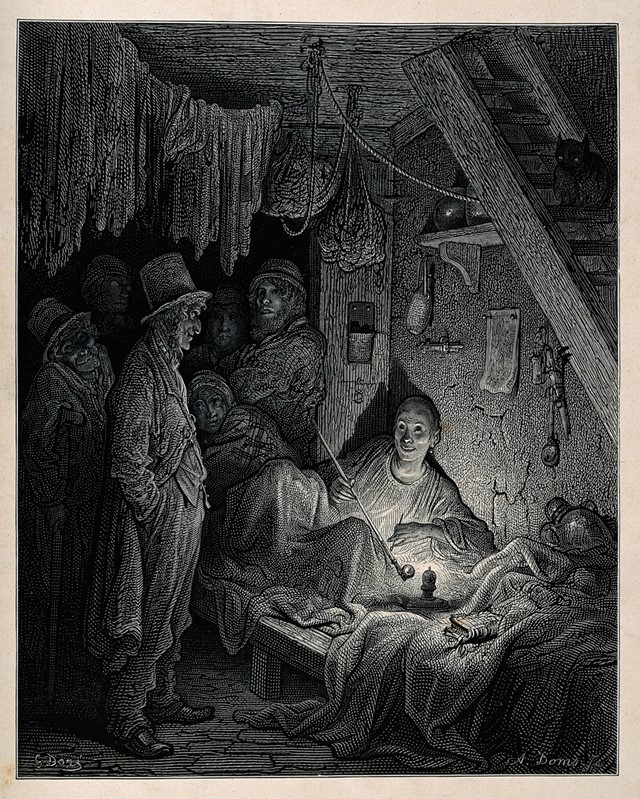
All of the silent versions, including the previous 1913 Hicks version, suffered from making shortcuts to the plot, sometimes eliminating entire important characters with most also taking a fairly perfunctory attitude towards the actual filming which tended to show a lack of any real sense of style. This time however we have a proper film treatment and it's this film that sets the template for every subsequent Scrooge film. It's fortunate that Hicks waited a couple years after the first introduction of sound and filming techniques caught up with the need to record so we do get a camera that is mobile enough to avoid seeming overly stage-bound. Twice we get a sweeping view of how London celebrates Christmas and the camera soars over a miniature of the city and then to a rain and windswept lighthouse and a storm lashed ship at sea with sailors shouting their season's greetings through the maelstrom. This evocative sequence, which would later be reproduced almost identically for an animated version in the nineteen sixties, resembles a similar sweeping vista in the 1926 FW Murnau version of "Faust". Other more obvious influences from German film comes in the sequence with the Ghost Of Christmas Future which is the highlight of the film. Previously the film has been shot with gritty realism but now we switch to classic Expressionist shadowplay with Scrooge being shot as a shadow silhouette or even a disembodied head superimposed onto it's own shadow while the Ghost's skeletal hand points over him. While these scenes have a nightmarish quality they are essentially dreamlike compared to the even darker scenes where the Undertaker, Mrs Dilber the Charwoman and the Laundress haggle with Old Joe the Fence over Scrooge's stolen possessions. Here we get a London underworld with characters shot as disembodied learing faces and grasping goblin-like hands fondling their ill-gotten coins. The later classic 1951 Alistar Sim version would do it's own take on this scene with some fine acting but even that excellent version doesn't match the Stygian gloom of this version. While there are some Expressionist flourishes here as well the main influences here were likely closer at home. In 1872 the French illustrator Gustave Dore did a series of iconic views of London including its underground in the age of Jack the Ripper showing London in its seedy, grimy glory and it's Dore's London we see here.  
80252
GUSTAVE DORE'S LONDON UNDERWORLD

The sets and costumes here are vividly Dickensian; dark, cold and gloomy with none of the ornate decoration of some later versions. The building interiors are sparse, spartan and unadorned although the streets are busy and vibrant. This is a harsh London with none of the usual romantic escapism of other portrayals of the Victorian Era with the entire main cast seeming to be cold, hungry and worn down, an effect accented by their often threadbare clothes. Instead of the glamour that the Victorian Era is usually shown with here we get the dreary, desperate city of the muckraking photographers like Jacob Riis showed in his contemporary series of photos of New York. It's probably not a coincidence that this film was shot during the depths of the Great Depression and in Britain. America had spent the previous Roaring Twenties in an extended economic boom, however illusionary, as had Weimar Germany. By contrast in Britain the twenties had already experienced an extended recession and political instability by the time the actual Depression hit Britain. In American and German film the thirties were a time of lavish escapism but there is none of that in this version which can truly be called Dickensian. As evidence that this was a conscious artistic decision and not due to budget constraints we have the scenes of Christmas for the Upper Crust at the Lord Mayor's Ball which is indeed lush and ornate.    

  This version is not without its flaws. Chief amongst them was the bizarre decision to not show Jacob Marley but to instead have him as a disembodied voice thus depriving the film of one of its most iconic images. As by 1932 film techniques were fully capable of shooting a double exposure ghostly image the decision to not do so here is frankly inexplicable. As Hicks was known for having played the role on stage for over twenty years it's possible that this was how the character was done on stage but it shows a lack of film technique that the film does display elsewhere. Similarly the Ghost of Christmas Past is only shown one once as a ghostly silhouette and then only briefly cutting the visit to Scrooge's past too abrupt to have much impact. Unlike most later versions we also do not really see a young Scrooge presumably because again this was not done on stage and Hicks, being in his sixties by this point, was too old to pull off the youthfulScrooge and didn't want to share the role with another younger actor. Shortening these scenes also makes Scrooge's rehabilitation too abrupt. Unlike some other versions Scrooge's where transformation takes time as he slowly realizes how his past life shaped him and what it has cost but by rushing through things we miss the whole point of this transformation as Scrooge caves almost instantly. As is common with many films of the era the musical soundtrack can be a bit overpowering at times.
3-W4m2z-Z-asset-mezzanine-16x9-oi9-B5-T1

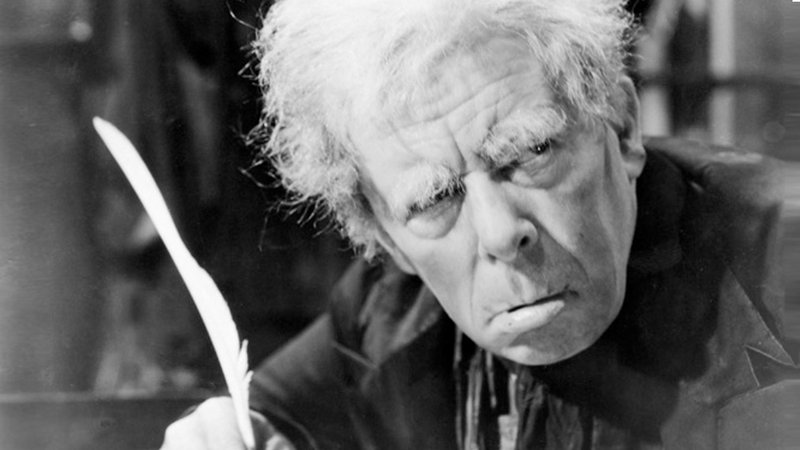
As Scrooge, Hicks is an ill-tempered, glowering presence. Stocky and florid with wild hair, bushy caterpillar eyebrows and a lumbering, bullish walk. For a stage actor he is not especially histrionic and avoids going over-the-top in his portrayal. Setting aside the relative absence of Jacob Marley and the ghost of Christmas Past the supporting characters set the template for most of the succeeding decades. As Cratchit Donald Calthrop is appropriately frail, stooped, servile and weather-beaten. The trio of greedy Charwoman, Laundress, Undertaker and the Fence are vividly decadent and debased. The actor playing Tiny Tim is not as cloying as others would be in this maudlin role.
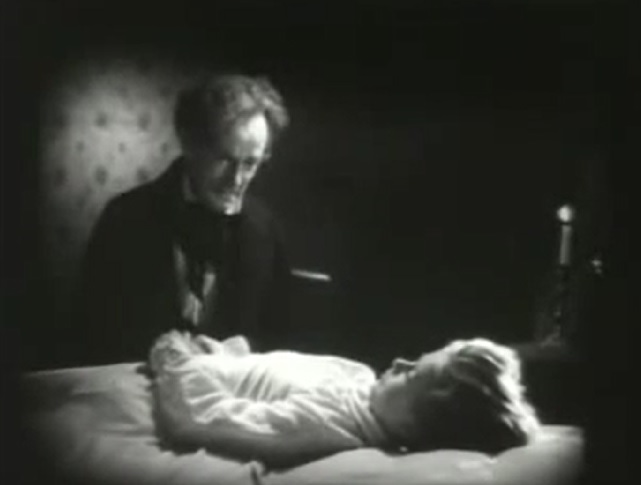
1935-cratchit
DONALD CATHROP AS CRATCHIT

Sir Seymour Hicks was born in 1871 and had appeared on the stage from the time he was a teen and would continue acting almost up to his death in 1949 aged 78. Director Henry Edwards (1882-1952) had a long career as an actor and director dating back to 1915. Donald Calthrop (1888-1940) also had a career starting in the silent ear and would later include five of Alfred Hitchcock's UK productions. The voice of Jacob Marley was played by Claude Raines in one of his early roles which was ironic as he would later become famous as the Invisible Man. Another actor making an appearance in an early role was Robert Morley as one of the gentlemen asking Scrooge for alms for the poor. 

REGINALD OWEN; The Hicks film was successful enough to inspire an American version just a few years later giving the story the patented Hollywood treatment.

"A CHRISTMAS CAROL" (1938);


Directed by Edwin Marin
Cast;
Reginald Owen ~ Ebaneezer Scrooge
Gene Lockhart ~ Bob Cratchit
Kathleen Lockhart ~ Mrs Cratchit
Terry Kilburn ~ Tiny Tim
Barry MacKay ~ Nephew Fred Holliwell
Lynne Carver ~ Bess (Fred's Fiancee)
Leo G Carroll ~ Jacob Marley
Ann Rutherford ~ Ghost Of Christmas Past
Lionel Braham ~ Ghost Of Christmas Present
Ronald Sinclair ~ Young Scrooge
Elvira Stevens ~ Fann Scrooge
Olaf Hytten ~ School Master

After the grime and gloom of the British Hicks version this American shows the kind of flair of most Depression era Hollywood with lush detailed sets, elegant costumes and a soundtrack of swirling strings. Even the house and clothes of the Cratchits are comfortably bourgeois and cozy especially compared to the spartan and beleaguered ones in the Hicks version. Similarly Scrooge's home is richly furnished and not the chilly tomb of Hicks' version. The same is true of the exteriors which don't really look like Victorian London and could be any major city. This is all pretty to look at but it can hardly be called Dickensian. It does however reflect the escapist tastes of American Depression era audiences (the same trend can be seen in German films of the era) at least in major studio productions and this film was an immediate hit. This film does have some improvements over the Hicks version starting with having an actual visible Jacob Marley and Ghost of Christmas Past instead of a disembodied voice. Marley was played by veteran character actor Leo G Carroll and his portrayal has been the standard ever since with its chains and lock boxes, spectacles askew and jaw held in place by a bandage. Similarly while in the Hicks version the Ghost of Christmas Past was a vague (and presumably male) ghostly presence with a menacing echoing voice here she is a beautiful blonde (Ann Rutherford) who speaks and interacts as any mortal would thus allowing for more meaningful dialogue. This allows for the film to spend more time on Scrooge's backstory that has also become standard in all subsequent versions.
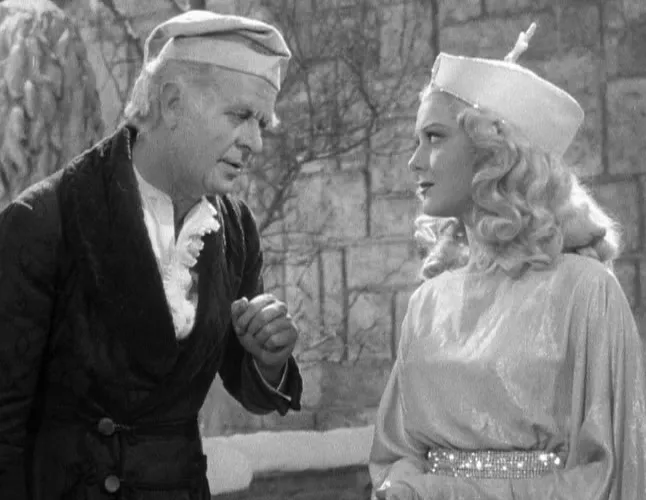
owen-past
REGINALD OWEN & ANNE RUTHERFORD AS THE GHOST OF XMAS PAST

This version also clearly looks better than the Hicks version with it's bright and clear cinematography. There are however also some weaknesses compared to the Hicks version. As a tradeoff for spending more time with Scrooge's past we spend less time on the Christmas present and we do not get any version of the sweeping panorama of the city. It's possible that this may not have been a creative decision but may be that shooting on existing Hollywood studio sets they simply did not have the appropriate sets and miniatures to recreate Dickensian London handy and decided to dispense with them. It's noticeable that the exteriors we do see could basically represent any Victorian city and were probably already in place. There is also nothing to compare to the nightmarish scene selling Scrooge's last effects at the Old Joe the Fence's darkened lair.
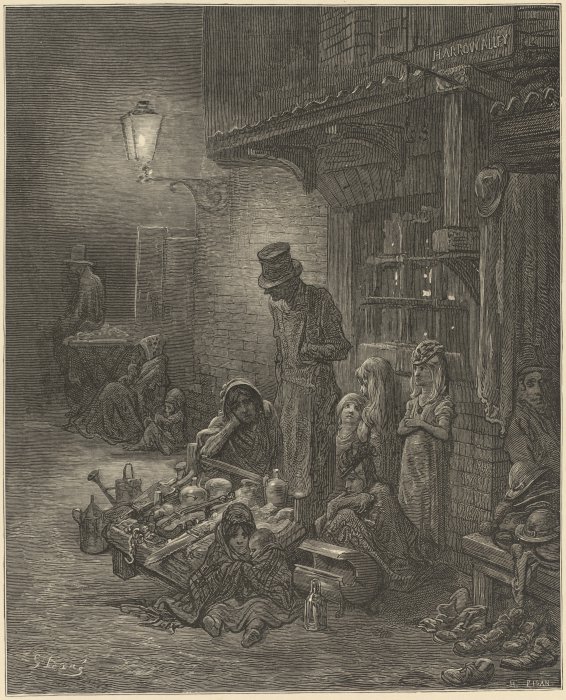
Gustave-Dore-London-A-Pilgrimage-Meister-Drucke-1240949
GUSTAVE DORE'S LONDON UNDERWORLD

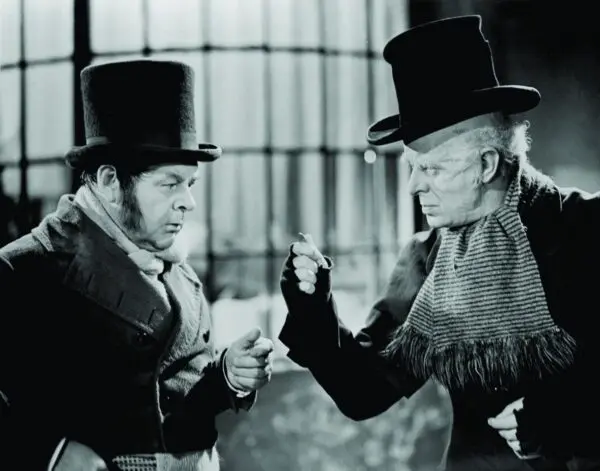
Reginald Owen as Scrooge is solid but unremarkable, lacking the brooding glower of Hicks or the self-loathing menace of the later Alister Sim and coming off as merely a crotchety old coot. Owen in some other roles had been a rather stolid and stocky presence even as he played Sherlock Holmes but here he is unrecognizable seeming to have lost weight and with an odd scuttling gait that would later be copied by Albert Finney in his 1970 musical adaptation. The Cratchits were played by actual married couple Gene and June Lockhart and they do have a natural familiarity and ease however Gene looks far too well fed and comfortable compared to Donald Calthrop's careworn, stoop shouldered version. Cathrop was believably meek and servile while Lockhart was so oppressively upbeat as to seem almost imbecilic and even getting fired (which doesn't happen in most versions) can't dampen his good cheer for long. The Cratchit's middle daughter was also played by their daughter June who would later go on to star in the 1950's and 60's on TV shows "Lassie", "Petticoat Junction" and "Lost In Space" and as of this writing she is still alive. We also spend more time with Scrooge's nephew Fred and his fiancee Bess who are a typical blandly attractive and wholesome Hollywood couple. One exception is Tiny Tim as played by Terry Kilburn who is sickly cloying even by the standards of the day. Kilburn would appear in "The Adventures Of Sherlock Holmes" (1939), "The Swiss Family Robinson" (1940), "Black Beauty" (1946) and some Andy Hardy and Bulldog Drummond films. As of this writing he is also still living.
a-christmas-carol-823-OCC-600x471
REGINALD OWEN & GENE LOCKHART AS CRACHIT

Reginald Owen (born 1887) was British actor who had a long film career as far back as 1911 in Britain before moving to Hollywood which had already included appearing in early two sound Sherlock Holmes films including appearing as both Dr Watson (opposite Clive Brook in 1932) and Holmes himself in 1933 giving him the odd and somewhat unenviable distinction of playing not one but three classic characters of Victorian fiction (Scrooge, Holmes and Watson) only to see them taken over and personified by other actors (Alistar Sim, Basil Rathbone and Nigel Bruce) in his own lifetime. Owen was not actually the first choice to be Scrooge with the role originally planned for Lionel Barrymore who had played the role on radio and was a bigger star but he was not available, they did get him for the trailer. Owen would have long life and career into the TV era usually in supporting roles in such films as the notorious epic bomb "Hotel Imperial" (1939), an adaptation of Robert Louis Stevenson's "Kidnapped" (1938), the 1962 adaptation of Jules Verne's "Five Weeks In A Balloon" and on TV in "Bewitched" and the supernatural anthology series "One Step Beyond" before dying in 1972.
MV5-BYz-Y0-MWY1-ZDEt-N2-Ez-OC00-NWYz-LTg5-Nm-Yt-ZGJk-Nm-Ji-OTEy-OTFm-Xk-Ey-Xk-Fqc-Gde-QXVy-Njc3-NDgw-Nz-U-V1
REGINALD OWEN
The Owens version was an immediate hit and would become the standard version for (at least in North America) until the classic 1951 Alistar Sim version and even today there are some Americans who list this as their favorite version but frankly that's a hard argument to see. It's attractive and its acting and direction are perfectly competent and I can understand preferring it to the more downbeat Hicks version but it's basically bland and lacks the personality, atmosphere and depth of the Hicks Scrooge let alone the masterful 1951 version with Alistar Sim.

ALISTAIR SIM;
intro-import

The Hicks and Owens films became the standard versions that would be rereleased every Christmas season with the Hicks version in the UK and Owens version in North America for the next twenty years with no other film production until a British production would become the iconic portrayal.

"SCROOGE" (1951);


Directed by Brian Desmond Hurst
Cast;
Alistair Sim ~ Ebaneezer Scrooge
Mervyn Johns ~ Bob Cratchit
Hermione Bradley ~ Mrs Cratchit
Michael Hordern ~ Jacob Marley
Michael Dolan ~ Ghost Of Christmas Past
Francis De Wolf ~ Ghost Of Christmas Present
Kathleen Harrison ~ Mrs Dilber the Charwoman
Louise Hampton ~ The Laundress
Miles Malleson ~ Old Joe the Fence
Glyn Dearman ~ Tiny Tim
Carol Marsh ~ Fanny Scrooge
Rona Anderson ~ Alice
George Cole ~ Young Scrooge
Patrick Macnee ~ Young Marley  

By the time this version was made over a decade had passed since the previous versions and the lush and syrupy  escapism of the Owen version was quaintly old fashioned in the age of stylish Film Noir and gritty Realism and this version has elements of both. It's a return to the dark and gloomy Dickensian world of the Hicks version but done with a better budget. Scrooge's mansion and office are dusty tombs with cobwebs and tattered drapes, Cratchit's home is spartan and London looks cold and lonely except in the scenes from Scrooge's past and again at the end when everything seems more lively meaning this was a creative decision rather than a budgetary restraint as may have been partially the case in the Hicks version. The costumes are however not as threadbare as those in the Hicks version. Everything looks authentic and lived-in as only an English production could have pulled off. There are also better special effects particularly in the scene where Marley's Ghost visits and shows Scrooge the street scene where the massed spirits ineffectively try to aid a homeless mother and child in the snow below. The music is used more sparingly than in the 1938 version but it has more impact.

For the first time this version narrative structure gives plenty of time to vividly establish Scrooge's miserly character as well as spending enough time with each of the Spirits to justify his redemption which unlike in the previous versions happened more slowly rather than abruptly as the realization dawns on him making his final redemption scene more satisfying.
7B-kUe

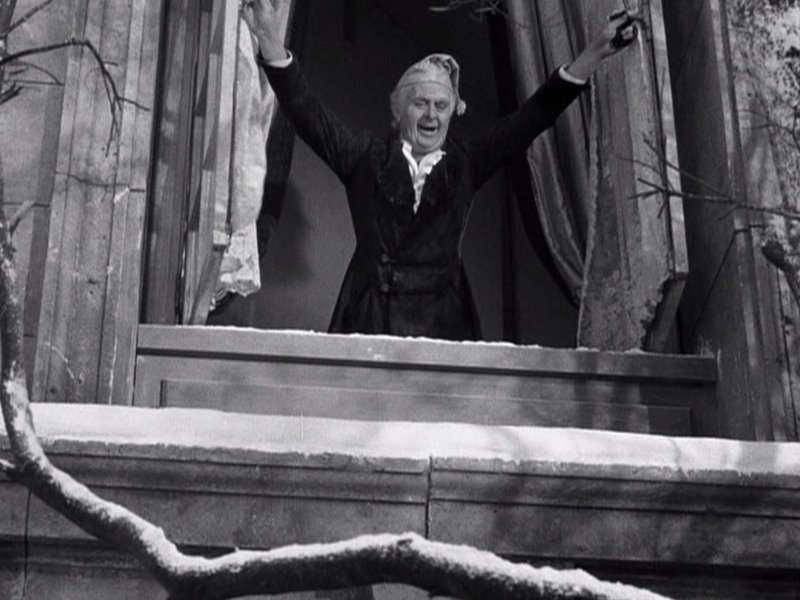
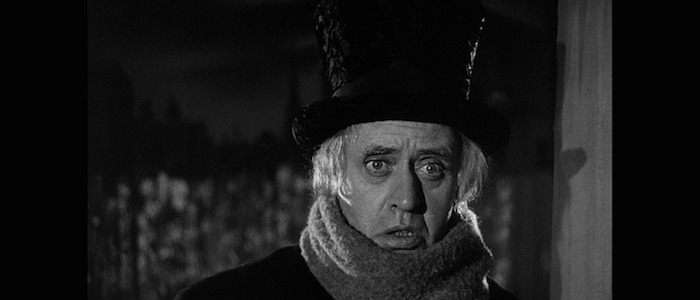
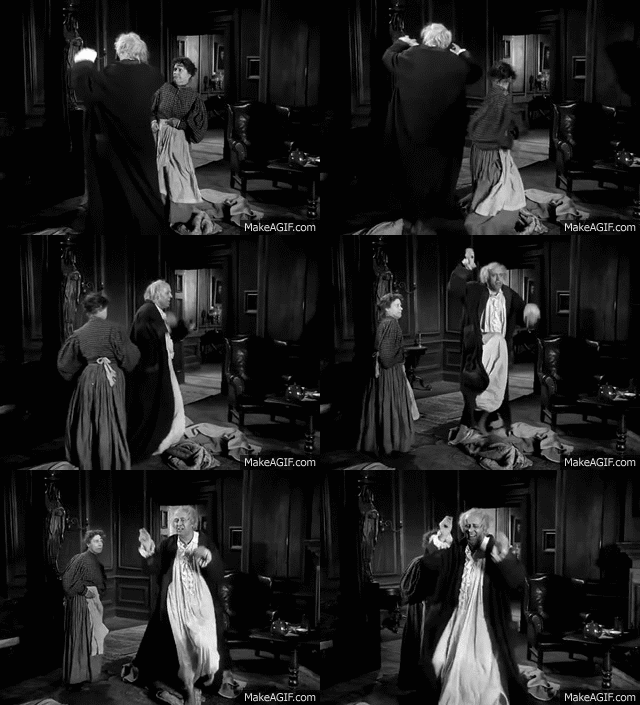
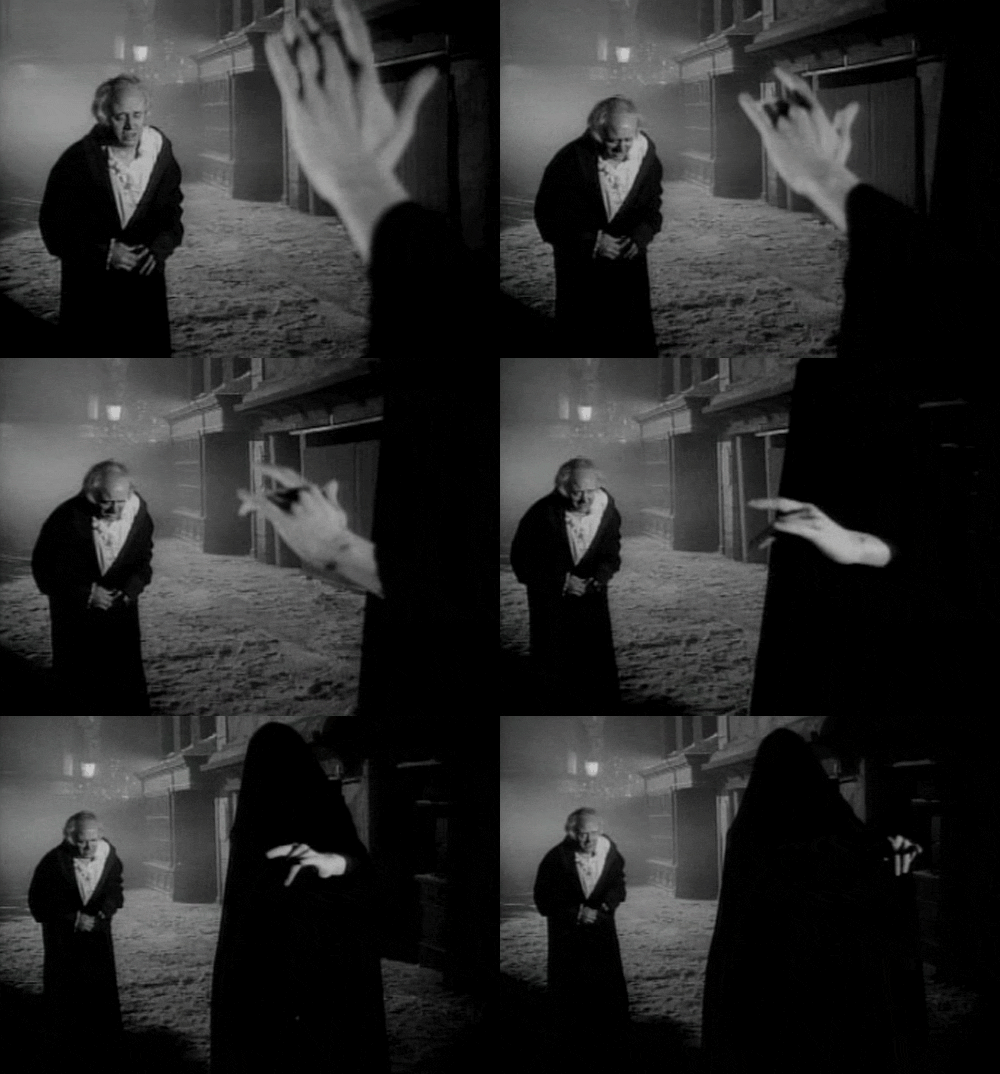
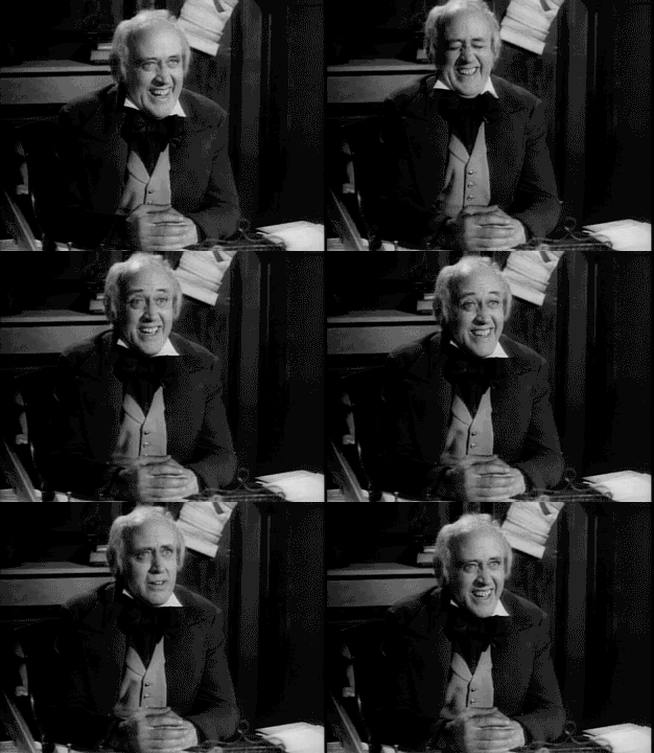
While the whole film is well made and true to the source in it's writing the focal point and the thing everybody remembers is always Alistair Sim's Scrooge. Sim brought a depth and complexity to the role. His Scrooge wasn't just crotchy, rude and cheap, he was cruel, cynical, arrogant and full of sheer disgust and revulsion for his fellow man, a true misanthrope. In the scene where he is seen signing Marley's death notice and inheriting his miserable estate has no actual dialogue or action other than the sneer on his face as the Spirit describes him as a miserable, grasping, covetous old miser but the sneer indeed tells us all we need to know about Scrooge's character. At the same time Sim manages to convey something else about Scrooge that wasn't made clear before. That he is also a frightened old man full of self-loathing. His Scrooge is self aware, he knows he is a bad person however much he may justify it, and so watching him learn (or relearn) how he got that way and what the consequences are make his redemption arc feel earned in a way previous efforts had not. The famous scene where at the end where Scrooge wakes up and is overjoyed at getting a second chance was criticized by some as being overly broad and indeed he does seem to be almost having a nervous breakdown but given the real depth of Sim's performance and after watching the film spend enough time to develop his Scrooge it does feel like an organic reaction. Perhaps more revealing and far more subtle is the scene where he arrives at his nephew's house for dinner and hesitates at the door, shoulders hunched with a look of his fear of rejection before being wordlessly encouraged by the maid. The entire scene is in fact worldless but has more emotional power beyond what may have been in the script.  
tumblr-7615f9fa0e83ea0f31472019a0c75af3-9c5a1fc2-500

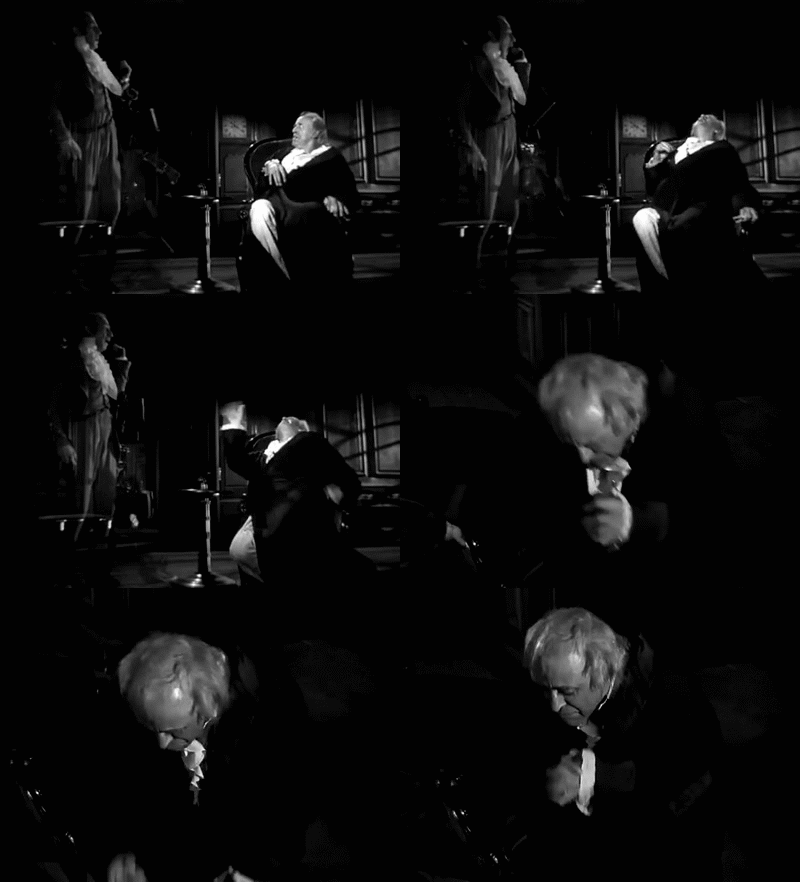
Besides Sim the rest of the cast was solid with Mervyn Jones also being the best Cratchit so far, certainly more believable than Gene Lockhart and with more depth than Donald Calthrop. Michael Hordern's Marley is more ghostly and anguished than Leo J Carroll in the 1938 version although he is helped by better special effects. One notable change from the Owen version is switching the Ghost of Christmas from a beautiful woman to a wizened old man. This is a lateral move but perhaps it ultimately better served the story to have the spirit be a remote figure rather than the lovely Ann Rutherford. Another change is the increased prominence given to Kathleen Harrison as Mrs Dilber the Charwoman. The role had existed in the Owen version but here she is given much more dialogue and Harrison plays off Sim well in his classic morning after scene. She is also excellent in the scene with Old Joe the Fence as is the rest of her partners in crime although this scene isn't as creepy and nightmarish as in the Dore influenced Hicks version it is more realistic. As a final note modern audiences will spot as young Marley Patrick Mcnee who would later go on to become John Steed in the classic 1960's spy series "The Avengers".      
tmI6o5

Sim was a Scottish actor who was previously best known as a comic actor but he seems to have been the filmmaker's first choice and this role would become his legacy. He would take much of the decade off as he was apparently somewhat typecast and seen as being something of a relic as tastes changed in modern British cinema. Sim was a private man who gave few interviews so if he had become somewhat resentful of being overshadowed by his creation as basil Rathbone had been about his Sherlock Holmes he never said so. In fact he would later reprise the role in an animated version in 1971 but that will have to wait for another year. He died in 1976.
icegif-1422

The Alistair Sim performance became instantly definitive in Britain but while it took longer for Americans to catch up once they did the 1951 production would become an annual Christmas tradition effectively discouraging any more large screen productions until 1970's musical production with Albert Finney and Alec Guinness. Instead for the rest of the 50's and 60's productions would be limited to TV.

TAYLOR HOLMES (1949);

giphy

Most of the various TV productions do not survive and included a 1947 starring John Carradine and his young son David and an even younger Eva Marie Saint as Cratchit children. Other versions were made as early as 1943 but like most if not all early TV shows they were done live and no copies were preserved with the oldest surviving version coming from 1949 in a short half hour version narrated by Vincent Price.

"THE CHRISTMAS CAROL" (1949);


Cast;
Narrator ~ Vincent Price
Taylor Holmes ~ Ebaneezer Scrooge
Pat White ~ Bob Cratchit
Nelson Leigh ~ Jacob Marley
Queenie Leonard ~ Mrs Cratchit
Jill St John ~ Bessie Cratchit

At only a half hour this version obviously skimps on the details and races through the story although unlike some longer versions it actually does include all the major characters. The cast of mostly no-names (aside from Price obviously) was probably obscure even then and would remain so. Taylor Holmes is the least intimidating Scrooge yet seeming merely cranky and the rest of the cast are similarly competent but bland and it's a shame they didn't just get Price to play Scrooge or at least Marley which would have added an interesting touch. The sets are also bland and lack character. This version could best be described as perfunctory. Aside from Price the best known actor here was Queenie Leonard who played Mrs Crachit, she was a veteran stage and cabaret star from Britain before moving to America and a long career in TV and doing voice work for Disney. She died in 2002. One of the Cratchit daughters was played by a young Jill St John, future starlet and Bond Girl then only nine and still under her real name of Jill Oppenheim, as of this writing she is still alive. Taylor Holmes died in 1959.
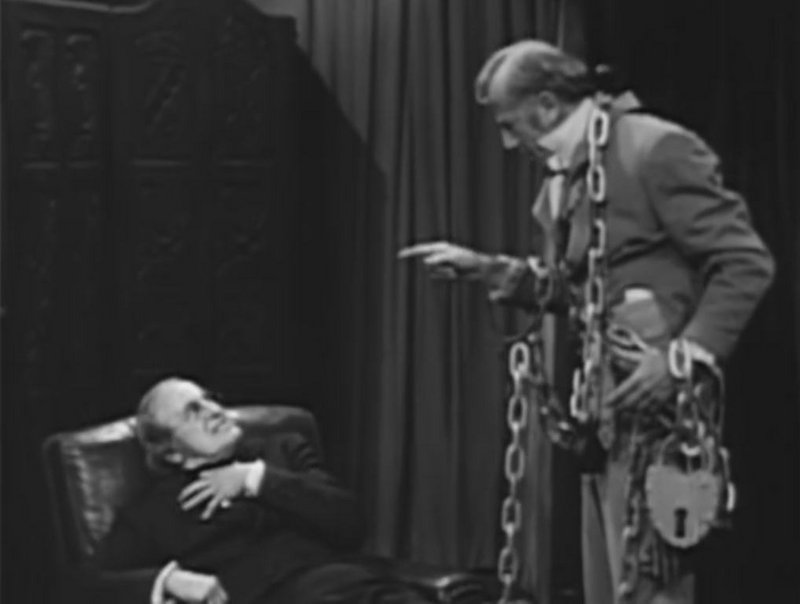
christmascarol49marley
TAYLOR HOLMES & NELSON LIEGH


FREDRICK MARCH (1954);


Directed by Ralph Levy
Cast;
Fredrick March ~ Ebaneezer Scrooge
Basil Rathbone ~ Jacob Marley
Bob Sweeney ~ Bob Cratchit
Fred Middleton ~ Nephew Fred Holliwell and the Ghost of Christmas Present
Sally Fraser ~ Belle and the Ghost of Christmas Past
Queenie Leonard ~ Mrs Cratchit
Bonnie Franklin ~ Susan Cratchit

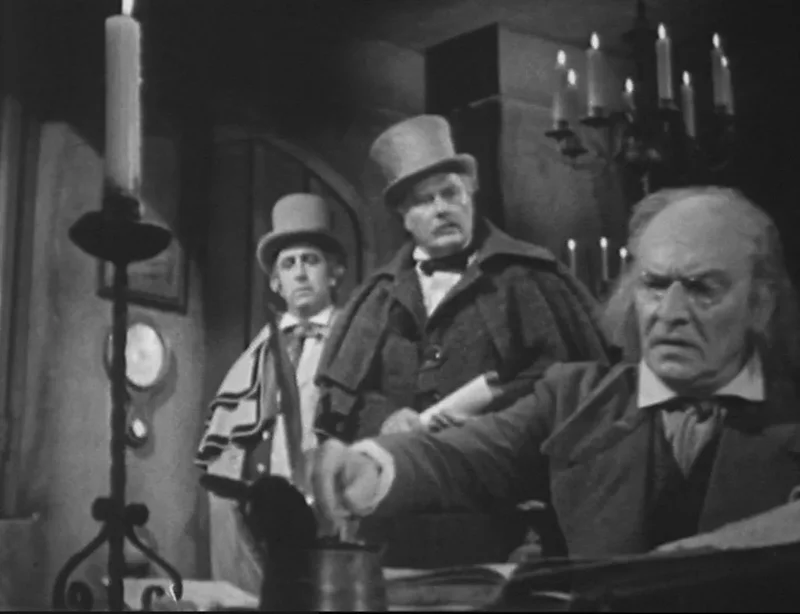
Part of an anthology series called "Shower Of Stars" which featured treatments of stories from a variety of sources ranging from contemporary melodramas to ghost stories and works of classical literature usually featuring a couple of stars from the big screen. It was originally broadcast in both black & white and colour versions but only the B&W version has survived. Unlike other TV treatments of the era it took a full hour and had a more suitable budget for sets allowing for a more cinematic look. This is partially a musical with several musical numbers mostly in the first half, these tend to the maudlin and overwrought and slow the proceedings down and affect the erratic pacing. At times there are scenes with more dialogue than other adaptations while others race along too abruptly particularly towards the end as if the filmmakers suddenly remembered they needed to wrap things up. There is not even a Ghost of Christmas Future instead having Scrooge visit a graveyard accompanied only by a cackling raven as he finds his own grave. The graveyard does have a spooky b-movie look and the other sets look authentic enough although without either the lushness of the Reginald Owen Hollywood production or the seedy grandeur of the Sim or Hicks versions. Fredrick March was by this point an established Hollywood star since the beginning of the sound era including appearing in "Dr Jekyll & Mr Hyde" (1931), "Death Takes A Holiday" (1934), "Les Miserables" (1935), "Anna Kerenina" (1935) and "A Star Is Born" (1937) and was certainly capable of playing a cantankerous old bastard and he effortlessly does so here although he doesn't have the larger-than-life quality of Alistar Sim. Perhaps to make the rather square jawed March look more like the classic image of Scrooge he is given a distractingly large fake nose.
fredric-march3
FREDRICK MARCH


Marley is played by Basil Rathbone, then even more famous from the iconic Sherlock Holmes series whose ghost is even more desparing than usual and also gets more dialogue. Given that this is at least partially a musical much of the rest of the cast were chosen for being singers rather than actors and are merely competent. This is true of the other Ghosts of Christmas Past and Present who also appear as Scrooge's past fiancee Belle and nephew Fred. Having some characters doing double duty as ghosts was unusual if not unique but has occasionally been done since notably in the 1979 American/Canadian TV adaptation by Henry Winkler, a 2004 TV musical starring Kelsey Grammer and a "WKRP" special episode with mixed results.
intangible
BASIL RATHBONE AS MARLEY

Another difference from most other but versions (with the notable exception of the Reginald Owen Hollywood version) the Ghost of Christmas past is played by a beautiful woman, here the tall blonde Sally Fraser, a TV actress better known from various B-Horror movies like "It Conquered The World" (1956), "Giant From The Unknown" (1958), "War Of The Colossal Beast" (1958) and "Earth Versus The Spider" (1958) and the TV anthology series "One Step Beyond". She retired by 1970 and lived until 2019. Mrs Cratchit was played again by Queenie Leonard returning from playing the same role in the 1949 Taylor Holmes version. Once again one of the Crachit daughters was played by a future star in Bonnie Franklin who would later star in the popular 1980's sitcom "One Day At A Time".

sally-fraser-beautiful-1950s-actress-by-slr1238-d9fj8ck-fullview
SALLY FRASER

BASIL RATHBONE (1956 & 1959);

Already an established star for his iconic portrayal of Sherlock Holmes in a series of films in the forties would play Scrooge twice becoming the second actor to play both Holmes and Scrooge after Reginald Owen. This first being a musical version.

"THE STINGIEST MAN IN TOWN" (1956);


Cast;
Basil Rathbone ~ Ebaneezer Scrooge
Martyn Green ~ Bob Cratchit
Robert Weede ~ Jacob Marley
Johnny Desmond ~ Nephew Fred
Ian Martin ~ Ghost of Christmas Past
Vic Damone ~ Young Scrooge
Patrice Munsel ~ Belle
Robert Wright ~ Ghost of Christmas Present
The Four Lads ~ Carolers

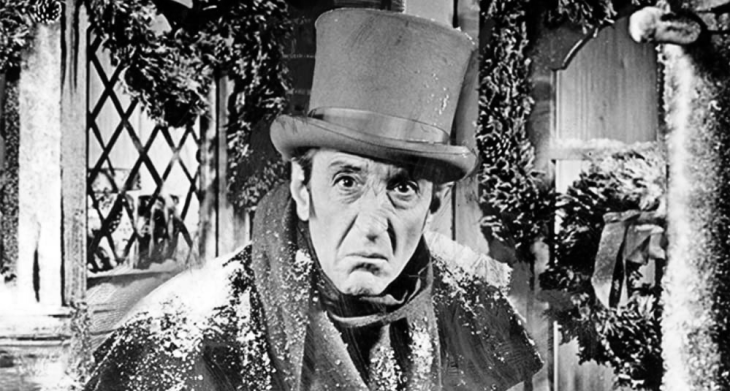
This is a musical version which is twice as long as previous TV versions, longer in fact than the film versions and a fairly major production by the standards of 1950's TV. Most of the cast are not surprisingly singers rather than actors with Vic Damone, Johnny Desmond and the Four Lads being Pop stars (but most definitely not Rock & Roll or Jazz) of the era. And then there's Basil Rathbone. Best known as the iconic version of Sherlock Holmes in the previous decade on both film and radio although by this time his career was in decline having been somewhat typecast as Holmes on the big screen he had retreated to TV and B-horror movies. He was still a respected figure and had previously played Marley so his casting made sense and he does indeed provide whatever heft this version has. It needs it too. The sings can be generously described as slight and forgettable ranging from sappy to histrionic styles that were already old hat and they often drag out the pace. Most of the performances are merely adequate aside from Rathbone who is too skilled an actor to simply phone it in. With his cadaverous face, fright wig hair and harsh, creaking voice he is the image of Dickens' Scrooge and he does a credible job although he can not match the depth of Alistair Sim. On the other hand while a skilled actor he clearly can not sing so it's fortunate that he is given few chances to do so.
Basil-Rathbone-Stingiest-Man-In-Town
BASIL RATHBONE AS SCROOGE

Given the restrictions of TV productions of the era this does a reasonably good job of working with the stagebound sets which are more detailed than previous TV versions. As for the story, although this version is twice the length of previous TV versions since most of that time is spent on extended musical numbers this does not mean that we really spend much greater time on the character's development. This can be seen in the scenes from Scrooge's past which are done as syrupy and over-wrought song and dance routines which lack the bitter-sweet mood the scene requires for Scrooge's future redemption to have real impact. The final scene at the graveyard with the Ghost Of Christmas Future discards the treacle ballads for an interpretive dance number which is rather spooky leading to Rathbone's emotional breakdown. Among the rest of the cast besides the singers sharp-eyed viewers will notice one of the Gentlemen from the beginning seeking a donation for charity is John McIver who would later show up in "Twilight Zone".  

    After the musical version Rathbone would finally get to play Scrooge again in a non-musical version, albeit another brief one.

"A CHRISTMAS CAROL" (1959);


Cast;
Fredrick March ~ Host & Narrator
Basil Rathbone ~ Ebaneezer Scrooge
Wilfred Fletcher ~ Jacob Marley
Bob Townley ~ Bob Cratchit
Walter Hudd ~ Ghost Of Christmas Past
Alexander Gauge ~ Ghost Of Christmas Present
Brian McDermont ~ Nephew Fred

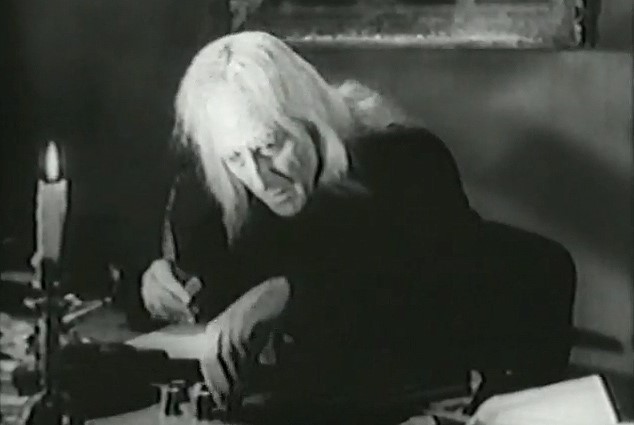
This was part of an anthology series hosted by Fredrick March who played Scrooge in the 1954 version and narrates here as Vincent Price had done previously. Once again this is another version that is too short and perfunctory to do more than a basic if credible job of telling the story, in fact it appears to basically be a restaging of the Taylor Holmes version from a decade earlier along with some scenes being lifted word-for-word from non-musical Rathbone version albeit with better sets and direction and a stronger cast. The Ghost of Christmas Future scene does show some more artistic directorial choices but given the abbreviated nature of this version it is too short to make much of an impression. Rathbone, whon had played Marley opposite March in 1954 is fine and could have easily done an effective Scrooge in a proper version as it is; he still ranks near the top in our survey of black and white Scrooges behind only Alistar Sim. Rathbone died in 1967 having been reduced to mostly playing in low budget drive-in theatre horror fare like "Tales Of Terror" (1962), "Voyage To A Prehistoric Planet" (1965), "The Ghost In The Invisible Bikini" (1966) and "Hillbillies In A Haunted House" (1967). Fredrich March had better luck, appearing in prestige films like "Inherit The Wind" (1960) and "Twelve Days In May" (1964) dying in 1975.
chris-carol-rathbone
BASIL RATHBONE

STERLING HAYDEN (1969);

The last major black & white Scrooge production would come from some high powered names including Joseph Mankiewicz and Rod Serling and star an impressive cast.

"A MODERN CHRISTMAS CAROL" (1965);


Directed by Joseph Mankiewicz Cast;
Sterling Hayden  ~  Daniel Grudge
Ben Gazzara ~ Nephew Fred
Steve Lawrence  ~  Ghost Of Christmas Past
Pat Hingle  ~  Ghost Of Christmas Present
Robert Shaw  ~  Ghost Of Christmas Future
Peter Sellers ~ The Imperial Me
Percy Rodriquez ~ Charles the Butler
Eva Marie Saint ~ Navy Nurse Lt Gibson
James Shigeta ~ Doctor
Britt Ekland ~ Mother
Peter Fonda ~ Marley Grudge

Written by Rod Serling this version updates the Dickens story into a modern America to present a different political story focusing on anti-war. Serling was of course an innovative and thoughtful writer however he could be overly wordy and at times preachy. In the context of the half hour "Twilight Zone" episodes these urges were usually kept in check but given ninety minutes to play with (that's actually longer than any previous version) and under the direction of the the equally intense Mankiewicz he is allowed to let his typewriter work overtime and the results are more like a dour and angry sermon than even Dickens himself allowed.

In this version Scrooge, renamed as Dan Grudge and played by Sterling Hayden, is a millionaire who is grieving the loss of his son in war and has turned his back on humanity becoming a belligerent Cold War isolationism motivated more by fear and bitterness rather than Scrooge's greed. The various Ghosts show Scrooge, I mean Grudge, the results of war and isolationism and lecture him on his selfishness. And I do mean lecture. Each visit is an extended hectoring monologue which drag on without any of the quirky touches Serling was known for. There are a few scenes creatively shot but the whole show is dour and slow moving. There is an impressive cast including Ben Gazzara as Grudge's nephew, Robert Shaw as the Ghost of Christmas Future, Pat Hingle (best known from Clint Eastwood movies) at the Ghost of Christmas Present, Steve Lawrence (best known as a singer) as the Ghost of Christmas Past along with Eva Marie Saint ("The Manchurian Candidate"), James Shigeta ("The Flower Drum Song" and a later Christmas classic, "Die Hard") Peter Sellers and a cameo from Sellers then wife Britt Eckland. Unlike most versions this is very talky and so Shaw's Ghost gets to make his own speeches with which his cold, clipped, accent gives added bite.
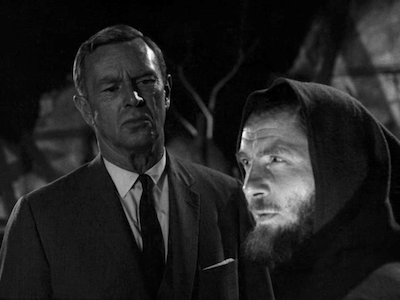
carol-for-another-christmas-crop
STERLING HAYDEN AS GRUDGE & ROBERT SHAW AS THE GHOST OF XMAS FUTURE

Hayden is fine as Grudge although lacking the depth of Sim's Scrooge or even Owen. Hayden and Sellers were fresh off appearing together in "Dr Stangeglove" and while Hayden is more understated than his character in that film Sellers is typically over-the-top in a scenery chewing which has no comparable character in the traditional story, or any other. While this version is longer than previous versions and far more dialogue heavy it is shallower as we don't actually see any of Grudge's past or evolution and the characters lack depth being instead stock archetypes who declaim somber lectures so there is no real connection with the viewer. Even the ending is thoughtful and understated rather than joyous so Hayden does not get a version of Sim's giddy Christmas Day speech. Long as this is it was originally even longer as Grudge's son was played by Peter Fonda but he was cut out of most of the finished product and so only appears as a ghostly image and in a large painting. Other actors reportedly cast but dropped or cut out were Christopher Plummer and Richard Harris. Sterling Hayden had already starred in Stanley Kubrick's first important film "The Killing" (1956) and would later appear in "The Godfather". He died in 1986. Eva Marie Saint had made her debut in the lost 1947 TV version with John Carradine and as of this writing is still living (at 99 years old!) as is Britt Eckland.
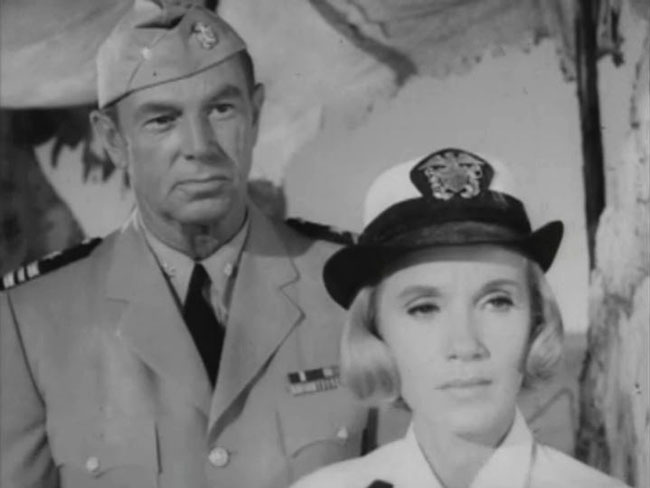
Carol-for-Another-Christmas-4
STERLING HAYDEN & EVA MARIE SAINT

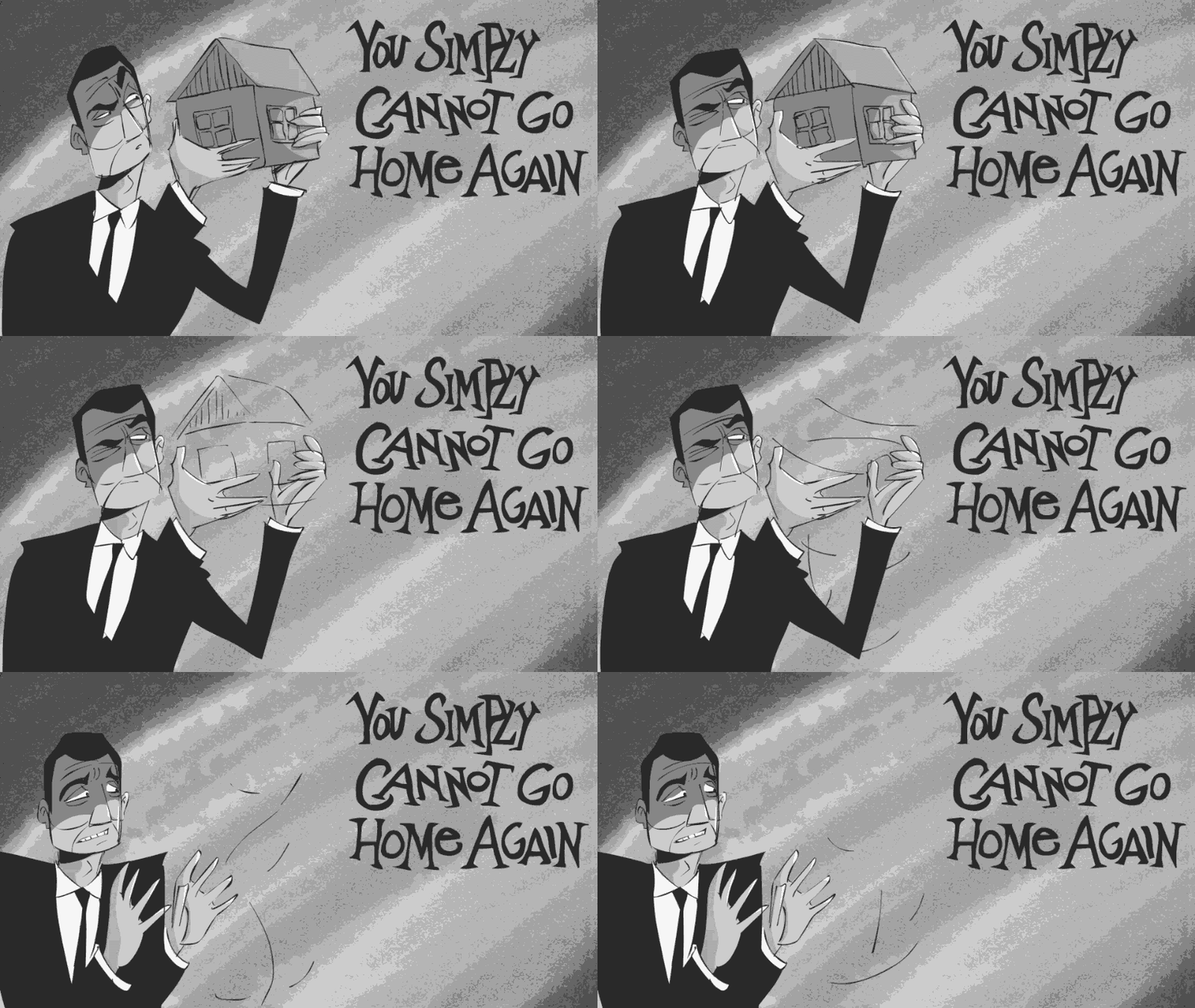
This is typically stagebound but unlike the earlier TV entries there is some creative camera work and innovative set design. There is also a solid musical soundtrack from Henry Manicini including a guest appearance from the Andrews Sisters. In future years there would be other attempts to update the Scrooge story including versions starring Henry Winkler, Bill Murray and the cast of WKRP all of which, whatever their shortcomings, are more watchable and certainly more entertaining than this dour, hectoring sermon which however sincere and well meaning does not show Rod Serling at his best and lacks the sense of humour he was certainly capable of instead replacing Dickens' more maudlin excesses with his own. This version was in fact originally planned as a political broadside during the 1964 Presidential election promoting the work of the United Nations and taking pointed swipes at the Vietnam War, segregation and GOP candidate Barry Goldwater for his isolationism and sabre rattling rhetoric in the however reportedly the ABC censors insisted on making cuts and toning down some of the dialogue for fear of offending the GOP. The entire cast felt strongly enough about the project that they each took substantial pay cuts to appear (including the prickly Sellers who was also coming off a serious heart attack) however the show received poor reviews and after airing was shelved for the next fifty years when it was rediscovered and aired again on TCM and released on DVD.  
Y2Ax
ROD SERLING


THE FOUR LADS

Friday, 24 June 2022

The Eve Of Destruction pt.2; Death From Above


"And I saw, and beheld a white horse: and he that sat on him had a bow; and a crown was given unto him: and he went forth conquering, and to conquer. And there went out another horse that was red: and power was given to him that sat thereon to take peace from the earth, and that they should kill one another: and there was given unto him a great sword. And I beheld, and lo a black horse; and he that sat on him had a pair of balances in his hand. And I looked, and behold a pale horse: and his name that sat on him was Death, and Hell followed with him." (John The Revelator; Revelations 6:8)

++++++++++++++++++++++++++++++++++++++++++++++
Last month I wrote about a number of post-nuclear apocalypse films of the Cold War era so this month I thought I'd continue the theme looking at some other post-apocalypse films, however this time the end is not man-made but comes from space. By this I mean natural occurring disasters like a meteor or comet of the type that wiped out the dinosaurs or some sort of similar nature based strike. Thus these films purport to keep just this side of reality and more-or-less scientific facts rather than the sort of fantastic alien invasion (such as HG Wells "War Of The Worlds") or religious themed films like any number of Noah's Ark films or somewhat related natural disaster films like the various versions of "Last Days Of Pompeii". However it is worth taking a quick look at a couple of these early Ark and Pompeii films to see how they handled the visuals of mass destruction even if the theme of the Ark myth is not more-or-less science based.

++++++++++++++++++++++++++++++++++++++++++++
OqN

The first real film epics came from Italy in a series of films based on classical themes; Dante's "Inferno", "Cabria", "Ben Hur", "Quo Vadis" and "Last Days Of Pompeii". These films with their then extended running times of an hour or more, large casts of extras and impressive sets caused a sensation when shown in Europe and America where they played not in the usual movie houses but in large theatres with high priced tickets to well-heeled, cultured audiences who were impressed with their pretentious scale and mythical themes. They would inspire later large scale epic films from the likes of DW Griffith, DeMille, Eisenstein, Fritz Lang and Abel Gance. That does not mean these were actually good films though. Influenced as much by opera than films or even plays they were slow, ponderous, pompous, with cliche writing, pedestrian editing, completely static camera work that consisted of simply shooting full length shots with few closeups, stage-bound sets and acting that consisted of standing around posing, making faces and gesticulating wildly, these films were in not really advanced from "The Great Train Robbery" except in size and artistic pretense. Of these films only "L'Inferno" is still watchable and that's strictly for it's still spectacular sets and effects. The Italian film industry's brief time as a film heavyweight would only last a few years as they would soon be overtaken by more imginative filmmakers from America, France, Russia, Scandinavia and later Germany.

"LAST DAYS OF POMPEII" (1908);


One of the first of the Italian Classical Proto-Epics was "Last Days Of Pompeii" directed by Ambrosio in 1908 and based on a 1834  British novel. The story has little to do with the actual eruption of the volcano and instead is a complicated soap opera about a lovers' triangle, competing religions with plenty of togas, parties, swordplay until Mt Vesuvius erupts and some of the characters manage to flee. The movie is full of the usual dramatic posing and over-acting and with the climactic eruption consisting of lots of smoke and extras running back and forth while paper mache columns fall on them. Given the techniques of the day it's about what one would expect and does tell a coherent story albeit done on a slightly larger scale and sense of importance than an American film of the time would have done but it would soon be surpassed. The film is actually only a one reel short and thus not really an epic but it was successful enough to encourage the slew of full length Italian epics to follow soon after. This was actually the second film adaptation with the first being a now lost 1900 British version which is no doubt even shorter and more stage-bound and crude but it would be interesting to see how they handled the explosion. Director Ambrosio would make several movies including "Quo Vadis" (1924) one of the last of the massive Italian epics, the failure of which was a disaster for the Italian film industry and ended his career. "Last Days Of Pompeii" would be remade four more times during the silent era, all in Italy and several more times in the sound era. The slow moving full length version which survives actually spends even less time on the eruption scene in spite of being three times as long and is of no interest to us.

+++++++++++++++++++++++++++++++++++++++++++++++  

"THE DELUGE" (1911);


This was an American film dealing with Noah's Ark and it thankfully limits itself to the flood and eliminates all the long run-up plot about the burning bush and building the thing so we get to the action fairly quickly. This is actually quite well done for 1911, an era known for static camera work, stodgy editing and cheap stage sets. Here we get a few more camera angles then the usual full-length group shots and even some good closeups. Unlike other films of the era that feature a crowd of panicky extras running around wildly waving their arms about and making faces, these ones are actually well filmed and directed and look realistic trudging through the downpour. These are effectively intercut with closeup shots of some sort of clan leader's face as sits on his throne like King Canute and realizes the flood waters are not going to stop and another character, clearly the local bully, who at first tries to laugh away the rain then we see his smirk turn to fear as the waters rise. We get some good shots of hapless peasants clinging to rocks and trees as torrents of water wash over them. The Ark itself is convincingly massive and looks realistic enough. Oddly we see more of the flood's victims than we get of Noah who doesn't really show up until three quarters of the way in and we barely see his family at all. Noah looks suitably haggard but he's just not as interesting as the Clan Chief or Bully.

This film is something of a mystery and there are few details about this film other than it being made by Vitagraph Studios with the cast and director being unknown. Vitagraph made a disaster film "The Juggernaut", a 1915 serial directed by Ralph Ince (brother of respected western director Thomas Ince), which was noted for its spectacular scene of a train crashing over a bridge and into a river so it's possible he directed this film. It's also possible this surviving film was edited down from a longer version which would explain why we get so little of Noah and no real introduction. The opening credits list not Vitagraph but an obscure Exclusive Movie Studios who probably bought the rights to distribute a version which they then edited down and added the intertitles which take pains to claim the factual truth of the Biblical account. The opening credits have an art deco look which looks more like something from the 1930's rather than 1911 and must have been added several years later when Exclusive bought the distribution rights. There would still have been a market for such a film to show for church groups well into the sound era.

+++++++++++++++++++++++++++++++++++++

  "THE END OF THE WORLD" (1916);

Directed by Otto Rung
Cast;
Frank Stoll  ~  Olaf Fonns
Manager West  ~  Carl Lauritzen
Dina West  ~  Ebba Thomsen
Edith West  ~  Johanne Fritz-Peterson
First Mate Reymers  ~  Alf Blutecher
Worker Flint  ~  Thorleif Lund
The Preacher  ~  Fredrick Jacobsen
Professor Wiseman  ~  K Zimmerman
Plot Synopsis (spoiler alert);
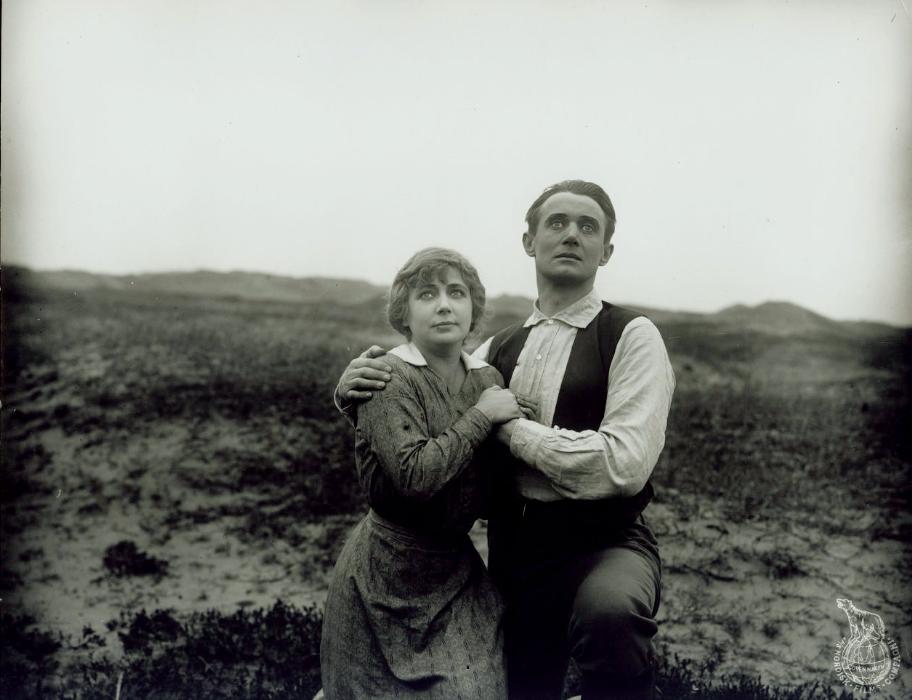
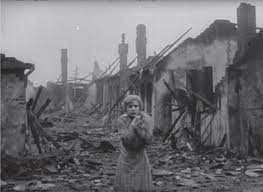
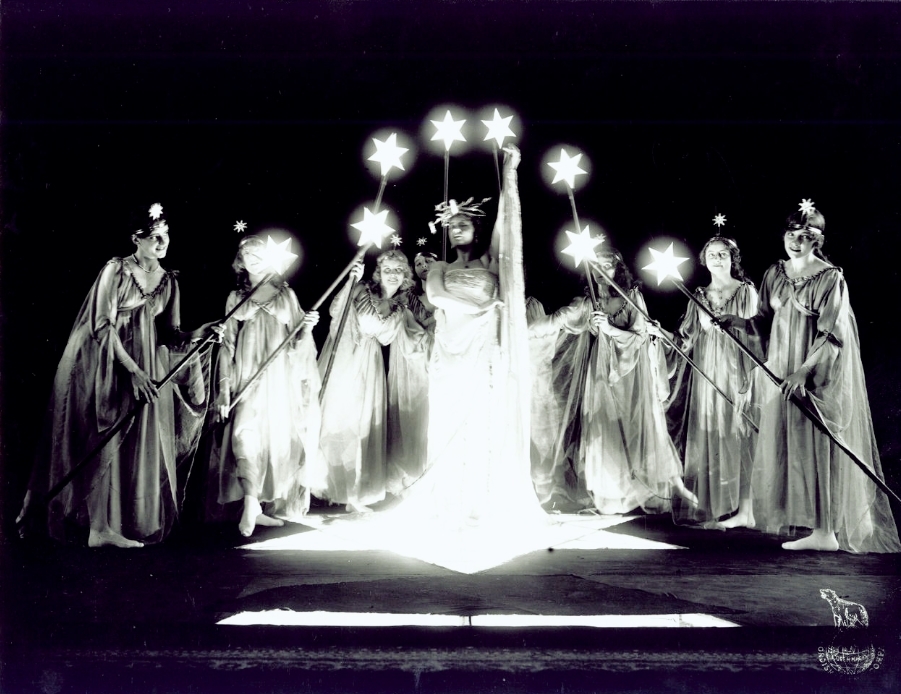
Dina & Edith West are sisters living in a mining town. Their father is the mine manager and the owner is Frank Stoll who is in town inspecting the mine. Also visiting town is a Preacher. Dina is engaged to Flint, a worker at the mine. The sisters and Flint go to a dance where Frank Stoll sees them and asks Dina to dance with him and she agrees to the annoyance of Flint. Meanwhile Edith meets her boyfriend Reymers, a ship's officer. Frank asks Dina to return to the capital with him and she says she will consider it. When she returns home Flint and her father are waiting and they confront her with her father denouncing her as a "harlot". Angry, she decides to leave with Frank. Flint, who has been following her, sees this and confronts them leading to a fight where Frank strikes him and they leave. Fast forward a few years later Frank and Dina are married and living in the capital where he has become wealthy by playing the stock market. Dina has become bored and spoiled. Frank's cousin, Professor Wiseman, an astronomer discovers a new comet which he calculates will enter the Earth's atmosphere. He explains his fears to the Astronomical Society who inform the press. The news causes a run on the stock market which Frank exploits buying up cheap stocks dismissing the fears about the comet. Frank returns to the town where he says he has some more business, he will take Dina although she fears being confronted by her father. Meanwhile Reymers has passed his First Mate exam. News of the comet, which can now be seen distantly in the sky, reaches the town. The Preacher declares it is God's punishment. Edith and Reymers discuss marriage. As the Astronomical Society debates, Frank asks Wisemen to send him inside information on the discussions. The Society figures that the comet will cause catastrophic damage, particularly to Northern Europe but decides to avoid a panic and not to inform the press. Wiseman is opposed to the news blackout and privately informs Frank of this. Frank plots with a newspaper editor to keep the public in the dark in order to prevent another run on the market. The paper puts out a story reassuring the public which calms the market allowing Frank to sell his shares at a profit. Wiseman becomes aware of Frank's plotting and confronts him but Frank is dismissive. With the comet now more visible in the sky Frank decides to return to the town before his scheming is discovered. Back in the town he is telling people to repent while Reymers head off to sea. Frank and Dina arrive in town. Flint has become a leader of the miners and rouses them to attack Frank outside her father's home. As they do Edith urges her Father and the Preacher to intervene but instead he denounces her for disgracing the family name. The police arrive and arrest Flint and Frank and Dina manage to escape and drive off to his mansion. The comet has become larger in the sky and Frank begins to worry. Hidden under his mansion is a secret passage leading to an old mine shaft where he believes they can take shelter. The Father dies of a heart attack. As Wiseman is tracking the comet, Frank throws a party for his wealthy friends and the Preacher delivers a sermon urging all to prepare for the end. Frank is dismissive and the party becomes more rowdy and decadent with dancing girls performing as comet particles begin to rain down. Flint is in jail and sees the comet's damage start and he breaks out of jail. Returning to town he riles up the workers to take revenge on the wealthy and attack Frank's mansion where the party is going on. The rioters break into the police station and arm themselves before storming Frank's mansion where the party guests barricade themselves in the ballroom and also arm themselves and a gun battle erupts. In the resulting chaos many die and Frank takes Dina and escapes into the hidden mine tunnels. Flint discovers the secret door and follows them as the mansion catches fire. Meanwhile Reymers aboard his ship sees the meteorite shower and returns to port. Wiseman is still at the observatory monitoring the comet when it is struck and destroyed. In the town there is panic as buildings catch fire and buildings collapse. Down in the mine poisonous gas is released killing Dina, Flint and Frank. Edith hides in her house while Reymers struggles to guide his ship home through the storms. As the town burns a tidal wave sweeps in and Edith is trapped. At sea Reymers ship is sunk and he escapes in a lifeboat. The Preacher has also somehow survived and rows out to Edith's home which is now flooded out and rescues her, taking her to a cave along the shore where she passes out and the Preacher leaves her to sleep. The next morning she ventures out to find the town abandoned and in ruins. Reymers, alone at sea, makes it to shore and heads home. The one building left intact is a church where Edith breaks in and begins ringing the church bell. Reymers hears the bell and goes to the church where they are reunited. Finis.

MV5-BZDlj-MGU5-NGMt-YTYy-NS00-OWI4-LWJk-OTMt-MDYw-OWI0-Mzc4-ZDli-Xk-Ey-Xk-Fqc-Gde-QXVy-NDEz-MTI3-MTU-V1
++++++++++++++++++++++++++++++++++

This 1916 Danish film reached an international audience at the time but has been forgotten about which is kind of a shame as it's probably the first film to deal with the concept of the Apocalypse apart from a few Christian films. The threat here comes from space in the form of a comet which is essentially what wiped out the dinosaurs although that was not a commonly known theory at the time. The choice of a comet as the agent of destruction likely came instead from a more recent astrological event. In 1910 Halley's Comet made its highly visible pass by the Earth, an event that happens roughly every 75 years. Halley's Comet had inspired a whole set of myths and superstitions for centuries. Halley's Comet made an appearance before William The Conqueror invaded Britain in 1066 and was seen as an omen by the Saxons but by the Normans as proof God was with them (omens seem to be rather random in how they are interpreted), it even turns up in the Bayeux Tapestry. Another appearance in 1301 was seen as an inspiration by Genghis Kahn and an omen by the Christians while yet another in 1456 was yet another omen for Christians as the Ottoman Turks invaded Hungary. By 1910 omens were a bit old fashioned but Mark Twain, who had been born during the Comet's passing in 1835 had predicted in 1909 that the next time the Comet passed by he would die and famously he in fact died the day after the Comet's appearance. In fact 1910 actually saw not one but two comets as a different comet known as the Daylight Comet also zoomed past some months earlier, both being highly visible. While most people no longer placed much faith in omens some Christian sects did with the Millennialist sects like the Adventists and Jehovah's Witnesses seeing the Comet as a sign of the End Times, a belief soon bolstered by the start of World War One.

images

It's easy to forget now, after two world wars and the constant threat of nuclear winter, how traumatic the Great war was to those who lived through it. There had been a generation of relative peace (aside from various colonial wars of course) and it was assumed that advances in modern technology and attitudes would make future wars short if not obsolete so the mass slaughter of the trenches, mechanized warfare, poison gas, organized genocide, a global pandemic, lagre scale famines in Russian and China and revolutions that toppled ancient monarchies in Tsarist Russia, Imperial Germany, Hapsburg Austria-Hungary, Ottoman Turkey plus Manchu China deeply affected and shook the beliefs of a generation seeming to some to prestage the end of the world itself. In 1916 some of these events had not quite happened yet and Denmark was a neutral country and not directly affected but they could hardly be unaffected by events next door nor could the other Europeans who saw the film as an import and would have understood the films quasi-religious and (less quasi) anti-capitalist themes.  

MV5-BYTIy-Y2-Vm-YTIt-NDg2-My00-OGZi-LWE2-Zm-Mt-Mm-Y4-NTQ5-Mz-Fj-MDdj-Xk-Ey-Xk-Fqc-Gde-QXVy-NDEz-MTI3-MTU-V1
END OF THE WORLD BALL

Like many post apocalypse films it's only somewhat about the end of the world with the bulk of it's plot being morality plays focussing on the sisters with the good (blonde haired of course) sister staying home with her apparently chaste boyfriend while the bad (dark haired) sister defies their strict father and runs off to the big city to live a life of luxury and decadence with the greedy Frank Stoll. No prizes for guessing which one survives. The film oddly seems to undermine it's premise by having Dina's jilted fiancee, Flint, be such a jealous, possessive, vengeful and violent rabble-rouser however. Frank by contrast, while he is greedy, arrogant, unscrupulous and reckless, is also loyal and devoted to Dina as the film takes pains to point out and the viewer would have to grudgingly have to admit that she would made the right call in leaving behind her thuggish boyfriend and judgemental martinet of a father to run off to the big city with the wealthy and doting Frank. If it were not for the whole comet thing of course. The character of Frank does not really serve as a lecherous rake however but instead represents capitalism at it's most predatory and careless as he takes advantage of the panic to manipulate the stock market then attempts to save himself and Dina by holing up in his hidden tunnels placing him the world of movie villains somewhere between the Mayor in "Jaws" and Paul Rieser's character in "Aliens". His plot also seems a little short sighted in that even if he is successful in riding out the rain of fire in his caverns it's hard to see how his ill-gotten gains will be worth much in the resulting scorched Hellscape even assuming there are survivors. His throwing of a last party makes even less sense and seems instead to give the angry mob something to attack and also serves as a reference to Edgar Allan Poe's "Masque Of The Red Death"  in which the decadent wealthy throw a lavish party while a plague rampages through the countryside. We actually spend far less time getting to know the heroes of the film, Edith and Reymers who are by comparison blandly virtuous and who end up as Adam and Eve figures albeit with no Garden Of Eden. To further stress the religious theme is the Preacher who is more of a Casandra figure from Homer's "Odyssey" who is right about the coming end but whose warnings are largely ignored although he does rescue Edith at the end before conveniently disappearing so Edith and Reymers can be lone survivors. Presumably he'll come back at some point to marry them so they won't be living in sin in this scorched earth Eden.

end-of-the-world

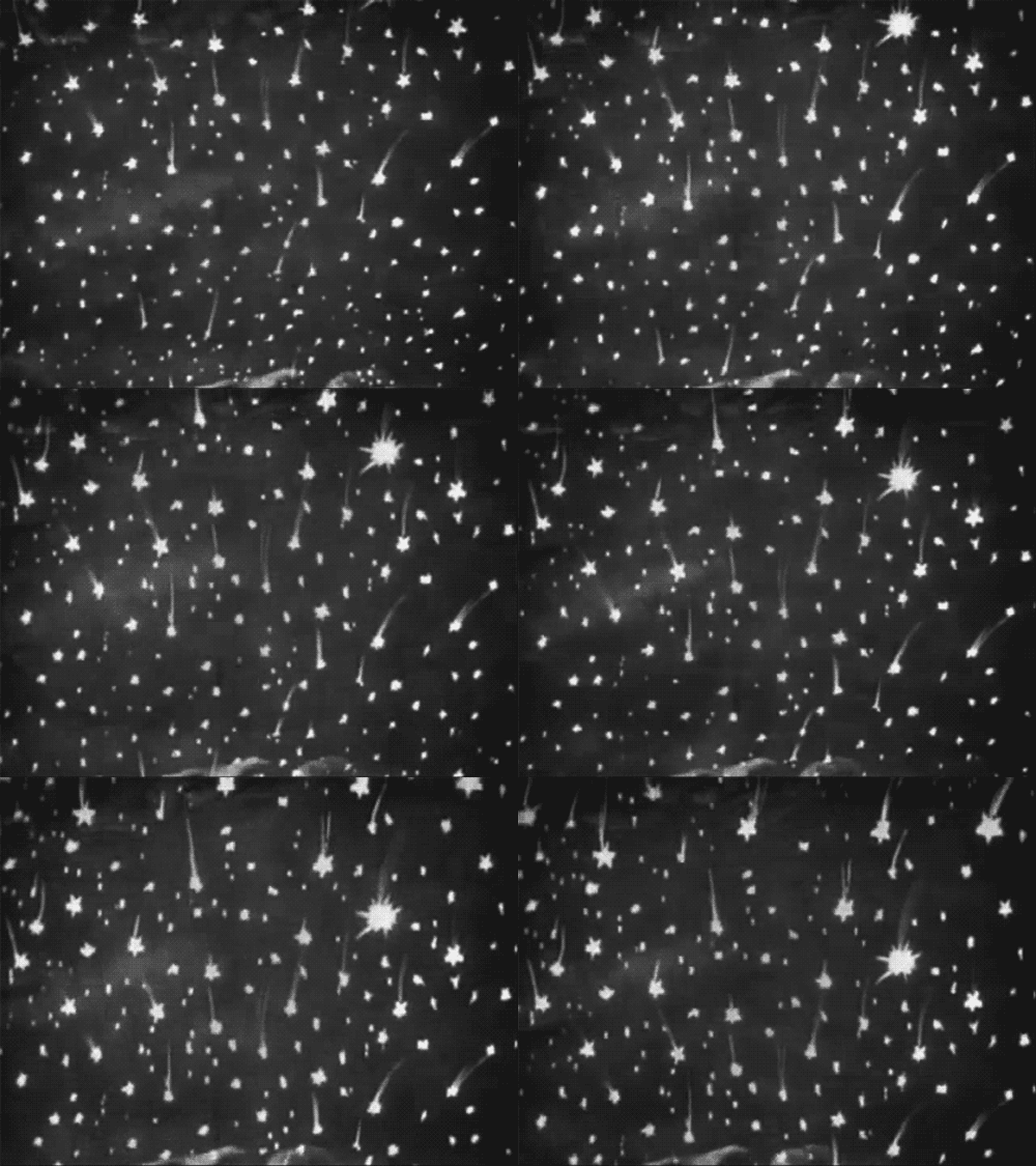
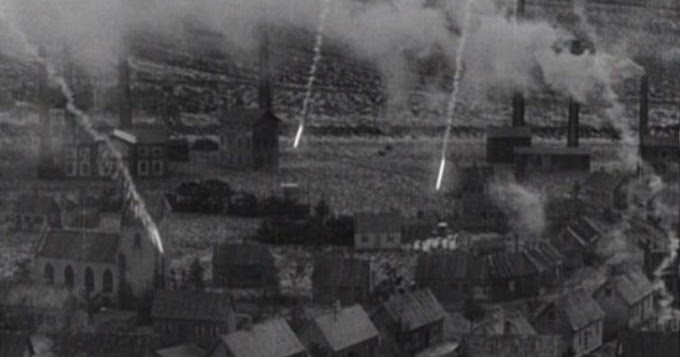
In the film the comet appears to breakup in the atmosphere and comes down in the form of smaller flaming fragments and I frankly don't know enough about science type stuff to know who realistic that is but the film does a pretty good job within the constraints of what was probably not a huge budget of showing the destruction of the mining town. Aside from some scenes set in the capital city the film spends its time in the mining town along with a couple scenes on board Reymer's ship which is probably also a product of a somewhat limited wartime budget and allows the filmmakers to avoid having to arrange for the destruction of an entire city full of hundreds of extras. This makes the film seem more insular than a film about the literal end of the world should be but as we shall see this will not be uncommon in post apocalypse films. As it is, the final rain of death from above is rather effective and the final scenes of Edith staggering through the smoking ruins of the town are effective. Having the destructive force come in the form of a comet leads to several scenes where the comet can clearly be seen in the night sky. The far away comet looks like one of George Melies creations but it does gain a certain menace as it appears to be getting slowly larger. For all its limitations this film does have a more effective portrayal of mass destruction than the closest comparisons namely the various versions of Noah's Ark of the "Last Days Of Pompeii" and it's easy to see how contemporary audiences would have been impressed.

The film's director August Blom was a well known figure in Danish film and had also made another important disaster film with "Atlantis" in 1913 which was inspired by the sinking of the Titanic and which has recently been rediscovered and noted for its realism and epic scale. He made several dozen films in Denmark (including a lost 1910 version of "Dr Jekyll & Mr Hyde") to considerable acclaim but after the Great War unlike some other figures of Scandinavian film like Asta Neilsen, Greta Garbo, Urban Gad and Viking Eggeling he did not leave to seek opportunities in Germany as the domestic industry slumped and instead retired from film after 1924 to manage a theatre company until his death in 1947 aged 77. Of the cast Olaf Fonns (Frank Stoll) had also appeared in Bolm's "Atlantis" but he did move to Germany where he made dozens of films including an influential early horror film "Homunculus" (1916) of which a portion remains. The opposite of Frank Stoll he was an active supporter of the Social Democratic Party and fled Germany after the Nazis siezed power and returned to Denmark where he served as the President of the Actors Union and on the national Film Censor Boad until his death in 1947. Ebba Thomsen (Dina), Carl Lauritsen (Father West) and Fredrick Jacobsen (The Preacher) had also appeared in Atlantis and like the rest of the cast had extensive careers in Denmark, some into the sound era.

+++++++++++++++++++++++++++++++++++++

"FIN LA MONDE" (1931);

In the aftermath of the Great War and pandemic the theme of mass extinction seems to have lost its allure as a film topic. This may have helped by the spectacular failure of another round of big budget versions of Noah's Ark and Pompeii films in America and Italy in the 1920's followed by one more big budget appocalypse movie in the early sound era, this time from Abel Gance, the French director of the 1927 epic "Napoleon". 1931's "Fin Le Monde" ("End Of The World") would use much the same plot as the 1916 Danish film although this version would have an even more complicated plot;

images_(2)

The film opens on an extended scene of Jesus being crucified. As the camera pans out we learn that this is actually a play and Jesus is being played by actor Jean Novalic (played by director Abel Gance). Isabelle Bolin attends with her boyfriend, stock promoter Schomburg (Samson Fainsilber) who is in turn attracted by the blonde actress playing Mary Magdalene, Genevieve de Murcie (Colette Darfeuil). Genevieve is in turn in love with Novalic who she wishes to marry but her scientist father Monsieur de Murcie (Jean D'Yd) prohibits any marriage. He is jealous of Novalic's father, and rival astronomer Martial Novalic (Victor Francen) and accepts money from Schomburg to build an observatory better than Novalic's. Schomburg then announces his intention to court de Murcie's daughter.
Walking home Jean aids a young woman being beaten by her father, who accuses Jean of rape rousing a mob who stone him critically wounding him with a blow to the head leaving him hospitalized. Schomburg accompanies Genevieve to a fancy party, but takes her back to her apartment and rapes her. In his observatory, Martial determines that Lexell's Comet is on a collision course with Earth. Jean predicts a coming apocalypse and claims that the cataclysm has arrived to "save the hearts of man". Martial confides to his colleagues that the comet will strike in 114 days. After Jean is taken to an asylum, Martial and Genevieve listen to his phonographs, where he has left a message which instruct Genevieve to abandon her worldly life and help Martial inaugurate a new world government. Jean's voice tells them they must marry and become the shepherd and shepherdess of humanity. Genevieve has visions Jean as Christ.

download_(2)
ABEL GANCE

With 92 days left, Schomburg has been playing the stockmarket and invests heavily in armaments, while Martial goes to the rich Werster and tells him that the world will end. Werster deals with Schomburg and gives Martial money to buy a newspaper and a broadcast station which they use to surpress information about the comet. Genevieve has remained single, but helps to organize Radio Martial Novalic's broadcasts of peace bulletins. Martial's confederates jam official radio news, blocking warnings that war mobilization is imminent and issue warnings about the Comet and coming end of the world. Stock markets plunge around the globe, but Schomburg continues to buy. De Murcie and Schomburg accuse Novalic of kidnapping Genevieve and using the comet as a hoax to destroy the economy. A government minister orders the exchanges closed and the arrest of Martial and Werster. But Martial's agents learn of the arrest warrant with a hidden microphone. The newspaper is confiscated and the radio station destroyed, but Martial and Werster escape.
The government hides the truth, which allows the stock markets to recover. Schomberg holds a party the very night Martial claims that the comet will become visible. Schomberg tells gangsters he will pay a million francs if Martial and Werster are found dead before morning. Genevieve returns to her father and joins Schomburg in the garden; the jealous Isabelle runs to warn Martial Novalic. At the party, the comet comes into sight. Isabelle helps Martial escape and learns that war mobilization will soon be announced. He and Werster rush to destroy the government's radio antenna in the Eiffel Tower tracked by agents of Schomberg who also races to the tower. Genevieve tips off Martial by telephone that Schomburg and his killers are ascending in an elevator. Werster warns Genevieve to stay on the ground and uses a cutting torch to sever the elevator cable, but Genevieve had taken the elevator as well seeking to disuade Schomburg and is killed with the rest.

img-23-small580

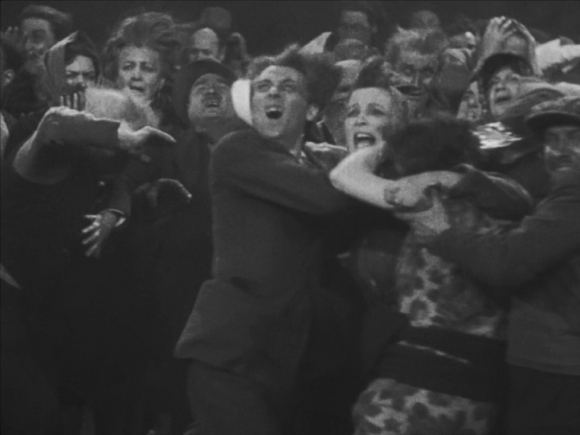
The entire world can now see Lexell's Comet, and Radio Novalic resumes broadcasting. Martial calls for the first convention of the "General States of the Universe" on 5 August, the night before the collision. People around the world begin to pray as the Comet looms larger in the sky and extreme weather ensues, including blizzards, storms, earthquakes and tidal waves. Riots break out and a thousand revelers bring musicians into a great hall for a feast and orgy. Monks carrying candles interrupt the orgy and lead the group in prayer. As the orbits of the comet and the Earth converge, Martial Novalic addresses the One World Congress, which unanimously agrees to unite all governments into a single harmonious entity. The comet narrowly misses the Earth causing much destruction but leaving it intact. As the film ends we are assured that the survivors will rebuild and live in peace under a one world government. Finis.

THE COMET STRIKES IN "FIN LE MONDE" (1931);


The plot of this film was based on a 1894 French novel "Omega; The Last Days Of The World" by Camille Flammarion, and it has so many similarities with the 1916 Danish film that Danish director Blom must have read it as well. It's unclear how influenced Gance may have been by the Danish film but it was apparently successful enough that he must have seen it but on-the-other-hand he had reportedly been considering the project since 1913, a full three years before Blom's film. At any rate both films feature a comet strike, both comets are discovered by a bold astronomer who largely disappears from the story, both feature ruthless capitalists who seek to profit off the stock market chaos, both have attempts by those in power to conceal the truth, both feature the decadent wealthy throwing wild parties as the comet closes in, both have lovers triangle subplots, both have strident Christian religious symbolism, both have the capitalists getting their just deserts while some good Christians survive to rebuild a new world.

comet-space

The main difference is one of scale. The Danish film, while not exactly low-budget, was certainly no epic either, keeping most of its action to the mining town, using a lot of indoor sets and having a cast of dozens (including extras) rather than hundreds. Director Abel Gance was of course notorious for his mammoth "Napoleon" extravaganza of 1927 and this film does have some trademark Gance touches notably the hallucinationatory religious visions and the mobile camera during the Eiffel Tower scenes. These are effective and the ending chapter as the comet closes in is a well constructed montage with a mix of short scenes of stock storm footage, buildings in ruin, fleeing animals, reaction shots, people of various faiths in prayer, a spinning globe, the comet streaking across the sky, panicking people and crowds, the parties of the rich contrasting with the piety of the poor, all in turn mixed with scenes of Jean addressing the League Of Nations and convincing them to vote for a one-world government. This montage is very well done and during the scenes of the wild party makes effective use of the wildly swinging camera Gance had used so spectacularly in "Napoleon" to convey a sense of drunken nausea until the somber monks show up to shame them into repentance. Gance does overdo it though as in the scene where the League votes in favour of Jean's plan and the camera goes to blurry shots of the enthusiastic members. This is supposed to be the whole point of the film as they vote for a future of global peace but Gance's unwillingness to stop using camera tricks makes it as disorientating and uneasy as the destruction scenes. Speaking of camera tricks we should note his treatment during these scenes of panicky African tribespeople who are shown sped-up with their voices also sped-up to sound like cartoon characters. They are the only ones given this treatment and they are clearly meant to be seen as silly comic buffoonish characters not only robbing them of their dignity (they are intercut with white tribesmen in Lapland who are shown in regular time and not in a panic) it also distracts from the serious scenes of destruction and the solemn tone to toss in some random comic relief. To be fair Gance does not actually have the Africans behave any differently, and certainly no worse, than the white ones, some of whom are shown as drunken reprobates, he just chooses to and edit them in a dismissive way for a quick laugh. Oddly he does not treat all non-white characters this way as there are also scenes of devout Muslims at prayer.      

HALLUCINATION SCENE FROM "FIN LA MONDE";


But while Gance does make good use of innovative techniques he can not totally escape the limitations of early talkies as the sound is muffled and some of the actors seem hesitant and have awkward line readings in the still fairly new medium of sound. The bigger problem with the film however is it's incredible sense of self-importance. It is not too much of a stretch to call the film "Messianic" when it starts with the main character (who is also the director) in an extended scene of his character being Christ crucified on the cross to become the world's saviour. Gance's Jean character is almost absurdly virtuous as he rejects the advances of the beautiful Genevieve to remain pure to his work, rescues a young girl and is falsely punished for it and is seen in visions as an explictally Christ figure. Gance manages to make Kevin Costner's laughably Messianic characters in the (now) camp classics "Waterworld" and "The Postman" seem modest and relatable by comparison. Gance is also just not a good enough actor to carry a film, and certainly not this role. With his weepy eyes, sobbing voice and hangdog expression he is just not an inspiring figure while by the end in his climactic speech he seems more like a ranting cult leader which he basically is, albeit a sincerely well-meaning one. Like the 1916 Danish film this one combines an angry view of the amorality of predatory capitalism with Christian sinfullness but unlike the earlier film it has a clear view of redemption for mankind, albeit by following a cult leader. Since the Danish film leaves unknown the fate of the larger film we do not know if there are other survivors or the surviving Edith & Reymers are truly alone (along with that Preacher) like Adam & Eve while in the French film it is made clear that there are indeed survivors who will rebuild. The Danish film also differs in the treatment of its religious figures. The Preacher in the 1916 film does rescue Edith but then leaves and doesn't play any larger role while in the 1931 film Gance's Christlike Jean becomes a literal saviour of a united world. Besides showing Gances ego this also shows the difference between the very Catholic French film and the Lutheran Denmark where the very idea of a Messiah figure rising to world power to save mankind after the Apocalypse could be seen as rather blasphemous.

download_(1)

Two trivial notes; Lexell's Comet, while not as famous as Halley's Comet was in fact a real comet that also buzzed passed the Earth several times over the centuries and was seen as an omen. Howevere it mysteriously disappeared in 1770 and hasn't been seen since. Scientists are think it was either thrown out of orbit by Jupiter and either sent out of the Solar System or sucked into the giant planet's orbit. As an additional trivia note the wealthy ball at the end has one of the very few onscreen uses of a now obscure and obsolete musical instrument called an Ondes Martenot, a more complex French version of the iconic Theremin that electronic music nerds will enjoy seeing however briefly.


ONDES MARTENOT PLAYER AT THE BALL

The making of this film was fraught with troubles similar to those of the notorious Erich von Stroheim as Gance ran over budget and over schedule eventually leading to the studio taking the film off his hands and editing it down from over three hours to 105 minutes with the excised footage now lost. A bitter Gance blamed the studio for the film's subsequent failure claiming that they had butchered the movie and the lost footage would have made the film more coherent. While his bitterness is understandable it is unlikely his full version would have solved the film's problems and even less likely it would have been successful. While the film does have enough Gance flourishes to be interesting it was fundamentally too bloated and infused with religious mania to really hold together and only parts of it work. Considered a failure both critically and financially this film was a blow to Gance's career while he would continue to make films into the 1960's rarely would he be trusted with the sort of huge budgets and creative independence he had in the 1920's.

The failure of "Fin Le Monde" and the big budget epic remakes of "Noah's Ark" (in America) and "The Last Days Of Pompeii" (in Italy) marked the end of big budget apocalypse epics with would-be religious or classical themes although it did not mean that the topic itself would not occasionally pop up however it would be treated more like a thriller and would be smaller in scale.  

images_(1)

+++++++++++++++++++++++++++++++++++++++++++++++++++

"DELUGE" (1933);
 

Directed by Felix Fiest
Peggy Shannon as Claire
Sidney Blackmer as Martin
Lois Wilson as Helen
Matt Moore as Tom
Fred Kohler as Jepson
Ralf Harolde as Norwood
Edward Van Sloan as Prof. Carlysle

PLOT SUMMARY (SPOILER ALERT);
Scientists in New York led by Prof Carlysle (Edward Van Sloan) are tracking a series of violent storms across the world with one coming their way. Worldwide low natural barometric pressure readings and a sudden eclipse of the sun suggests there is a problem with the world's orbit and it seems that global destruction is near. First Europe and then the Pacific Coast, New Orleans and the Mississippi delta are destroyed by a combination of hurricanes, earthquakes and tidal waves killing millions, and it is reported that a massive wave is heading their way.


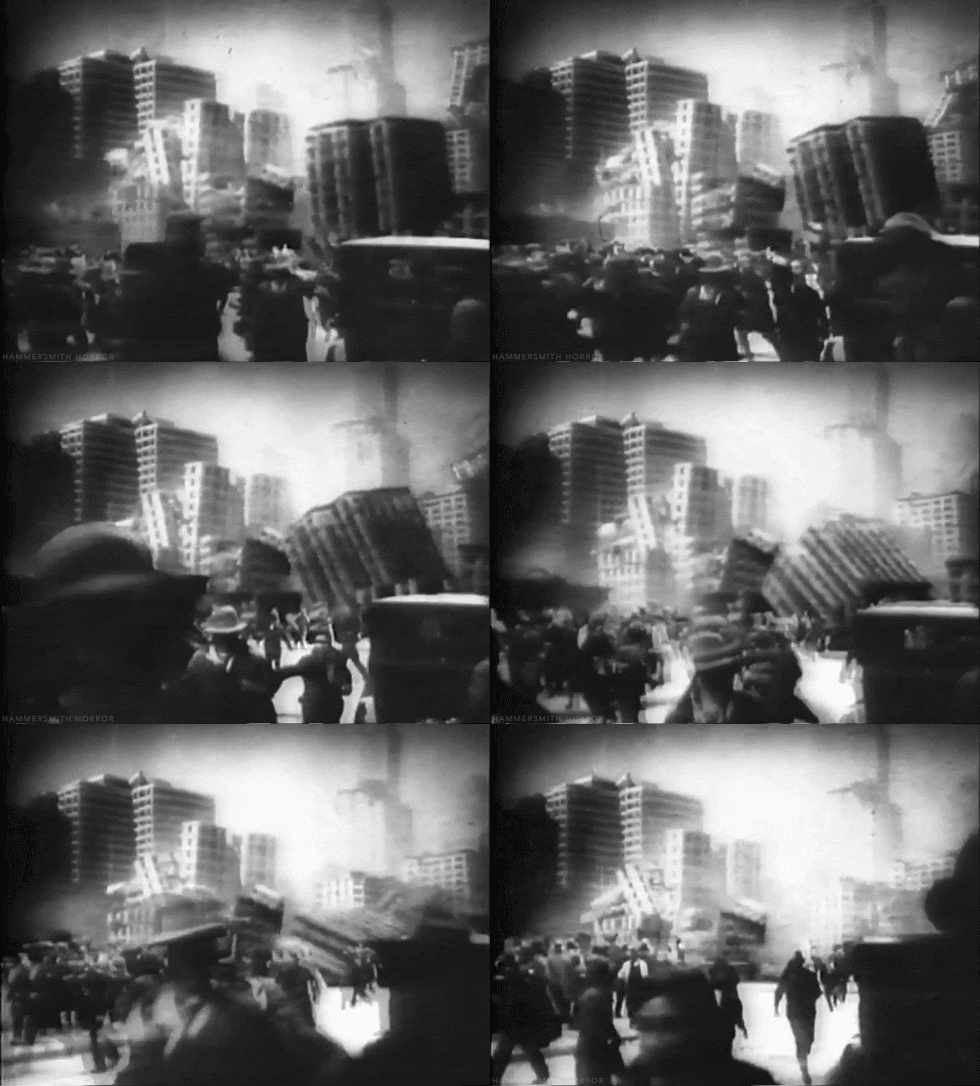
ny_city_destruction_by_flood_predicted_in_1933_film_the_deluge

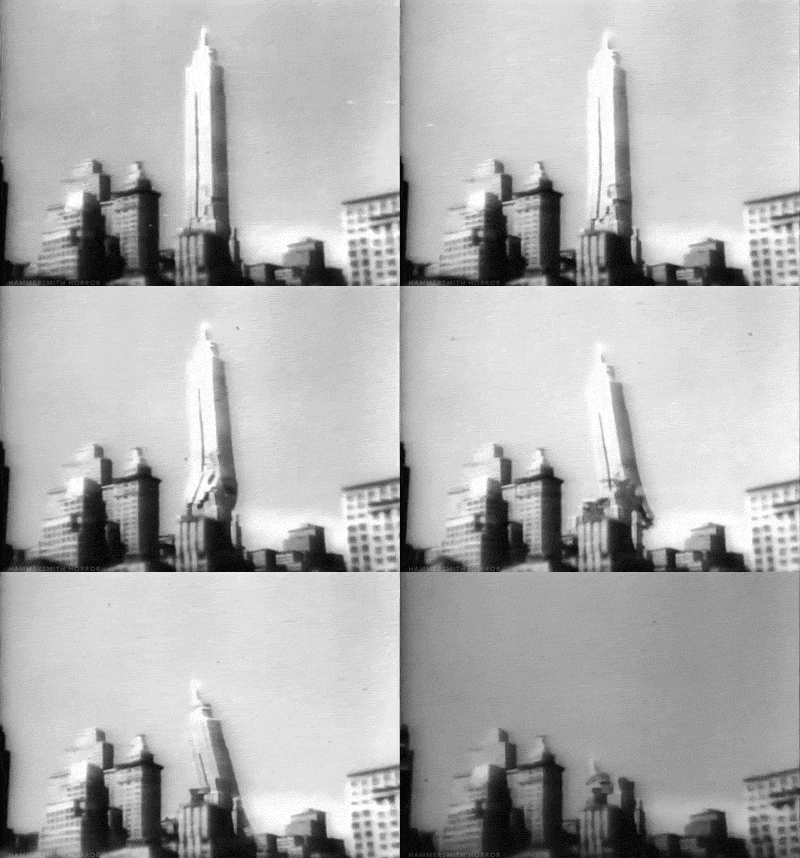
Claire (Peggy Shannon) a distance swimmer has a marathon swim planned but has to cancell it due to the storm and decides to take a trip to the coast, which frankly seems like an odd choice under the circumstances but we'll go with it. Martin Webster (Sidney Blackmer) and his wife Helen (Lois Wilson) are a wealthy couple who live on the shore. They prepare for the oncoming disaster by gathering their children and some essentials and head for a high rock formation to escape the floods. Martin leaves Helen and goes back to the house to get more food and clothes as the wave hits. New York is destroyed as buildings crumble from earthquakes and tsunami waters envelop the city. Martin wakes up on the beach to find his house gone and his wife and daughters are nowhere to be found. In the aftermath, grief-stricken Martin builds a cabin near an unsused mining tunnell and tries to survive on his own.

tumblr_52748a3dbc8e97366fe6f2a57956b1fe_15bd29c4_400

Surviving in a cabin in another part of the New York City outskirts, two bickering men, the hulking Jepson (Fred Kohler) and weasely Norwood (Ralf Harolde), find Claire unconscious and washed up on the shore. As she recovers, the men start feuding over her and become very possessive. Jepson kills Norwood and When Claire realizes the situation, she becomes uncomfortable and flees across the water for safety as she is a world-class swimmer, leaving the men angry and vengeful. Jepson kills Norwood and begins to search for Claire, vowing to bring her back. Claire washes up on another shore, where Martin finds her this time and takes care of her while she recovers. Jepson arrives spotted by Martin who trails him as Jepson runs into a gang of outlaws who having been ejected from a larger group of survivors for being too violent have been roaming the area having raped and killed an other woman. Jepson joins the band while Martin runs back to warn Claire who decides to stay with Martin.
Martin and Claire become good friends and eventually fall in love. Meanwhile the other survivors have gathered together to start a new town. Among these survivors is Martin's wife, Helen, and their children. Tom (Matt Moore), one of the townsmen, found Helen in the aftermath, and has been taking care of her ever since. He has also fallen in love with her, but Helen is convinced that Martin is still alive. However Martin and Claire are unaware of the group's existance.
Jepson is still searching for Claire and has taken over the gang of thugs who join him in laying siege to the old mine where Martin and Calire are holed up leading to a gun battle. The townspeople are alerted by the gunfire and rush to save Martin and Claire resulting in a gun battle in which Jepson and most of the gang are killed while the rest flee into the night. Martin and Claire are and brought back to the town. Once they arrive, Martin finds his children and discovers his wife is alive and well and goes to her. Tom is disappointed but he backs Martin as the town's new leader while Claire remains jealous. After the reunion, Martin explains to Claire how he is in love with both his wife children and with her and that he will not choose. Helen visits Claire and they have a painful discussion in which Claire says she will not give up Martin. However, when Claire sees Martin with his wife at the town meeting her heart breaks and she runs to the ocean. She swims away as Martin is left watching her go. Finis.

++++++++++++++++++++++++++++++++++++++++++++++++

Most apocalypse films spend a lot of their time setting the scene and introducing the main characters but this film basically begins with the world's ending and goes from there. The scenes of destruction for this modestly budgeted film use obvious miniatures and some of the clumsiest rear screen projections ever seen yet while they are not realistic they are oddly effective due to some quick edits, dramatic music and their ambitious scale. Some of the effects crew would later work on the 1936 version of the futuristic HG Wells novel "Things To Come". The film also makes good use of stock footage and as a trivia note included as part of the footage of ships and planes returning to base under storm warnings are shots of the actual US Airship Macon which would be lost at sea in 1935 ending the US Navy's Zeppelin program. The remaining two thirds of the film are about the survivors and could easily be a castaways movie. Like most such films of the era the good guys are notably freshly scrubbed and well groomed in the wasteland while the bad guys are scruffy and unshaven. One notable subplot sets aside this Pre-Code film from those that follow is the outlaw gang who are not just the usual thugs and bandits but also engaged in kidnapping, rape and murder and they've already raped and killed one woman whose body is partially shown, albeit not graphically. This sort of depraved sexual violence was probably shocking for the time and would never have been even alluded to once the Motion Picture Code came into effect the next year. Even in modern post-appocalpse sci-fi this sort of violent sexual subplot has only really shown up a few times notably in "A Boy And His Dog" (1975), the first two Road Warrior films and "Waterworld" but even these films have less implied sexual violence. Ironically while this film is ultimatley less less cynical than the modern films it's probably a more realistic result of societal breakdown then the law-abiding democratic frontier village the Good Guys founded here.

tumblr_pw0evbURkt1s01qkyo1_500

"Deluge" was shot on a modest budget and was a minor hit for RKO and disaster footage from this film would be lifted almost entirely and reused (with some added scenes of panicky crowds) in a lower budget 1939 film for Republic Pictures, "SOS Tidal Wave" which is sometimes confused with it. The latter is a very silly crime film with a convoluted plot in which a reporter discovers a scheme by a corrupt politician who tries to keep people from voting with a fake news TV broadcast using disaster footage from an old movie, which it carefully does not actually name as the two films came from different studios. The reporter is played by Ralph Byrd (from the Dick Tracy serials) along with a comic relief sidekick (an era cliche character "Deluge" notably does not have) and for some reason a ventriloquist. The addition of extra footage of panicking extras probably improves the disaster footage slightly but "Deluge" is clearly the smarter and better film. Of the cast of "Deluge" it's worth noting Edward Van Sloan (Dr Van Helsing from "Dracula") as the head scientist, and the film's willingness to abruptly kill off such a recognizable authority figure adds to the effectiveness of the destruction scenes. Fred Kohler as Jepson bears a striking resemblance to Gibson Gowland of Von Stroheim's "Greed" and is a menacing villain. Peggy Shannon (as the spunky Claire) was a brassy strawberry blonde with long legs, piercing eyes and bee-stung lips who was promoted as a successor to Clara Bow but would have an even more tragic fate. Starting with a successful Broadway career she was a Ziegfeld Girl then cast to replace Bow in "The Secret Call" (1931) after Bow had a nervous breakdown and pulled out of what would have been one of her attempts to comeback in sound films so Shannon received much studio publicity. However her hard drinking and reputation for being difficult soon caught up with her and she was limited to lower budget films like this. A full blown alcoholic and heavy smoker, she was found dead of a sudden heart attack and liver failure aged 34 by her husband in 1941. He shot himself weeks later.

5342t
PEGGY SHANNON

++++++++++++++++++++++++++++++++++++++
The aftermath of World War Two and the dawn of the Atomic Age and the soon thereafter start of the Space Race meant that future most Apocalypse films would either be based on Nuclear War themes or the more escapist invaders from space films although there were still a few films that explored a "natural" disaster theme.

"When Worlds Collide" (1951);


Directed by Rudolph Mate
Cast;
Richard Derr as David Randall
Barbara Rush as Joyce Hendron
Peter Hansen as Dr. Tony Drake
John Hoyt as Sydney Stanton
Larry Keating as Dr. Cole Hendron
Rachel Ames as Julie Cummings (as Judith Ames)

PLOT SUMMARY (Spoiler Alert!);
Pilot David Randall flies top-secret photographs from South African astronomer Dr. Emery Bronson to Dr. Cole Hendron in the United States. Hendron, with the assistance of his daughter Joyce, confirms their worst fears: Bronson has discovered that a rogue star named Bellus, accompanied by an Earth-sized planet named Zyra, is on a collision course with Earth. Hendron warns the United Nations that the end of the world is little more than eight months away. He pleads for the construction of "arks" to transport a lucky few to Zyra in the faint hope that humanity can be saved from extinction. With other scientists scoffing at his claims, his proposal is rejected. Wealthy humanitarians arrange for a lease on a former proving ground to build an ark. To finance the construction, Hendron meets arrogant wheelchair-bound business magnate Sidney Stanton. Stanton demands a seat on the space ark and the right to select the passengers in exchange for financing, but Hendron refuses his demands except for allowing him a seat. Stanton capitulates. Joyce, attracted to Randall, persuades her father to keep him around, much to the annoyance of her boyfriend, medical doctor Tony Drake. As Bellus nears, martial law is declared, and residents in coastal regions are evacuated to inland cities. Groups in other nations begin to build their own spaceships. Zyra makes a close approach first, causing massive earthquakes, volcanic eruptions, and tsunamis that wreak havoc around the world. Several people are killed at the camp, including Dr. Bronson. Afterward, Drake and Randall travel by helicopter to drop off supplies to people in distress in the surrounding area. When Randall gets off to rescue a little boy stranded on a rooftop in a flooded area. As the day of doom approaches, the passengers are selected by lottery, though Hendron reserves seats for himself, Stanton, Joyce, Drake, pilot Dr. George Frey, and Randall, for his daughter's sake. He also includes the young boy who was rescued, raising the number of passengers to 45. Randall, feeling he lacks any necessary skills, rejects his reserved spot; he pretends to draw a lottery number, but Hendron knows better. For Joyce's sake, Drake tells Randall that Frey has a "heart condition" that may kill him during liftoff, convincing Randall he is needed as the co-pilot. The cynical Stanton fears what the desperate lottery losers will do, so he has stockpiles weapons. When a young man turns in his winning number because his sweetheart was not selected, Ferris, Stanton's much-abused assistant, claims it at gunpoint, only to be shot dead by Stanton. Hendron agrees to the precaution of having the selected women board the ship, while the chosen men wait just outside. Shortly before blastoff, many of the lottery losers riot, seizing Stanton's weapons to try to force their way aboard. Hendron triggers the launch prematurely while he and Stanton are still outside, so the ship will consume less fuel on the journey. Meaning he and Stanton will be left behind. The desperate Stanton (who had been forced to give up his gun) stands up tries to walk in a futile attempt to board the departing spaceship which leaves without them. The crew are rendered unconscious by the g-force of acceleration, and the Earth collides with Bellus. When Randall comes to and sees Dr. Frey already awake and piloting the ship, he realizes he has been deceived. As the spaceship enters Zyra's atmosphere, the fuel runs out; Randall takes control and glides it to a safe landing. The crew find Zyra to be habitable. David Randall and Joyce Hendron walk hand-in-hand down the ramp with their fellow survivors into Eden as a new day dawns.
4475489422-2d3c5c9b06-b

+++++++++++++++++++++++++++++++++++++++++++++++++++++++
This is the first colour view of the apocalypse and it was done with a decent budget by science fiction producer George Pal (originally none other than Cecille B DeMille had wanted to make it) that he intended as part of a series of unrelated sci-fi films. Like those films this makes full use of miniatures and gorgeous matte paintings for a lush technicolour look that still has a retro beauty. The actual rocketship looks more Flash Gordon fantasy than Stanley Kubrick sci-fi realism but to be fair the basic shape as well as having it launch via a roller-coaster rail line is a reasonable version of the WW2 German V1 and V2 rockets that people were already familiar with and it does look cool. The actual space travel however doesn't apparently require any actual space suits, breathing apparatus or anti-gravity suits (instead they wear matching hoodies as if on a fishing trip) which while common in sci-fi of the era was already known to be scientifically wrong. The scenes of destruction via massive earthquakes, volcanos, landslides, collapsing icebergs and floods are mostly done with miniatures in the style of the time and are suitably dramatic topped with an evocative matte painting of water-logged skyscrapers and beached ocean liners littering the submerged sidewalks of New York.
download

The story is more somber and thoughtful than many of the more escapist or exploitative sci-films of the era with questions about who deserves to survive and who should be left behind although not quite as thoughtful as it thinks as naturally all the survivors are white and English speaking and nobody questions this. However as was typical of the genre the romantic subplot is tacked on and uninteresting and the main characters are two-dimensional and dull. Leading man hero goes from a cocky womanizing cynic to a self-sacrificing leader with no explanation as to his change of heart or why he would be instantly trusted and given authority and top secret access in spite of being little more than a mercenary pilot. He is also unaccountably instantly attractive to any woman for reasons that are not obvious. Barbara Rush's character falls for him immediately and deserts her doctor fiancee for no apparent reason while said doctor first swears revenge then quickly changes his mind and gallantly steps aside minutes later. The arrogant billionaire Stanton is at least a suitably hateable villain however, at least his motives are clear, consistent and believable and he has a real personality. He's a cold, callous, megalomaniacal, bastard but at least he's watchable.
One oddity is that the film doesn't actually show the world's end. Instead we get the ship blasting off one step ahead of the angry mob while Stanton and Dr Dr Hendon look on and we never look back. So perhaps the destruction will not be total and there may be survivors. Maybe producer George Pal left open that question to be addressed in a possible sequel to be called "The Last Man In The World" but it was left unmade even though this film was successful enough. Pal had already made "Destination Moon" and would later go on to make versions of the HG Wells novels "The War Of The Worlds" (1953) and "The Time Machine" (1960) with similar use of effects.This film lacks the dramatic power or spectacle of those two classic films and is less remembered but it's one of the better sci-fi films of the era.
images-1

+++++++++++++++++++++++++++++++++++++
"The Night The World Exploded" (1957), "The Day The Sky Exploded" (1958) were two movies in this genre of Earth destroying disasters that don't completely qualify as Post Apocalypse as (SPOILER ALERT HERE!) in spite of their clickbait titles the Earth is saved in the nick of time. However both films do have the Earth getting enough of a close shave to have some serious damage.
"The Night The World Exploded" was produced by Sam Katzman, prolific maker of such b-movie fare as sci-fi and horror camp classics "Earth vs The Flying Saucers", "It Came From Beneath The Sea", "Creature With The Atom Brain" "The Giant Claw", "Zombies Of Mora Tau", teen exploitation flick "Rock Around The Clock" (w/Bill Haley) and various westerns. By the usual Katzman standards this film is rather sedate and low key.
  MV5-BY2-E0-Zm-Ew-Zj-Ut-Zm-Vl-OS00-Yjc0-LTlh-ODEt-NGJk-NDcz-Nz-Y0-Mj-Y4-Xk-Ey-Xk-Fqc-Gde-QXVy-Mj-Ex-Mzc2-MTY-V1
This time destruction comes not from space but from a newly discovered compound deep in the earth which becomes combustible when brought into contact with the air causing the Earth's axis to change by three degrees leading to massive earthquakes, floods and volcanoes which will eventually break apart the Earth. The destruction is shown using some brief newsreel and stock footage of earthquakes, train derailments and fires. Much of the film is spent with our heros heading into Carlsbad Caverns which is full of cool looking Plaster-Of-Paris stalactites. Eventually they will discover the new element and it's explosive qualities which can only be minimized if submerged in water leading to a plan to use bombs to dig a massive trench and divert a river into the cavern, dousing it and saving the planet. And you know what this means; Stock footage of WW2 bombers! The cast is not very large having only a handful of scientists working on this literally world shaking problem including the stolidly handsome, square-jawed, cigarette smoking lead scientist and his pretty, efficient female assistant who he of course does not realize he is in love with. Of course at some point she will become hysterical and need to be comforted although she is otherwise perfectly capable. As befits it's limited budget the scale of this film is modest with no shots of world-wide destruction. The direction is basic B-movie competent but no more as is the acting. Kathryn Grant, who plays the female scientist would later marry Bing Crosby who was thirty years older and basically retire from the screen although she would appear in the fantasy cult classic "the Seventh Voyage Of Sinbad". As of this writing she is still alive.

++++++++++++++++++++++++++++++++++++++++++++++++++

"THE DAY THE SKY EXPLODED" (1958);


Directed by Paulo Huesch
Cast;
Paul Hubschmid as John MacLaren
Fiorella Mari as Mary MacLaren
Ivo Garrani as Herbert Weisser
Madeleine Fischer as Katie Dandridge

"The Day The Sky Exploded" (AKA "Death Comes From Outer Space") is an Italian film in which a rocket jettisoning its atomic retro rocket setting off a chain reaction leading to an explosion which causes asteroids to move from their orbit and merge into a giant asteroid that then hurtles towards the Earth. Got that? OK. This leads to a series of increasingly serious natural disasters including earthquakes, volcanos, landslides, forest fires, tidal waves, floods and a drastic increase in the world's temperature. This in turn leads to mass migrations, rioting and panic. Scientists come up with a plan to combine the world's supply of nuclear missiles and fire them at the giant comet to destroy it. Because nuclear missiles; Both the cause and solution to our problems am I right? At any rate as the launch begins one of the scientists goes crazy deciding the comet is god's judgement and attempts at gunpoint to sabotage the launch by shutting off the base's air conditioning which will short out the base's computers. There is a shootout before the rogue scientist is killed, the missiles hit their target and the comet is destroyed just in time.
download-1
The destruction scenes mostly make use of a little stock footage (some of WW2 vintage), a few miniatures in slo-mo, stage sets of ruined buildings and shots of milling and panicky crowds which are notably less effective than in the other films although the shots of the comet hanging in the sky like a dying sun do have a certain eerie quality. This film is slow moving and talky, not getting to any real action until an hour in with far too much attention given to pseudo scientific explanations and debates and the cliche personal lives of various characters who are just not interesting; the astronaut is focused on his job than his family and his wife resents it. One male scientist wants to seduce the woman scientist who is chilly and aloof but will of course dissolve into not-to-convincing tears at some point and need to be comforted etc. The direction is rote and the acting is flat and stiff except for the scientist who goes crazy and gets to overact with some bug-eyed yelling. In the scenes of the main astronaut in his capsule he is so slow moving and talking I assumed the character was supposed to be suffering from oxygen depletion but it turns out he's just really boring. Most of the action, such as it is, consists of scientists arguing although at least the various banks of computers, consoles, screens, knobs and banks of twinkling lights look fairly realistic. Although this is an Italian made film with a cast that included Swiss and French actors it was either shot in English or seperate scenes were shot for the English market and it doesn't have the often awkward dubbing of the Spaghetti Westerns.  

download-2
++++++++++++++++++++++++++++++++++++

"THE LAST WOMAN ON EARTH" (1960);


Directed by Roger Corman
Cast;
Betsy Jones-Moreland as Evelyn Gem
Anthony Carbone as Harold Gem
Robert Towne as Martin Joyce

As with "The Night The World Exploded" this was also produced by a notoriously prolific producer of B-Movies, in this case Roger Corman, with a script by Robert Towne on a limited budget. This time world destruction is caused not by a planetary source however vague. In the story a couple which include Harold, a shady businessman, his bored wife Evelyn, and nervous lawyer Martin take a scuba diving trip to Puerto Rico and when they surface they discover the oxygen has mysteriously been sucked out of the atmosphere and everybody has suffocated leaving them the only survivors. What may have caused this disaster is never explained but the nature of this world ending scourge means that this film isn't required to spend any time (or more importantly money) on showing images of destroyed buildings, landslides, piles of bodies etc. Instead our heroes can simply move to a luxury estate and fight over the affections over the Last Woman On Earth which is what the bulk of the film is really about. Eventually Harold and Martin have a falling out leading to the latter fleeing with Evelyn and Harold giving chase. Harold catches up to them and a fight breaks out in which Martin is killed, Harold and Evelyn make up and go off together alone.
last-woman-on-earth-md-web
Robert Towne's script is fairly wordy but the characters are inconsistent. Harold ranges from being an arrogant, corrupt businessman who is under indictment to being a responsible take-charge leader to violently jealous. Evelyn goes from being a bored, resentful, drunk who flirts with Martin to being a loyal wife to running off with Martin and back to loyal wife again for no good reason. Martin goes from being a nervous and uptight killjoy to becoming bachelor on the prowl at random. None of the characters are particularly likable or interesting. Other than a brief moment where the trio travels into town and come across a few bodies (including a child) little thought is given to what happened to everybody else or what caused the disaster. Are there other survivors? Based on the evidence shown here there must be other survivors who also spent the day in closed oxygen environments such as submarines, jet planes or mountain climbers but this film doesn't consider that possibility. Most of these type films are fairly shallow about the implications of world destruction and being the last survivors but this one basically uses it's premise to engage in a castaways lover's triangle which is not interesting because neither are the characters.
images-2
BETSY JONES-MOORELAND

The story and direction are at least typically efficient and don't waste too much time and the settings are attractive. The film was released in both B&W and colour prints. The male characters are unlikable but Betsy Jones-Moorland as Evelyn shows some charm, especially as the bored, tipsy wife and could have been more interesting with a better role. The role of Martin is actually played by scriptwriter Robert Towne under a fake name and as an actor he makes a better writer. Towne would go on to become the Oscar winning writer of Roman Polanski's "Chinatown" (1974) along with scripts for "Shampoo" (1975), "The Last Detail" (1973), "The Two Jakes" (1990) and the first two "Mission Impossible" films. He would also direct "Personal Best" (1982), "Without Limits" (1988) and "Tequila Sunrise". As of this writing he is still alive. Betsy Jones-Moorland would star in another Corman film "Creature From The Haunted Sea" but after that she acted mostly in small roles on film and TV before retiring in the 1970's dying in 2006.
download-3

+++++++++++++++++++++++++++++++++++++++++++++++

"The Twilight Zone" (1961);
86263

Rod Serling's classic TV Sci-Fi/Mystery/Fantasy/Horror anthology did have a few episodes dealing with post-apocalypse stories but most of these were based on nuclear war themes. One exception was "The Midnight Sun" in the third season. In this story the Earth has somehow gone off its orbit and is heading closer to the Sun to it's ultimate destruction. Two women, an elderly landlady (Betty Garde) and her younger tenant (Lois Nettleton) try to cope with the growing heatwave. At the end it's revealed the story is actually a dream in the mind of the younger woman who is suffering from a high fever and as she wakes up we learn that in fact the Earth is actually moving away from the Sun and into a deep freeze ice age. Given it's typically short length and simplicity there's not much else to say about it. As is usual there are only a few characters and all the action takes place in their apartment with a detailed, thoughtful script (by Serling himself) and a twist ending with some dramatic speeches and fine performances (Nettleton would become an Emmy Award winner) and is one of the stronger episodes of a one TV's greatest anthology series. BTW I've already written about "Twilight Zone" here and about the specifically Post Nuclear episodes here.
   Rod-Serling-Twilight-Zone

+++++++++++++++++++++++++++++++++++++++++++++
THE DAY THE EARTH CAUGHT FIRE (1961);


Peter Stenning (Edward Judd) is journalist with the Daily Express in London, formally a successful writer he has been drinking and has been divorced and has been sidlined at his job and become cynical. Stenning's only real friend, Bill Maguire (Leo McKern), is a veteran Fleet Street reporter who offers him encouragement and occasionally covers for him by writing his copy. Meanwhile, after the Soviet Union and the United States detonate simultaneous nuclear bomb tests, strange meteorological events begin to affect the globe. Stenning is sent to the British Met Office to obtain temperature data, and while there he meets Jeanie (Janet Munro), a young typist. They "meet cute", trading insults; later, they fall in love. Stenning then discovers that the weapons tests have had a massive effect on Earth. He asks Jeannie to help him get any relevant information. It becomes apparent that Earth's nutation has been altered by 11 degrees, affecting the climatic zones and changing the pole and the equator. The increasing heat has caused water to evaporate and mists to cover Britain, and a solar eclipse occurs days ahead of schedule. Later, characters realise that the orbit of the Earth has been disrupted and the planet is spiralling in towards the Sun. Jeannie gets caught leaking information to Peter and is arrested and fired for which she blames him. She is later released and given a job at the paper by Maguire. The UK government imposes a state of emergency and starts rationing water and supplies. People start evacuating the cities. Scientists conclude that the only way to bring Earth back into a safe orbit is to detonate a series of nuclear bombs in western Siberia. A riot breaksout in Jeannie's neighbourhood and Peter rescues her during which one of the rioters is killed. Stenning, Jeannie and Maguire then gather at a bar to listen to the radio broadcast of the event. The bombs are detonated, causing shockwaves. Peter heads out to survey the damage and finds the streets deserted, and the river Thames dried up. He goes to the newspaper office, two versions of the front page have been prepared: one reads "World Saved", the other "World Doomed". The film ends without revealing which one will be published or what the results of the detonations was, but Stenning says in voiceover "humanity will recover after all this horror."

images-3

++++++++++++++++++++++++++++++++++++++++++++++++++
images-4
This British production marks a departure from previous efforts. Setting aside the pretentious 1931 Abel Gance film "Fin La Monde", the others were straightforward sci-fi genre pictures, usually done on fairly limited scale and budgets suitable for placing on a double bill or a drive-in. "Deluge" has some darker, violent sub-plots and "When Worlds Collide" had a bigger budget to spend on effects but otherwise both are still genre films. This film however is more adult in it's presentation. The rapid fire dialogue between the main characters is more authentic and less stagebound. The characters are more real with plausible back stories and less like stock figures and plot devices. The basic premise of nuclear bomb tests setting the Earth off it's orbit is not any more realistic than those of the previous films but it's presented in an earnest fashion and  does give the film a moral about nuclear war that the other films did not have although the afore mentioned "Fin Le Monde" and "When World's Collide" did have their own morals. The look of the film is both realistic and (in it's later scenes) gritty and has a believable atmosphere with sets that seem lived-in. The newsroom looks like a legit newsroom crowded, cluttered and bustling and the busy streets also look real. Director Val guest had previously worked for Hammer Films, notorious for its lush colours and low-cut gowns on equally lush women but he also made the two classic "Quatermass" sci-fi series about an alien invasion which were done in a gritty quasi-documentary style closer to the style here. Some of the scenes of characters at a protest look as if they were inserted into an actual protest in the way that would be done in the 1968 film "Medium Cool". Similarly other streets scenes and at an amusement park have a cinema verite feel. Adding to the sense of realism is the dialogue with characters often interrupting and talking over each other in rapid fire back and forth wisecracks. Unlike most of the previous films the main characters here are not scientists but hard drinking cynical reporters which justifies the banter which plays like a screwball comedy only serious.
day-the-earth-caught-fire-19
Special effects are done with the usual combination of miniatures, matte paintings, stock footage, newsreels and in-camera effects but they look more authentic than in previous films and are integrated well into the staged footage of floods, fires, windstorms and blizzards. The shots of a parched and barren London look appropriately stifling and shots of fog shrouded streets include some shots that may be actual footage of one of the serious smog storms that smothered London in the 1950's and 60's when coal fires and leaded gasoline were normal. As the world moves closer to the sun we get some striking matte paintings of the dried up River Thames and sweltering streets. Unlike in films from the 40's and 50's where characters are invariably perfectly groomed (at least the good ones) these characters are often drenched in sweat and grime and look uncomfortable as they become increasingly irritable although we do get a scene of partial nudity from Janet Munro as the love interest.
tumblr-bcddeb03ca9dea4f36f1787a957b7dcd-ea6b2fff-1280
JANET MUNRO

Previous such films were seen as basic genre films and not taken very seriously by film critics with the obvious exception of the 1931 Abel Gance film, whose artistic and political/religious themes invited more scrutiny but was seen as a failure. However this film, while only modestly successful, was critically acclaimed as a serious and thoughtful effort which won writer/director Val Guest a Best Screenplay Award at the 1962 BAFTA Awards. Guest would go on to a long career in film and TV into the 1980's before retiring and dying in 2006. As for the cast; Leo McKern, who plays Stennings' reporter friend, was later best known in the title role in the long-running UK TV series "Rumpole Of The Bailey". To further increase the realism the Editor is played by Arthur Christensen who was actually the editor of the "Daily Express" in real life and no doubt consulted on the authenticity of the newsroom scenes. Other cast members would meet more unhappy fates. Edward Judd as the lead role as the cynical, hard drinking reporter Peter Stennis, got good reviews and plenty of film offers but it would seem his real life personality was too similar to the abrasive Stennis and his career never really took off. He continued on in supporting roles and voiceover work before giving up acting and dying in 2009. His wife Gene Anderson, who has a small role here, died suddenly in 1965 aged only 34 of natural causes which probably contributed to his drinking. Love interest Jeannie was played by Janet Munro would appear in several Disney films but would meet her own tragic fate, dying of a sudden heart attack in 1972 aged only 38. Note the presence in a bit role as a traffic cop of a young Michael Caine (who was actually a friend of Judd's) and he is instantly recognizable by his distinctive voice.

Previous films had ended on a somewhat hopeful note; the world may have suffered tremendous damage but there would be at least some survivors to rebuild, albeit in the case of George Pal's "When Worlds Collide" on a different planet. However by the sixties and our last two entries attitudes after fifteen years of Cold War were more cynical, or fatalistic depending on your point of view. In the "Twilight Zone" episode the world and everybody on it is condemned to an icy death while in this film the ending is ambiguous. We are shown two newspaper headlines ready to go to print; one announcing the world is saved and the other it's doom with no clue as to which will be sent out. Whichever ending you prefer also depends on your point of view.

tumblr_p7d7pb32qD1vd8jsjo1_500


JOHNNY PAYCHECK ~ "THE CAVE"