Wednesday, 1 February 2023

Black History Month Special; The Musicals Of Louis Jordan


"LET THE GOOD TIMES ROLL" (Louis Jordan, 1939) s-l1600
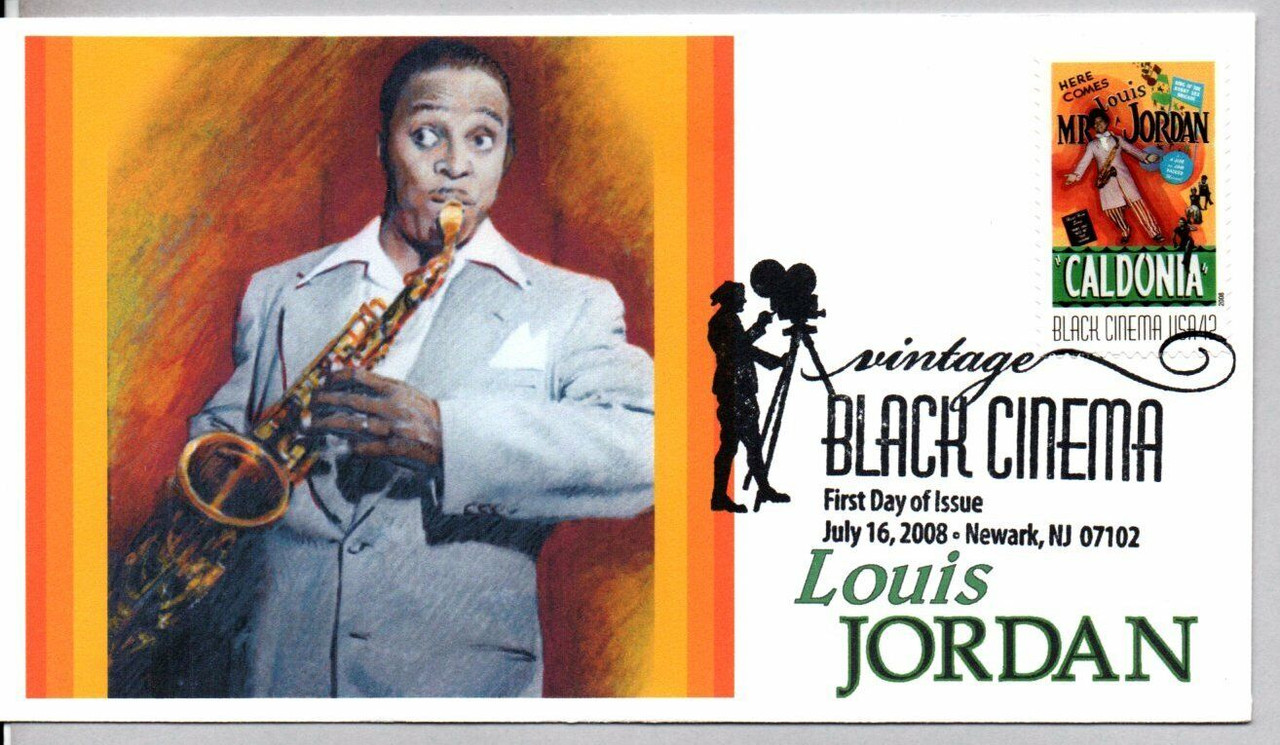
Louis Jordan (1908-75) is one of the most important figures in Black music in the Post WW2 era with his stripped down and jumped up version of Swing being cited as one of the central building blocks of Rhythm & Blues, Rock & Roll and Jamaican Ska but what is less well known is that he was also briefly the biggest, if most unlikely stars of 1940's Black Cinema.

THE KING OF THE JUKEBOX;

Born in Arkansas, Jordan's father James was a sax and clarinet player with the Rabbit Foot Minstrels, a popular travelling revue that toured through the South in the 1900's. Minstrelsy was a genre of musical comedy that had its roots in the Antebellum South originally starting with black performers doing musical and comedy skits gently mocking the high class dances and exaggerated and dress manners of the fancy dress cotillions of the white plantation class. Soon white audiences, most not entirely in on the jokes, found these shows entertaining and travelling shows soon toured the entire country and would lead to white minstrel groups imitating the black groups and performing in blackface. These blackface troops were so wildly popular that in the weird inverted logic of a deeply racist society many black performers themselves had to "cork up" and perform in blackface (or sometimes whiteface) including stars like Bert Williams and Wilbur Sweatmen and young not-yet stars like Scott Joplin, WC Handy and Gus Cannon who all later reported that they had started out performing in blackface. Minstrelsy was by far the most popular form of entertainment for more than a generation from the Antebellum Era until the 1880's when it was finally replaced by Vaudeville although obvious traces of it would continue into the post WW2 era in figures like Amos & Andy and even in the white Hayseed comedy of the Grand Ole Opry and later carried on into the 1970's with the TV show "Hee Haw".

By the time Louis was in his late teens and old enough to leave home and join the Rabbit Foot Minstrels in the 1920's the audience for such revues was mostly in black communities in the South where a troupe would set up outside town in a large tent and stay for several days giving multiple performances, thus coining the term "tent-shows". Given the audiences were now entirely black the more degrading blackface elements were omitted in favour of risque comedy and dance numbers and the bands included the new sounds of Ragtime and Jazz. The Rabbit Foot Minstrels were one of the most popular of these troops and at various times included such stars as Bessie Smith, Ma Rainey, Ida Cox, Half Pint Jaxon, Big Joe Williams and a young Rufus Thomas. While playing with the Minstrels Louis would learn the basics of what would be his later crowd pleasing style. Instead of the clarinet, and instrument associated with the now old timey New Orleans jazz bands, he would focus on the sax, a louder, sexier and more danceable instrumental. But it was enough not to be a good sax player, if one wanted to stand out he also had to be an all-around entertainer singing, telling jokes, clowning around, telling stories, pulling faces, doing a few dance steps, anything to win the audience over, Louis would do it. He would carry this crowd pleasing attitude on through his career even after he left the largely rural audiences of the tentshows in favour of the bright neon lights of the big city Jazz clubs.

LOUIS JORDAN ~ "YOU GOTTA HAVE A BEAT";


By the 1930's Louis Jordan himself had left the troupe and made his way to New York where he was a good enough sax player to find work with the Jazz pianist Clarence Williams (who had also recorded Bessie Smith), eccentric Jazz violinist Stuff Smith and in the Big Band of Chick Webb (which included Ella Fitzgerald). With Stuff Smith and Chick Webb Jordan would show he could not only play but sing up-tempo numbers and provide comic relief and by the late thirties he was a big enough name to start his own band and get a residency at a club in Harlem before heading to Los Angeles. He would puckishly name his band Louis Jordan and His Tympany Five (or Six) in spite of the fact that his bands could have anywhere from five to nine members none of whom actually played the tympany drum. Heavily influenced by the Zoot Suited scat singing shows of Cab Calloway (then the house band at the legendary Cotton Club) Louis would work out his own stripped down version featuring his blaring sax playing fast paced big beat dance numbers that he would punctuate with his jive talking lyrics and good time endless party persona. Once he started recording with Decca he was an immediate success and would rack up a stunning fifty four hits on the "Race Music" (ie Black) top ten charts with eighteen number ones making him one of the biggest sellers of all time and earning him the title of "Jukebox King".  Besides recording for Decca Records during WW2 he would record for the V-Disc label run by the US Armed Forces Network thus getting around wartime shortages of shellac as well as reaching a potential audiences.

  Jordan's hits included such classics as "Caldonia", "Choo-Choo-Cha-Boogie", "Saturday Night Fishfry", "Five Guys Named Moe", "Ain't Nobody Here But Us Chickens", "Is You Is Or Is You Ain't My Baby", "Reet Petite & Gone", "I'm Gonna Move On Out To The Outskirts Of Town" and "Let The Good Times Roll" and would almost single handedly kick-off the switch from the Big Bands of the War years to the Post War Rhythm & Blues scene that would lead directly to the early Rock & Roll bands and gained him the title of Father Of Rhythm & Blues. His many records struck a constant theme in his insistence that life was an endless party and were the opposite of the smooth ballads of the other major hitmaker of the forties Nat King Cole (who would still cover one of Jordan's songs) as was his persona of a happy-go-lucky Zoot Suited scamp. He would be cited as a major influence on the first wave of Rock & Roll and R&B stars Bill Haley, Lloyd Price, Smiley Lewis, Freddie Bell & the Bellboys, Rufus Thomas, Roy Brown, Wynonie Harris, Screamin Jay Hawkins, Chuck Willis, Chuck Berry (who later said that if he had to play in anybody else's band it would be for Jordan) and Jackie Wilson who would take Jordan's "Reet Petite & Gone" into his own classic "Reet Petite''. The term "Rhythm & Blues" became commonly used to describe his records as being clearly more song oriented and energetic than the Big Bands but also more Jazzy and danceable than the guitar based Blues records or the piano based Boogie Woogie records. Besides his influence on the next generation of R&B and Rock & Roll singers his influence would make its way (partly through the V-Discs carried by black sailors) to the Caribbean where it would show up in the bouncy, sax driven Jamaican Ska.
5909a961d0dde706a24514d33d41ea02

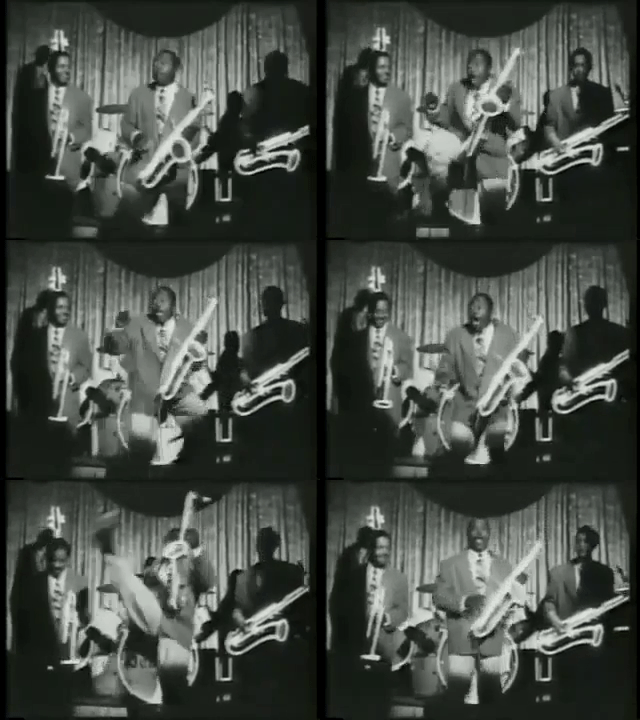
Given the success of Jordan's records it was probably inevitable that he would be tapped to appear in films. Several white singers had already been made into screen stars including Bing Crosby and Gene Autry and there was also a mini genre of short musical "Soundies" which could be played as opening teasers on bills with other films as well as in Soundie Machines which were video versions of jukeboxes that were installed in Juke Joints and other Bars just as jukeboxes were. Soundies had already been made almost as soon as talkies came in by black artists like Bessie Smith (providing the only actual footage of her), Duke Ellington, Louis Armstrong, Count Basie and Cab Calloway. These shorts usually featured a short intro to set up a musical number and Jordan's Soundie would feature one of his biggest hits "Caldonia".

"CALDONIA" (1945);


This short film had just the basics with Jordan and his band playing a song in a hotel room and that's it (Duke Ellington and Cab Calloway had done similar shorts) but showed Jordan's basic happy-go-lucky persona as he flashes his smile and mugs for the camera but while he may have been clowning he was no mere clown as he was also wearing an expensive suit while surrounded by a gaggle of admiring girls and the blaring power of his alto sax along with a nice muted horn solo is undeniable. As this was a short that could be easily added to any bill it would have also been seen by both black and white audiences aside from the black audiences who would normally see the series of all-black films made for the black theatres in the 1930's and forties.

From the 1920's to the 1950's era of Jim Crow era segregation there existed a network of movie theatres in black communities just as there was an older network of black vaudeville and music halls known as the Chitlin Circuit that featured black music, dance and comedy acts. These theatres meant that there was an audience for all-black movies as well so by the 1930's there were made a series of films with all-black casts, usually made by black directors to fill this niche. These films were rarely seen by white audiences, did not make it to TV and have been largely forgotten.

LOUIS JORDAN ~ "JACK YOU DEAD";


During the Vaudeville Era a network of black owned theatres sprang up across the both the Northern and Eastern cities as well as the segregated South to cater specifically to black audiences which was referred to as the Chitlin Circuit which helped to further nourish a star system of black music, dance and comedy acts and eventually this would lead to a similar network of black owned movie houses. Besides the black owned theatres many white owned theatres in black neighbourhoods would sometimes run these films at special times especially at midnight showings that were known as "Midnight Rambles". These theatres meant that there was an audience for all-black movies as well so by the 1930's there were made a series of films with all-black casts, usually made by black directors to fill this niche. These films were rarely seen by white audiences, did not make it to TV and have been largely forgotten until relatively recently when they've been picked up by the BET network and released on limited home video.

In the silent era director Oscar Michaud (who I already wrote about here) started things off with his response to DW Griffith's "Birth Of A Nation" and continued to make films into the sound era. His films were serious minded and intended to offer messages of moral and racial uplift, sometimes with a religious subtext although he did make a few genre pictures. Others would make films of a decidedly less serious nature, especially actor/writer/producer Spencer Williams who made a number of low budget comedies as well as the "Son Of Ingagi" horror film (which I wrote about here). Equally low-budget musicals (including some starring Cab Calloway), musical revues and Film Noir crime films were also made but the most popular, and oddest films, were a series of westerns made in the late thirties and early forties starring singer Herb Jeffries (who I wrote about here). Setting aside Michaux's more ambitious films most of these films were low budget B-movies of mediocre quality but they do have some cultural value.  

The number of films made by black filmmakers would increase along with movies made by white owned Poverty Row studios once they realized there was a sizable audience for films that could be made cheaply. These Poverty Row films often had white directors and producers but maintained all black casts. Collectively these films were given the name "Race Films" regardless of genre just as the recording industry had been referring to the profitable series of Jazz, Blues and Spiritual records as "Race Records".

LOUIS JORDAN ~ "LONG LEGGED LIZZIE";


These films exist in an alternative universe in which there are no white characters at all with every character being black regardless of their social status. Not only the usual servants, musicians, laborers, farmers, hustlers, gamblers, pool sharks, dancing girls, bellhops, and other lower class characters who might show up in a regular Hollywood production but establishment figures like doctors, lawyers, professors, bankers, businessmen, cops and judges were all black as well. White society was seldom even mentioned at all. This means that the villians in such movies including greedy bankers and landlords, corrupt cops and snooty wealthy toffs were all black as well. No doubt the black audiences for these films would have been perfectly happy to have the villians in these films be white but such a film would never have been shown in the South where a good portion of the theatres were.

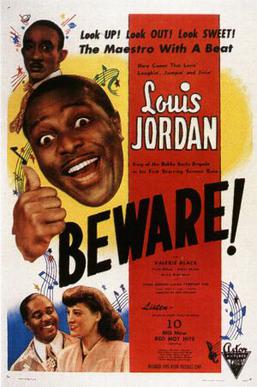
The most popular Race Films were probably the Musicals and Musical Revues (the latter being straight forward music and comedy concerts) which could use already established musical stars with proven box office appeal. chief among them being Cab Calloway and Louis Jordan. Plot-wise these films were simple in the extreme consisting of the slightest storylines as an excuse to string together a bunch of musical numbers. The first of Jordan's musicals typifies this genre.
Beware-Film-Poster

"BEWARE" (1946);


Directed by Bud Pollard
Cast;
LOUIS JORDAN  ~  Lucious Jordan
FRANK WILSON ~ Prof Dury
EMORY RICHARDSON ~ Dean Hargreaves
VALERIE BLACK ~ Annabelle Brown
MILTON WOODS ~ Benjamin Ware
DIMPLES DANIELS ~ Long Legged Lizzie
WILD BILL DAVIS ~ Pianist
EDDIE BYRD ~ Drummer

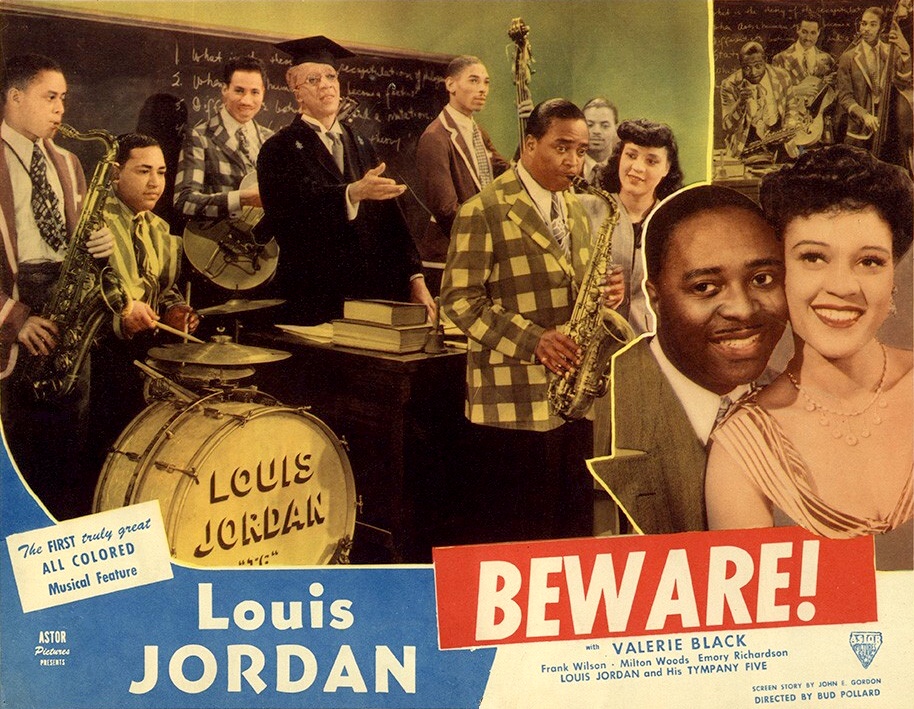
PLOT (spoiler alert); Jordan plays a sax playing bandleader who just happens to be named Louis Jordan (formerly Lucious) who is a former student of a Ware College, a fictional privately owned black college in small town Ohio. Ware College is apparently small and resembles more like a highschool and it's also strapped for cash as its owner has died and his grandson, Benjamin Ware III (Milton Woods) who has inherited it is threatening to sell. The Dean (Emory Richardson) and Professor (Frank Wilson) plan to deal with this by inviting the school's various illumni to return to help raise funds, including Jarvis, who happens to be on tour, drops by anyway and is told of the school's problems. It turns out that Jarvis originally left the school and town under an unexplained cloud and was once in love with Annabelle (Valerie Black) another former student and current teacher who Benjamin Ware has designs on so he agrees to stay and help the school by playing a gig. His band agrees to stay as well. While he's waiting Jordan also puts in a call to his accountant to go through the school's books. At the big dance Ware shows up and offers to relent on foreclosing on the school if Annabelle agrees to marry him but she refuses. Jordan then arrives and Ware threatens to have Jordan arrested and run out of town again but Jordan reveals that his accountant has discovered that Ware has been cooking the books and the school doesn't need to be closed. Jordan punches out Ware and threatens to have Ware arrested instead. Ware backs down and announces the school will be staying open. Jordan and the students celebrate by playing the show while Ware slinks out. Jordan and Annabelle will live happily ever after. Finis.
Louis-Jordan43

There's not much to be said about this movie as a film. The plot is perfunctory even by the standards of B-movie musicals of the era. The acting (setting aside Jordan for the moment) is blandly competent as is the direction. There are only five different sets in total, all of them simple indoor sets, and the camera work is similarly by-the-numbers. But of course what sells the movie is the presence of Louis Jordan and his music and there is plenty of both. Jordan's music is full of innocent joy and charm and sometimes silliness (as with "Don't Worry Bout That Mule" which comes out of nowhere) with equal parts catchiness and danceability. Jordan's infectious sense of fun is nicely shown in the outro of one number as Jordan leads the students out of the classroom doing the stroll. Accordingly the ratio of music-to-plot is accordingly higher than in most musicals. Note that while Jordan's trademark was bouncy Jump Blues and rambling comedy numbers he did do the occasional smooth ballad and he gets a couple here.

LOUIS JORDAN ~ "GOOD MORNING HEARTACHE";


Jordan is of course no actor but he does have a natural charm while playing the same persona that he had already developed on stage for over a decade and is perfectly at home on screen. The movie all but acknowledges this by not even giving his character a name and instead just calling him Louis Jordan and getting on with the story. Gene Autry films often did the same thing. As for the rest of the cast, many were veterans of the legitimate black stage and screen. Emory Richardson (1894-1965) had a few screen credits while Frank Wilson (1885-1956) had an even longer career in both the Black cinema and in Hollywood including in "The Emperor Jones" (1933) with Paul Robeson. Milton Woods (1917-1966), who plays the slimey Benjamin Ware III, was known as "The Black Basil Rathbone" although he spent much of his career outside of the Black Theatre and Cinema was spent in minor and sometimes demeaning roles in jungle B-Movies and TV shows like "Tarzan', "Ramar Of The Jungle", "Sheena; Queen Of The Jungle", "Superman" and "Amos & Andy". As for Jordan's band, two members went on to notable careers on their own. Drummer Eddie Byrd would lead his own band while pianist Wild Bill Davis (1918-1995) would become an influential figure on the Jazz organ playing with the likes of Count Basie, Duke Ellington, Eddie Cleanhead Vinson, Ella Fitzgerald, Arnett Cobb, Johnny Hodges, Illinois Jaquet, Eddie Lockjaw Davis, Ray Brown, Sonny Stitt and Slam Stewart as well as solo.  
reet

"REET PETITE & GONE" (1947);


Directed by
LOUIS JORDAN ~ Louis Jarvis/Schyler Jarvis (as a young man)
BEA GRIFFITH ~ Honey Carter/Lovey Linn
MILTON WOODS ~ Sam Adams (Louis' Manager/Friend)
JUNE RICHMOND ~ June
LORENZO TUCKER ~ Henry Talbot (Schyler's Lawyer)
VANITA SMYTHE ~ Rusty
DAVID BETHEA ~ Dolph the Butler
PAT RAINEY ~ Pat Rains (Louis' Singer)
J LOUIS JOHNSON ~ Schyler (older man)

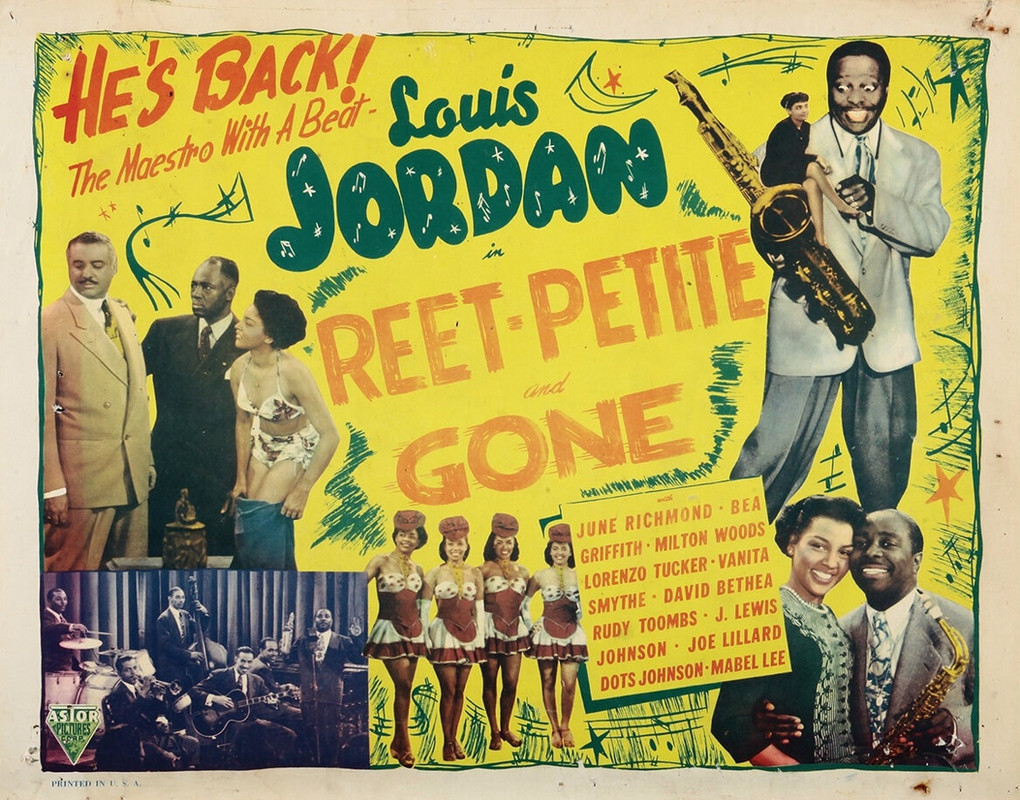
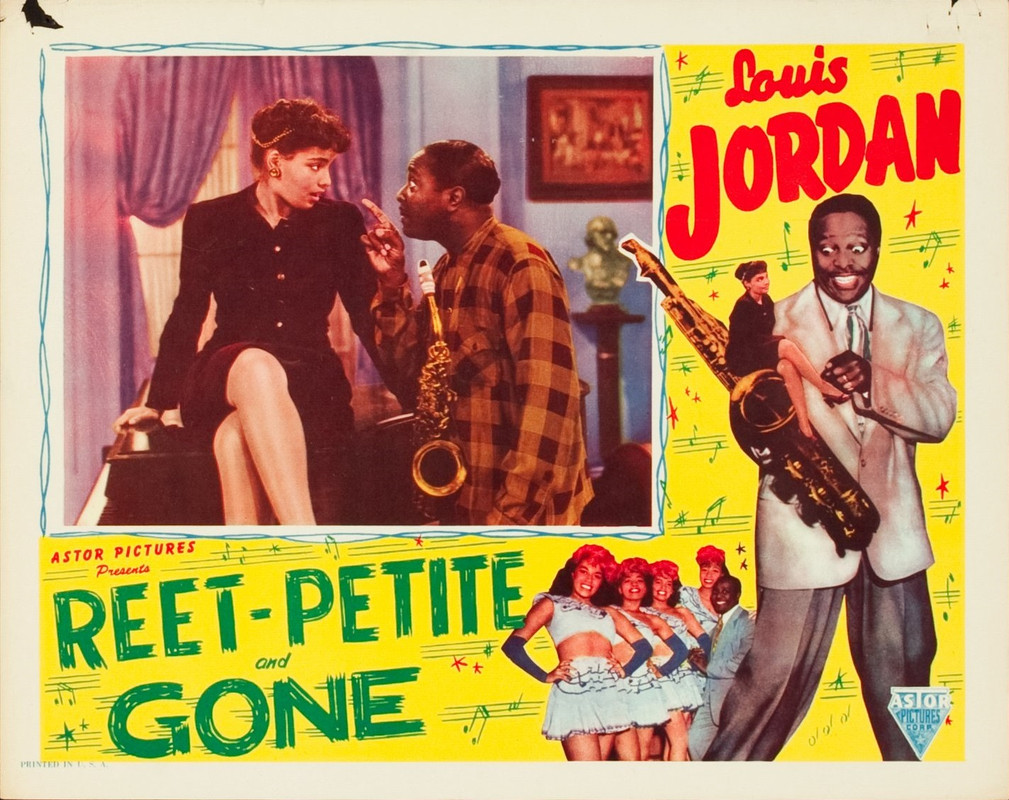
Plot Synopsis (spoiler alert); The second Jordan vehicle is even slimmer and more nonsensical as Jordan plays another sax playing bandleader, albeit this time named Louis Jarvis instead of Louis Jordan. Jarvis is playing a radio session when he is called away to New York where his father Schuyler (also played by Jordan) is dying. At the same time Honey Carter (Bea Griffith) has also been summoned by Schuyler along with her friend June (June Richmond). In a flashback Schyler (also played by Jordan) was also a bandleader and Honey's mother Lovey Linn (also played by Griffith) was a singer in his band and they were romantically involved. Louis and Honey knew each other as kids but haven't seen each other or Schuyler since. Schuyler dies before they arrive but he leaves a will which leaves his fortune to Louis on the condition that he marry a girl who is described as having a specific height and hair colour. Meanwhile Schuyler's lawyer Henry Talbot (Lorenzo Tucker) and his secretary Rusty are scheming to also get his fortune and they alter the will to add specific measurements that match Rusty (Vanita Smythe) and the lawyer then tries to convince Louis to marry her but Louis refuses. Instead Louis and his manager/friend Sam (Milton Woods) come up with their own plan to find the right girl by holding auditions for an upcoming Broadway revue that will include dancing girls using a new stage show during which measurements will be taken. Meanwhile Honey and June have arrived in town to be met by Talbot who tells them Schyler has died and tries to convince them to leave but they decide to stay and then come to the audition. At the audition Jordan plays several songs but none of the girls match the measurements. Honey and June arrive and June is hired as a singer and Honey is reunited with Louis who he signs as a dancer for the revue. Schuyler's butler Dolph (David Bethea) suspects that the will has been altered and before the show it is revealed that Talbot and Rusty had altered the will to trick Louis into marrying Rusty and they are arrested and Louis and Honey will be married. The film ends with some musical numbers at the revue.
MV5-BMm-Jl-MWE2-ODYt-MWQ0-ZS00-Nj-Bj-LTgw-NTEt-ZDY2-Nz-Ex-OTU1-MDdh-Xk-Ey-Xk-Fqc-Gde-QXVy-MTY5-Nzc4-MDY-V1

In spite of having a plot that is even more threadbare and frankly dumb but it's probably the best of the Jordan films simply because it has more music and the music has more variety along with some duets and revue numbers including dancing girls. Guest stars include the return of Milton Woods, the slimey villain of "Beware" although here he plays Louis' friend and manager which is inherently less interesting and he would have been put to better use as the greedy, arrogant lawyer. June Richmond as Honey's friend is ebullient and a strong singer. However there are a couple weaker members; David Bethea, as Dolph the Butler, is an older actor whose few other film credits include the Cab Calloway musical "Hi-De-Ho", has a disconcerting habit of looking directly into the camera while talking. Bea Griffith as the love interest sports some scantily clad outfits but she's wooden and it's notable that while she is added to Louis' Revue at no point does she display any actual musical talent, she doesn't sing and doesn't really dance either. Griffith does blandly sing a number with Louis while playing the mother but even his manager says she's not very good. It turned out to be Griffith's only film credit. Far better to cast in the romantic lead would have been the nameless model who wordlessly flirts with Louis at the audition. I don't know who she is (she isn't named and has no lines) but she is awfully cute and steals the scene. She is also the girl on one of the posters.

LOUIS JORDAN ~ "WHAM BAM" & "WHAT YOU PUTTING DOWN";


Jordan's band is not billed this time but clearly has several different members with the two most prominent members Wild Bill Davis and Eddie Byrd are absent. Singers June Richmond and Pat Rainey had musical careers of their own. Richmond was an established figure having sung with Cab Calloway and Andy Kirk. She was the first major Black singer to sing with a White band with Jimmy Dorsey and had appeared in another film. After which she would have other film roles and would appear on Broadway but her career would be cut short with her sudden death of a heart attack in 1962 at the age of 47. Pat Rainey would have a considerably more checkered career. After this film she would record a few moderately successful singles and appeared regularly in small Jazz clubs in New York. However she seems to have developed a heroin habit and was arrested in 1952 on charges of prostitution and drug possession and found guilty but, somewhat unusual for the era the judge showed leniency and gave her a suspended sentence on the condition that she return home to Boston with her parents and get treatment. Whether she did or not months later she was billed as performing at a Jazz club in Boston. Getting a second chance after such serious charges was even more unusual in that era but while she seems to not have recorded again she did tour Europe where she was reported to have had an affair with the notorious playboy King Farouk of Egypt in 1952. After these headlines however her career slowed down and she retired from music by 1961 returned to Boston married and dropped out of sight living quietly until her death in 1998 aged 72. One of the dancing girls in Jordan's Revue was appropriately named Roxy Joynes who had previously appeared in Jordan's short film Soundie "Caledonia". A model and showgirl, she had no other film credits but became tabloid fodder when she married baseball player Roy Campanella in 1964. She retired from showbiz and devoted herself to charity and they would stay married until his death in 1988. She died in 2004.

There would be one last quickie Jordan musical that year and it would be even sillier than the previous two.
lf

"LOOK OUT SISTER" (1947);


Directed by Bud Pollard
CAST;
LOUIS JORDAN  ~  Himself
SUZETTE HARBIN  ~  Betty Scott/Nurse
MONTE HAWLEY  ~  Mack Gordon
BILL DOGGETT  ~  Piano Player
PAUL QUINICHETTE  ~  Tenor Sax Player

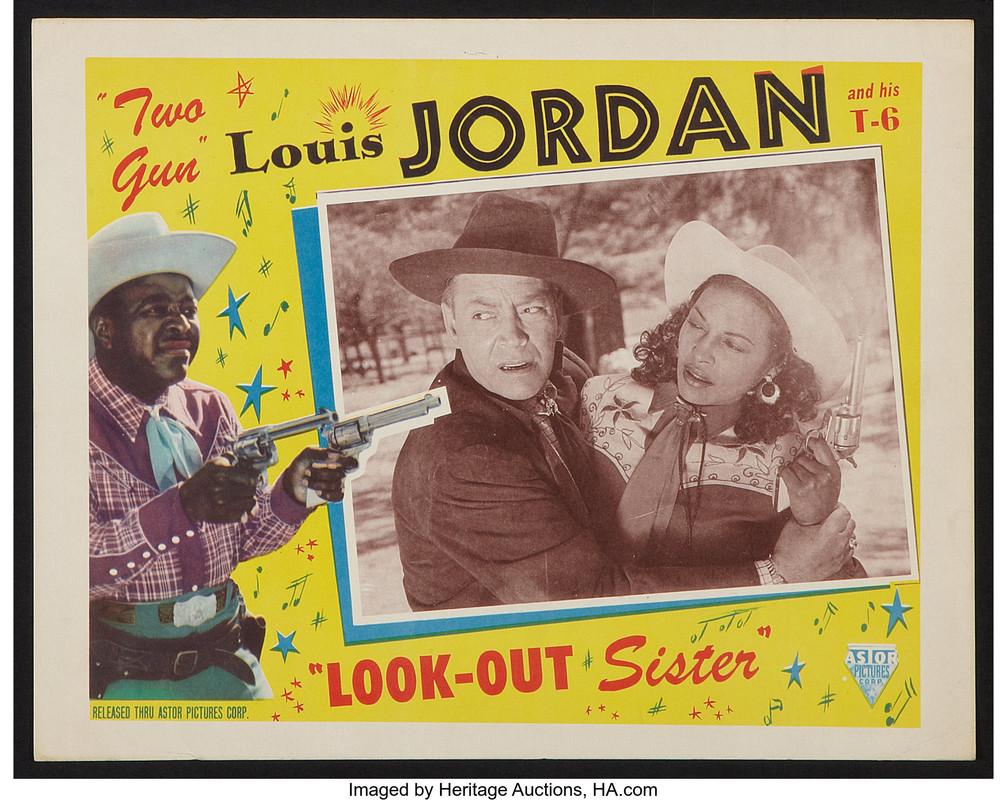
Plot summary (Spoiler alert); Once again Jordan is paying himself as a bandleader who has worked himself to exhaustion and after a photo montage of the band on tour (lifted from "Beware") gets sent to a sanatorium to relax. He befriends a nurse (Suzette Harbin) and a young boy who is also recovering at the sanitorium who is a fan of Westerns. While Louis sleeps he dreams he is at a Dude Ranch in Arizona as Two Gun Jordan, leader of a Western Swing band. The "H & H" Ranch (stands for "Health & Happiness") is an old fashioned western ranch with horses and a stagecoach and everybody wearing cowboy outfits and guns. The ranch is owned by Betty (also played by Suzette Harbin), a young woman and her brother Bob who are in debt to banker Mack Gordon (Monte Hawley) who holds the mortgage and is threatening to foreclose unless he is paid or she agrees to marry him. Betty is counting on Jordan to help by entertaining guests until Van Damme, a wealthy benefactor arrives. Unbeknownst to Betty Mack has discovered oil on the property and he sends Van Damme a letter telling him an infection has hit the ranch and he cancels his trip. Betty tells Louis they can't afford to pay him but he offers to help by staying with his band and playing for free as well as calling his friends in Hollywood for help raising the cash they need. Louis discovers Mack has discovered oil on the property so Mack frames him as a horse thief. A young boy who has befriended Louis overhears Mack plot to frame Louis. When Mack brings the sheriff to arrest Louis a fight breaks out and Louis and Bob saddle up and makes a run for it with Mack and a posse in pursuit. Louis shoots Mack but as the rest of the posse closes in he wakes up and announces he is going to send the children at the sanitorium to visit the the H&H Ranch and Nurse Betty falls in love with him as the film fades out.

LOUIS JORDAN;


Unlike the Herb Jeffries westerns which were copies of the Autry westerns and were intended to be such, Jordan's film is basically a parody of a Gene Autry western even though it's not really all that different from the actual Autry films. The difference can be seen in Jeffries performance which is relatively straight considering the inherent silliness of the genre. Jeffires doesn't wink at the camera or break character, while Jordan does. Jeffries plays the typical white hat wearing, two fisted, gun toting hero while Louis plays for comic effect. Jeffries could plausibly play a western hero because he looked like a matinee idol; tall and handsome while Jordan is short and slightly pudgy. Jeffries could ride a horse and looked believable in a fist fight while Jordan clearly can do neither. Not only does Louis play "himself" he makes a point of joking that he can't shoot a gun or ride a horse although he does at the end, albeit very awkwardly. The fight scene at the climax is filmed as sped up to look more slapstick and it also has the effect of reminding the viewer that this is supposed to be a dream which Louis is in fact about to wake from. The Autry films existed in a strange alternate universe where staples of the Old West existed alongside the modern world so Cowboys, Indian and outlaws ride horses and stages and shoot six guns while other characters (often greedy bankers) wear modern suits and fedoras, drive cars and use telephones and Autry uses a microphone and broadcasts on the radio. Jordan's film shares the same tropes but unlike the Autry films as a dream Jordan's film is aware of its silliness. Making the film a dream sequence, which is something none of the Jeffries or Autry films ever did no matter how outlandish their stories, makes clear that this is meant to be a parody aimed at adults rather than children. 

The audience for the original Autry films as well as their various imitators like Roy Rogers and Hopalong Cassidy were children who became devoted fans, excitedly attended the Saturday afternoon matinees and bought the wildly successful lines of merchandise. This included black kids even though they were not represented in these films and Herb Jeffries always said it was his explicit intention to do a Black version of Autry's film specifically saying that he wanted "little black children to have their own hero" and he was also hoping to market his own merchandise, although that didn't turn out to happen. Jordan on the other hand already had a large audience as a genuine musical star (Jeffries had also been a Big Band singer but was not exactly famous) that his previous film clearly played to and they were not children. Jordan's music was full of sly double entendres which were common in Blues but which would have gone over the heads of kids while still being subtle and gentle enough to avoid censors and the same is true in his movies. They were made for his existing fans as this film is aimed at adult audiences who would understand that it's a parody in a way that Jeffires superficially similar westerns were not. Having the by then rather pudgy and noticeably not a screen idol Jordan stumbling around, falling off his horse, clumsily twirling his gun and getting into an awkward slap fight while mugging for the camera is meant to entertain an adult audience who would understand he was parodying the tall, broad-shouldered two fisted heroes of white westerns, not imitate them. Note that the name of the ranch as the "Health & Happiness Ranch" is probably a reference to the "Health & Happiness" radio show hosted by Hank Williams which would have been familiar to the Southern members of his audience but not something kids would have picked up on. Thus this film, while hardly any sort of classic, is objectively a better film than the Jeffries films. Besides the fact that it has much better music of course.

LOUIS JORDAN ~ "LOOK OUT SISTER";


The cast doesn't have any real notable figures. Monte Hawley was a veteran of the Black Stage as well as several of Oscar Michaux's films and one of Duke Ellington's. He died in 1950. Pianist Bill Doggett would have a successful solo career including a hit single in "Honky Tonk" (1951) and worked with Ella Fitzgerald, Count Basie, Louis Armstrong, Lucky Millinder, Wynonie Harris, Johnny Otis and the Ink Spots. He died in 1996 aged 80. Sax player Paul Quinichette would have a successful Jazz career playing with Count Basie, Jay McShann, John Coltrane, Dinah Washington, Billie Holiday and Benny Goodman earning the nickname Vice Pres by way of tribute, with Lester Young being the Prez. Young himself called him "Lady Q" which was still considered a compliment. He died in 1983.

This would be Jordan's last feature film although there would be a few guest spots but like Herb Jeffries his brief career as a film star was over. The entire genre of Race Films essentially came to an end in the fifties for some of the same reasons that Poverty Row B-Movies did as television changed movie going habits forever and many smaller theatres closed down and the Poverty Row studios went out of business. Others switched to making the sort of Teen Exploitation movies that could play in the new network of drive-ins. For Jordan movies were never more than a sideline anyway but tastes in music were changing as well the Rock & Roll era began.

Although Jordan is now widely acknowledged as one of the founders of Rock & Roll and would be cited as an influence by the likes of Chuck Berry, Little Richard, James Brown, BB King and Ray Charles at the time he was seen by teen record buying teens as decidedly old hat. The audience for R&R in the fifties was almost exclusively made up of teenagers and by that point he had been around since before the war and the more associated with the Swing Era of Count Basie and Duke Ellington than Elvis and Chuck Berry. Especially since the main instrument for R&R was the guitar, not the sax and suddenly Jordan's jive talking saxman seemed as old fashioned as Louis Armstrong. Jordan himself was reluctant to cater to the new teen audience playing package tours instead relying on his older established fans and the night clubs and Chitlin Circuit. At the same time Jazz audiences had changed as well with the Swing Era he was somewhat related to being replaced by the more cerebral Be-Bop and Cool Jazz scenes who looked askance at Louis jukebox mugging. His contract with Decca Records ended in the early fifties and he moved through a series of other labels through the decade including Aladdin, Vik, and Mercury and he was also plagued by health issues which also slowed him down.

LOUIS JORDAN ~ "SWING OUT LOUD";


The Blues revival of the sixties was focused on the guitar and harmonica playing urban bluesmen like Muddy Waters and John Lee Hooker or the Folk Bluesmen of Son House and Mississippi John Hurt rather than a fast talking, sax slinging hustler who was once called the Jukebox King. Throughout the sixties he would record for various small Jazz labels but his days as the Jukebox King were over. Most modern Jazz critics have been even more dismissive, usually not even considering him at all. In a typical example in the 2001 Ken Burns documentary series and accompanying book Jordan is mentioned long enough to acknowledge his Jazz roots but then dismiss him as a corny showman who cheapened his talents with crowd pleasing antics for crass commercial motives. Cab Calloway and Slim Gaillard, two other proto R&R contemporaries get similar treatment. Louis Jordan died in 1975 aged 66 but he would eventually get his due.

By the 80's and 90's a new generation of artists like Joe Jackson, Kid Creole, Brian Setzer, Dexy's Midnight Runners and any number of Ska bands were wearing suits and adding horns to their repertoire and Jordan was being hailed as a godfather of R&R. The 1980 film "The Blues Brothers" included one of his songs and the US postal service issued a stamp with his image. Louis Jordan was inducted to the Rock & Roll Hall Of Fame in 1987 and in the Blues Hall Of Fame. In 1990 a musical based on his music called "Five Guys Named Moe" would run for four years in Londona and Broadway in 1992 winning an Olivier Award and two Tony nominations. In 2018 he was awarded a posthumous Grammy Award.

LOUIS JORDAN ~ "HOW LONG MUST I WAIT FOR YOU";


Louis-Jordan-Old-Man-Mose-1

USA-4339

Tuesday, 27 December 2022

A Mostly Complete List Of Rock Posters On WKRP In Cincinnati


tumblr-864154b8c1faa14493cf5b8f6890a2ca-4f0ce7d0-400

Last year Howard Hessemen, AKA Dr Johnny Fever of "WKRP In Cincinatti", died aged 81, and the year before Frank Bonner (Herb Tarlek) died at 79. Like any 80's kid who was into music I grew up on "WKRP" which aired from 1978-82, and it's pretty much the only sitcom I would actually watch religiously (along with "The Monkees") and still have literally every line of dialogue memorized and I'm not even alone on this. I'm not going to say "WKRP" and Johnny Fever are the reason I got involved with radio but it's not not the reason either. Other attempts at Rock related sitcoms have never worked out and haved dated even worse but the mighty 'KRP maintains a devoted audience even forty years later even though it was not really a massive hit at the time. The show was blessed with a fine ensemble cast and some excellent writing but what really earned WKRP it's cult status was music and radio nerds. Only a few episodes were really about music as the main plot driver, the bulk of the stories were about the sharply defined characters with the radio station being the backdrop but the show had a good understanding of radio (some of the producers and cast had worked in radio) and made excellent use of incidental and background music and (usually) showed a sincere understanding of the worlds of Rock and radio and it's worth remembering that some of the writers and cast had previous radio or music careers Howard Hesseman had in fact been a DJ at a popular FM Rock station in San Fransisco in the Psychedelic sixties while Gordon Jump (as Station Manger Arthur Carlson) had been an AM radio DJ in the early sixties, Jan Smithers (as Bailey Quarters) had sung in a Psychedelic Folk Rock band Hot Club Of Friends with her then boyfriend Christopher Mancini (son of Henry) who had scored an appearence on "The Midnight Special in 1973 and even Carol Bruce (as station owner Mother Carlson) had been a Big Band singer and dancer in the 1940's. Instead of relying on the sort of sappy Pop music and Disco that would have been popular at the time but would not have dated well WKRP instead used a combination of Classic Rock tracks (notably Clapton, Pink Floyd, Foreigner, Queen, Stones, Little Richard, Elvis, Ted Nugent), some riskier New Wave which turned out to also become classics (The Police, The Cars, The Pretenders, Blondie, even Captain Beefheart), Smooth R&B and Light Jazz (Grover Washington, Bill Evans) and Reggae (Bob Marley).

tumblr-mn2udg-NX0-Q1s9btcio1-400

They didn't get everything right of course, Radio nerds point out that WKRP only ever had four full-time DJ's at any one time; Dr Johnny Fever (in the morning drive spot, from 6AM to about noon), in the afternoon there was the once mentioned Dean The Dream later replaced by the occasionally seen Rex Erhardt (presumably from noon to early evening), Venus Flytrap (evening till around midnight) and the often mentioned but never actually seen Moss Stieger as the overnight spot, along with a Sunday morning show with the Rev Little Ed Pembrook all of which is wildly impractical. Also no AM station (and probably no non-campus FM station either) would have a programming schedule as wildly varied as WKRP's which ranged from Fever's Classic Rock and New Wave to Earhrdt's Yacht Rock and Soft Pop to Venus' romantic R&B and light Jazz. We never actually learned what Stieger played but he seemed to be a burned out hippie. But the concept of the show often made mention of the station's quirky and unprofessional approach as part of it's charm so this is acceptable enough in context. More noticably were the few episode that actually had music related storylines front and center which music nerds would eyeroll over. One such was a story featuring an ex flame of Program Director Andy Travis named Linda Taylor (played by Barrie Youngfellow who also died in 2022) who had become a major star as a singer in the mold of a mid seventies style Country Pop singer like Linda Ronstadt or Crystal Gayle who was already out of fashion by 1980 and unlikely to attract the kind of attention the show gave her. Another was a guest spot by Country singer/songwriter Hoyt Axton who once again played a type of early 70's Pop Country that was long obsolete on Top 40 radio. The Axton episode was actually one of only two to have actual musicians guest on the show.

THE RAMONES  ~  "DO YOU REMEMBER ROCK & ROLL RADIO";


But then there was the still iconic Scum Of The Earth episode. Scum were WKRP's answer to Punk Rock (or as they insisted, Hoodlum Rock) played by Micheal Des Barres, an actual singer and two other dudes. Scum were the stereotypical hotel trashing, audience baiting, DJ bashing bad boys. Musically they had more in common with an inferior Van Halen than the Clash but the episode had no lack of quotable lines that can still be recited by any rocker over the age of 30. Des Barres had had been kicking around the fringes of the UK and Los Angeles Glam Punk scene since 1972 (he also had some acting credits going back the sixties as a child actor including "To Sir With Love") with his bands Silverhead and Detective, without having any critical or fan success. His bands tried to appropriate some of the energy of Punk with the sheen of Glam and Glitter bands and the denser sound of mainstream Hard Rock bands like Aerosmith or Nazareth without managing to achieve the better qualities of any of them or any memorable songs. Silverhead recorded three albums between 1972 and 1975 but their most notable legacy being bassist Nigel Harrison who went on to join Blondie, with two others joining ex Led Zeppelin singer Robert Plant's band.

SILVERHEAD  ~  "16 & SAVAGED";


By the time of 1978 he had a second band, Detective, but Punk and New Wave had happened and Des Barres' Cock Rock antics seemed dangerously out of touch and the critics and actual punk scene despised them especially since two of the members had served in Steppenwolf and keyboardist Tony Kaye in Yes, the latter being one of worst possible pedigrees for the Punk/New Wave Era. Musically they sort of resembled the Tubes as fronted by David Lee Roth which might have worked if they had any of the Tubes catchy songs or sense of humour nor were they prepared to go as over-the-top as the Tubes' Fee Waybill which was a little odd given Des Barres roots as child actor. They might have been better off if they had just embraced his Cock Rock instincts like Van Halen or the original Quiet Riot (both of whom were starting out) but that's assuming they had a flashy guitarist like Eddie Van Halen or Randy Rhodes which they did not. They did tour with Nazareth and Kiss who liked them well enough to record (but not release) one of their songs. Detective were offered but passed up a chance to record "I Need A Lover" written by a young John Cougar which would later become Cougar's first minor hit as well as being recorded by Pat Benatar. The actual music for Scum would be provided by Detective but the band would be portrayed by Des Barres (named Dog) and two other actors, Peter Elbling (as Blood) and Jim Henderson as Nigel. The episode was easily the most publicity Detective ever got but it wasn't enough to lead to any real breakthrough for the band who broke up in 1979 after being dropped by their label. If they had been around for the late eighties Hair Metal scene they might have had better luck, or at least Des Barres might have. By contrast Blondie credited WKRP for helping to promo "Heart Of Glass" and even sent a gold record that would be displayed in the bullpen for the show's duration so apparently WKRP was thought to have some promotional clout, just not for Detective.

DETECTIVE  ~  "DETECTIVE MAN";


Post WKRP in 1984 Des Barres again lucked out getting tapped to replace Robert Palmer in Power Station, another New Wave supergroup that included John and Andy Taylor from Duran Duran drummer Tony Thompson from Chic who had already scored one hit album but with Des Barres all they managed was a another TV guest shot (this time on "Miami Vice") before they too broke up. Des Barres did go on to form another band in 1984, Checkered Past, a sort of Punk/New Wave supergroup including Nigel Harrison, Frank Infante and Clem Burke from Blondie, Steve Jones from the Sex Pistols and Tony Sales from Iggy Pop's band which once again failed with both critics and audiences after one album breaking up after about a year. After that aside from being rumoured as a possible replacement for David Lee Roth in Van Halen his biggest claim to fame was marrying super groupie Pamela Des Barres along with a few TV guest spots and fronting his own solo band. Ironically one of his most successful TV roles was in the 1991 remake series "The New WKRP" where he played a morning Zoo type DJ. As for the rest of Scum; the fellow Brit Peter Elbling was an experienced actor having appeared on Broadway as well as in the Rock Opera "Phantom Of The Paradise" (billed as Peter Oblong) where he was the singer in each of the weird bands killed off by the Phantom, he has continued to appear in film and TV to date. Jim Henderson, the other member of Scum, is a mysterious figure. Henderson has only one other listed credit on IMDB as a "Punk Rocker" in a 1981 episode of "Charlie's Angels" and is otherwise billed as a drummer. However there is no trace of what bands he played in (he didn't play in either of des Barres's bands) so either none of his bands recorded anything or he was primarily a session musician. A Google search turns up absolutely no trace of him since and I have no idea what became of him or even if he's still alive. His IMDB entry does list another film credit from the 1950's but unless he was a child actor this is probably some even more obscure bit player with the same name. These types of mistakes sometimes happen with the more obscure entries on IMDB.    

  THE SCUM OF THE EARTH  ~  "GOT ENOUGH LOVE";


                      Part of the fun for music nerds was playing spot the band with the numorous records played and posters displayed at the station. As a measure of the devotion music and radio nerds have for WKRP some dude managed to compile a list of every song used during the show's run which can be found here. Aside from a handfull of tunes recorded specifically for certain stories the show made good use of actual records of the era. This would later cause problems with copyright issues when the show went into syndication for reruns as well during which these songs would be switched out in favour of generic rock tracks much to the fans annoyance. This also tied up the eventual DVD release which was widley panned for the sloppy musical choices stifling subsequent releases until a rerelease in the 2010's. Besides the music the show's authenticity was boosted by decorating the set with contemporary posters encouraging eagle-eyed music nerds to play spot the band. And who's a radio & music nerd with two thumbs to type with? This Guy! Accordingly I've gone through every episode to list every poster used during the show's run which range from mainstream AM Pop to R&B to Hard Rock and New Wave and even some Jazz.

Les-Nessman-wkrp-in-cincinatti-40254083-500-412

A couple of notes; Most of the posters were from the second season onward presumably because they started getting serviced by record companies who would have had their own artists they wanted to promo. The list isn't quite all inclusive as there are about two dozen posters I either couldn't quite make out either because they were too small, obscured, or you only catch too brief a glimpse to be read even using pause along with a few I just couldn't recognize. Several artists appeared more than once, if the same poster was repeated I only counted it as one however when a different poster of the same artist was used I noted them separately.

~~~~~~~~~~~~~~~~~~~~~~~~~~~~~~~~~~~~~~~~~~~~~~~~~~
AD/DC ~ "FOR THOSE ABOUT TO ROCK";


The A's
AC/DC (X3)
Adam & The Ants
Aerosmith (twice)
Greg Allman
Herb Alpert
America
Joan Armatrading
Patti Austin
Albert Ayler (at Johnny's pad)
The Average White Band
The Babys
The Beat (the US band with Paul Collins, not the English Beat)

THE PAUL COLLINS BEAT ~ "ROCK & ROLL GIRLS";


Joan Baez (in a photo with Bob Dylan at Johnny's pad)
Jeff Beck
The Bee Gee's
Pat Benatar (twice)
George Benson
Black Sabbath (twice)
The Blasters

THE BLASTERS ~ "BORDER RADIO";


Blondie (three times including a gold record)
The Blues Brothers (X3)
The Brothers Johnson
Lenny Bruce (at Johnny's pad)
Irene Cara
George Carlin
Kim Carnes
Jim Carroll
The Cars (twice)

THE CARS ~ "SHAKE IT UP";


Carlene Carter
Roseanne Cash
Ray Charles
City Boy
Eric Clapton (X3)
Stanley Clarke

THE CLASH ~ "THIS IS RADIO CLASH";


The Clash (X4)
The Commodores
Perry Como (at the transmitter)
Rita Coolidge (twice)
Ry Cooder (twice)
Elvis Costello (twice)

ELVIS COSTELLO & THE ATTRACTIONS ~ "RADIO RADIO";


John Cougar

Crosby, Stills & Nash (X3)
Rodney Crowell
The Cretones
Charlie Daniels Band (twice)
Detective
Willie DeVille
Devo (twice)
Dire Straits
The Doors (plus one in Johnny's pad)
Bob Dorough (at Johnny's pad)
Duran Duran
The Durocs
Ian Dury
Bob Dylan (twice, also one of Dylan & Joan Baez at Johnny's pad)
The Eagles (twice)
Earth, Wind & Fire
Ebonee Webb
Dave Edmunds
ELO (X3)

ELO ~ "ROCK & ROLL IS KING";


Emerson, Lake & Palmer
Marianne Faithful
Jay Ferguson
Fleetwood Mac
Mick Fleetwood
Dan Fogleberg & Tim Weisberg
Foghat
Foreigner
Peter Frampton
Gamma (w/Ronnie Montrose)
J Geils Band (twice)

Steve Goodman

THE GO-GO'S ~ "WE GOT THE BEAT";


The Go-Go's
The Grateful Dead (X3)
Hall & Oates
Steve Hackett (twice)
Heart
Sammy Hagar (X4)
Bill Haley

BILL HALEY & THE COMETS ~ "ROCK AROUND THE CLOCK";


Hall & Oates
Emmylou Harris (X3)
Jimi Hendrix (X4)
Patrick Hernandez
Lena Horne (twice)
Ian Hunter (twice)
The Inmates
Interview
Joe Jackson (four times)

JOE JACKSON ~ "STEPPING OUT";


Michael Jackson
Rick James
Al Jarreau
Jefferson Starship (twice)
Jethro Tull
Olivia Newton John
Grace Jones
Rickie Lee Jones
Janis Joplin (at Johnny's pad)
Journey
Chaka Kahn (twice)
Kansas (twice)
The Kings
The Kingston Trio (at the transmitter)
The Kinks
Kiss
The Knack
Kraftwerk (twice)

KRAFTWERK ~ "RADIOACTIVITY";


Krokus
Nicholette Larson (twice)
Led Zeppelin (twice)
LeRoux
John Lennon (X3, twice with Yoko Ono)
Huey Lewis & The News
Little Feat (twice)
The Little River Band (twice)
Loverboy
Lena Lovich

LENA LOVICH ~ "LUCKY NUMBER";


Paul McCartney & Wings
Michael MacDonald
Madness
Melissa Manchester
Chuck Mangione
Barry Manilow (used as a dartboard by Johnny & Venus)
Bob Marley (twice)
Steve Martin
Randy Meisner
Pat Metheny
Midnight Star
Missing Persons

MISSING PERSONS ~ "MENTAL HOPSCOTCH";


Ronnie Montrose
Eve Moon
Van Morrison (twice)
The Motels (X3)
Gary Myrick (twice)
Randy Newman
Juice Newton
Stevie Nicks (twice)
Ted Nugent
Oingo Boingo
Yoko Ono (with John Lennon)
Pablo Cruise
Robert Palmer (twice)
Parliament Funkadelic
Jaco Pastorius
Pearl Harbor & The Explosions
Pink Floyd
The Pointer Sisters and Bonnie Pointer solo
The Police (X3)
Jean Luc Ponty

THE POP ~ "BEAT TEMPTATION";


The Pop (the L.A band with Tim McGovern later in the Motels, not the UK band the Pop Group)
Elvis Presley
Billy Preston (twice)
The Pretenders (X3)
Prism
Quarterflash (twice)
Suzi Quatro

SUZI QUATRO ~ "ROCK HARD";


Queen (twice)
Bonnie Raitt
Gilda Radner
Red Rider
Leon Redbone
Kenny Rogers
The Rolling Stones (X4 plus a photo of Mick & Johnny in Johnny's pad)

THE ROLLING STONES ~ "IT'S ONLY ROCK & ROLL";


The Romantics
Linda Ronstadt (twice)
Diana Ross
Todd Rundgren
Sad Cafe
Leo Sayer (twice)
Bob Seger (twice)
The Selector

THE SELECTER ~ "ON MY RADIO";


Dell Shannon
Simon & Garfunkle
Southside Johnny & The Asbury Jukes
The Sports
Split Enz
The Michael Stanley Band
Starbuck
Ringo Starr (twice)
Steely Dan
Rod Stewart (X4)
Streetheart

STREETHEART ~ "HOLLYWOOD";


Styx
Kasim Sultan
Supertramp (X3)
The Sweet
Syreeta
The Temptations
Ten Years After
Thin Lizzy
George Thorogood
Peter Tosh
The Tubes (twice)
Twennynine
Ultravox (twice)
The Undertones

THE UNDERTONES ~ "TOP TWENTY";


U2 (twice)
Van Halen
The Vapors
Tata Vega
Grover Washington Jr
The Whispers
The Who
Jesse Winchester
Steve Winwood
Gary Wright
XTC
The Yellow Magic Orch
The Yellowjackets
Neil Young (X3 plus one at Andy's pad)
Warren Zevon

XTC ~ "THIS IS POP";


Plus there were posters for local Jazz club The Blue Whisp (at Johnny's pad), record companies Stiff and Portrait Records and a few compilation albums including;

"The Last Waltz", the Martin Scorsese directed film about the final concert of the Band featuring Bob Dylan, Eric Clapton, Muddy Waters, Neil Young, Neil Diamond, Joni Mitchell, Emmylou Harris, Van Morrison, Ron Wood, Ronnie Hawkins, Paul Butterfield, Ringo Starr, Dr John, Bobby Charles & the Staple Singers.

"Propaganda" a compilation of UK New Wave including early singles by The Police, Squeeze, Joe Jackson, The Secrets & The Reds

"Times Square" Soundtrack including more Punk & New Wave figures including The Ramones, The Ruts, Pretenders, Roxy Music, Talking Heads, Gary Numan, XTC, The Cure, Lou Reed, Suzi Quatro, Patti Smith, and David Johansen

THE RAMONES ~ "WE WANT THE AIRWAVES";


A look at the bands listed shows a far more interesting mix of you would normally expect from commercial radio (actually Toronto & Hamilton had quite a varied and lively radio scene in the early eighties as would a few other places; New York, San Francisco, L/A, Boston and Windsor/Detroit, but not a commercial station in a smaller more conservative town in the Midwest) with genres ranging from the expected classic rock (John Lennon, Paul McCartney, the Stones, Doors, ELO, Heart, Rod Stewart, Neil Young, Hendrix, Supertramp, Jethro Tull, The Who, Ten Years After, Gary US Bonds) some R&B (Earth Wind & Fire, Parliament, Rick James, Chaka Kahn, Irene Cara, Grover Washington Jr, George Benson, Ray Charles, Pointer Sisters), Reggae (Bob Marley, Peter Tosh), Soft Rock (Dan Fogleberg, Leo Sayer, Kim Carnes, Juice Newton, Nicolette Larson), Country Pop (Kenny Rogers, Emmylou Harris, Carlene Carter, Roseanne Cash, Steve Goodman), Jazz (Jaco Pastorius, Jon Luc Ponty, Albert Ayler, Lena Horne, Al Jarreau), Oldies (Elvis, Bill Haley, Del Shannon, the Kingston Trio), Comedy (Steve Martin, Gilda Radner, George Carlin, Lenny Bruce), some Hard Rock & Metal (AC/DC, Aerosmith, Zeppelin, Sabbath, Van Halen, Krokus, Thin Lizzy, Detective, Ronnie Montrose & Gamma w/Sammy Hagar) and a surprising amount of New Wave and New Wave adjacent bands for a midwestern AM radio station in 1978-82 (The Clash, Pretenders, The Knack, Motels, the Cars, Romantics, Police, Vapors, Split Enz, Missing Persons, Inmates, Cretones, Undertones, U2, Ultravox, Duran Duran, Kraftwerk, Yellow Magic Orch, XTC, Lene Lovich, Elvis Costello, Jim Carroll, Joe Jackson, Ian Dury, and New Wave adjacent bands Dave Edmunds, Suzi Quatro, Dire Straits and Red Rider). There are some interesting choices; a small Duran Duran poster can be seen a year before they really scored any stateside success, likewise U2 show up twice a good three or four years before they made a big break in America, the Motels show up three times although at the time they were a cool but fairly obscure artsy New Wave band who would later score a few hits after the show's run, Missing Persons were another new band with a single EP and some good reviews but they also wouldn't have a hit until later, Ska bands Madness and the Selector would never score much US success, Lene Lovich, Oingo Boingo, the Sports, Pearl Harbor & the Explosions, Yellow Magic Orch, Sad Cafe, City Boy, the Pop (the US band not to be confused with the UK band the Pop Group) and the Beat (the US band with Paul Collins, not to be confused with the English Beat) were other New Wave bands that got some good reviews but would score no hits. John Cougar was just getting started and had only minor success but ironically as mentioned above one of his songs ("I Need A Lover") had been offered to Detective who turned it down only to see both Cougar and Pat Benatar havesome success with it. Kasim Sultan was the bassist with Prog Band Utopia but his solo career never amounted to much however he went on to a long career as a session bassist with Patti Smyth & Scandal, Joan Jett, Ronnie Spector, Todd Rundgren, Meat Loaf, Steve Stevens, Rick Derringer and the Rubinoos among others while Jay Ferguson was a former member of Prog/Psyche bands Spirit and Jo Jo Gunne but his biggest seller would turn out to be the theme from the TV series "The Office" thirty years later. Even more obscure, at least to me, were R&B bands Twennynine, Le Rouge, Syreeta and Ebonee Webb, Gospel singer Tata Vega, Jazz singer Bob Dorough and singer/songwriter Gary Myrick. BTW a parody in "Mad Magazine" had posters for Minnie Pearl and Jim Nabors which wasn't really funny but it was actually funnier than the rest of the article thought it was.

Ironically while Van Halen show up only once (for their first album) future singer Sammy Hager has three posters with one up for much of the second season. There's a fair amount of Cancon with not only the well established Neil Young, Joni Mitchell and Loverboy but also the less well known Red Rider, Streetheart, Prism and the Kings, no Rush though. As an additional note WKRP literally had much more black representation both visably and audibly than MTV did at that time (starting on air in 1981) and for a few years later when they were still so notoriously lily white that David Bowie actually brought it up during an on-air MTV interview.

AC/DC  ~  "LET THERE BE ROCK";


WKRP went off the air after only four seasons, which is one year less then the five seasons normally needed to sell a show for reruns in syndication but it's cult audience insured that it would eventually make its way into reruns throughout the eighties and nineties and eventually a DVD release of the first season. Unfortunately these reruns suffered from a problem unique to the show. Unlike other sitcoms WKRP used a lot of recognizable music which led to a tangle of copyright issues that would lead to having these reruns having most of its music removed and replaced with generic backing tracks. Since not only was much of the music used classic songs but some of the music in the show was integral to some of the jokes this attracted a lot of disappointed reviews from diehard fans and led to delaying the release of the complete series for several more years until the copyright issues could be sorted out. As it turned out the two episodes that featured guest spots from actual musicians, namely the Scum Of The Earth/Detective and Hoyt Axton episodes were virtually the only ones to keep their original music throughout the various syndication runs. Another ironic note; While Detective (who were on the show as Scum Of The Earth) get a poster in the same episode Hoyt Axton (who was also on an episode where he sang) did not. 

   waiting-wkrp

Surprisingly few of the show's cast maintained high profile careers. Loni Anderson (as Jennifer Marlowe) became a major sex symbol from the show but post WKRP her career declined with her biggest roles being a short lived TV detective series with former "Wonder Woman" Lynda Carter and playing the title roles in a Jayne Mansfield biopic then she essentially dropped out of sight to marry Burt Reynolds in 1988, they would have a messy divorce in 1994. After a few TV guest spots Jan Smithers (Bailey Quarters) would also retire to marry, in this case to James Brolin in 1986, they divorced in 1995 and she moved to Canada for a while before returning stateside where she remains. Of the rest of the cast, Gordon Jump (Arthur Carlson), Frank Bonner (Herb Tarlek) and Richard Sanders (Les Nesman) appeared in various TV guest spots with Gordon Jump notably appearing in a controversial episode of "Different Strokes", he died in 2003. Only Howard Hessemen (Johnny Fever) and Tim Ried (Venus Flytrap) went on to regular a series with Ried appearing in "Frank's Place" (1987-88) a sitcom about a restaurant owner and "Snoops" (1989-90) a detective show.

tumblr-ok64gp0-Gan1uppk2eo1-500

Hessemen became a semi-regular in the sitcom "One Day At A Time" from 1982-84 and "Head Of The Class" (1986-90) a highschool sitcom where he played a father figure teacher that was actually a hit although he was publically dissatisfied with his straight-man role and the shown has been largely forgotten about. Better remembered was his cameo in the classic Rock Mocumentary "This Is Spinal Tap". A word about two other cast members; Carol Bruce (Mother Carlson) had a career as a Big Band singer, dancer on Broadway and film actress going back to the 1940's, she died in 2007, actually outliving her onscreen son Gordon Jump a role that had originally been played by screen veteran Sylvia Sidney in the pilot episode until she backed out disliking the show and cast as silly and beneath her. The scene stealing character of Hirsch, Mother Carlson's ancient, sardonic butler was played by Ian Wolfe. Born in 1896 he had a respected career as a character actor going back to the early days of talkies including roles in "Zorro" in the 30's, several of the Basil Rathbone "Sherlock Holmes" films and Hitchcock's "Saboteur" in the 40's, Billy Wilder's classic "Witness For The Prosecution" and "Rebel without A Cause" in the 50's, "The "Twilight Zone" and "Star Trek" in the 60's and George Lucas's debut "THX" in the 70's. The odd thing about his roles is that from the start of his career he always played older witty, gentlemanly characters and always looked the same; a slight man with stooped shoulders and receding hairline with a distinctive lilting voice and mid-Atlantic accent. It was as if he was never actually young. By the time of "WKRP" he was in his eighties and Hirsch became his most iconic and beloved role, he continued acting including in cameos in Warren Beatty's "Reds" and "Dick Tracy" being his final role in 1990. He died two years later aged 95.            

THE KINKS ~ "COME DANCING";


The show stayed a cult favorite through the eighties and was finally revived in a new series "The New WKRP" from 1991 to 1993 which included half of the original cast in Arthur Carlson, Les Nesman, Herb Tarlek and for several episodes even Johnny Fever along with guest spots from Venus, Jennifer and Mother Carlson. However in spite of having much of the original cast and producers and treating the original series and characters with affection and respect the show simply wasn't funny and never caught on. After some initial attention from the original fans interest dropped off and not even the keeping the original's famously catchy if incomprehensible closing theme, having Michael Des Barres as a DJ and the much hyped return of Johnny Fever for several episodes could save the show. The revival is largley dismissed by all but the most diehard fans and I have not included any of its episodes in my above list of posters which would have also been from a different era of music and radio. As it happens the reboot actually had far less music and posters anyway, possibly they were looking to avoid the copyright issues that plagued the earlier show when it came to syndication. As it happened they weren't around long enough for that to become an issue.

In one final legacy of the show a few Punk and Metal bands have named themselves the Scum Of The Earth, a 1990's Toronto Indie Garage band named themselves Buzz Sapien after the shows stage manager and in 2004 veteran Toronto band the Rheostatics named one of their songs "The Tarleks" and even got the real Herb Tarlek to appear in the video along with one of his infamous plaid polyester jackets.

THE RHEOSTATICS  ~  "THE TARLEKS";


39b7fcb640ebec8f4f0c8455b1a70f4a

Tuesday, 22 November 2022

Kino-Pravda; The 1920's Soviet Newsreels Of Dziga Vertov


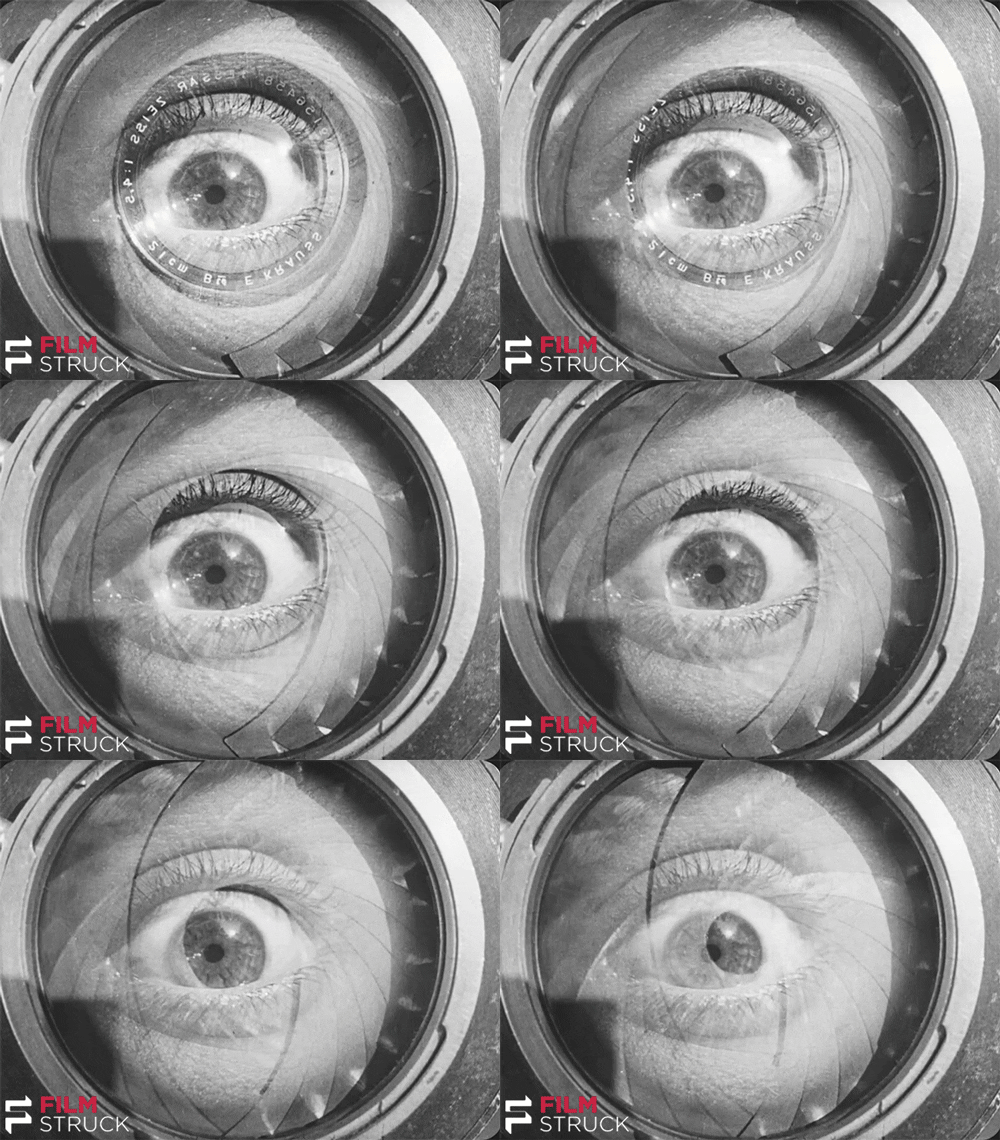
giphy

Last year I wrote an article (which can be found here) about the series of silent "City Symphonies", cinema verite documentaries made in various cities in the twenties that used the urban setting as a canvas to portray the city in all it's bustling glory as a complex human story. The acknowledged masters of the genre were the German Walter Ruttman with his classic "Berlin; Symphony Of A Great City" (1927) and the Soviet Dziga Vertov with his "Man With A Movie Camera" (1929). Critics have hotly debated which film is better but often left unsaid is that whatever the similarities and differences between the two films, the massive differences between the two filmmakers were even greater and they coloured the different ways they approached the subject. Ruttman (who I also wrote about here) was a craftsman who had made his start as a maker of Dadaist Op Art art shorts and early animation while Vertov started out as a film writer and maker of Soviet propaganda newsreels. 

image-w856
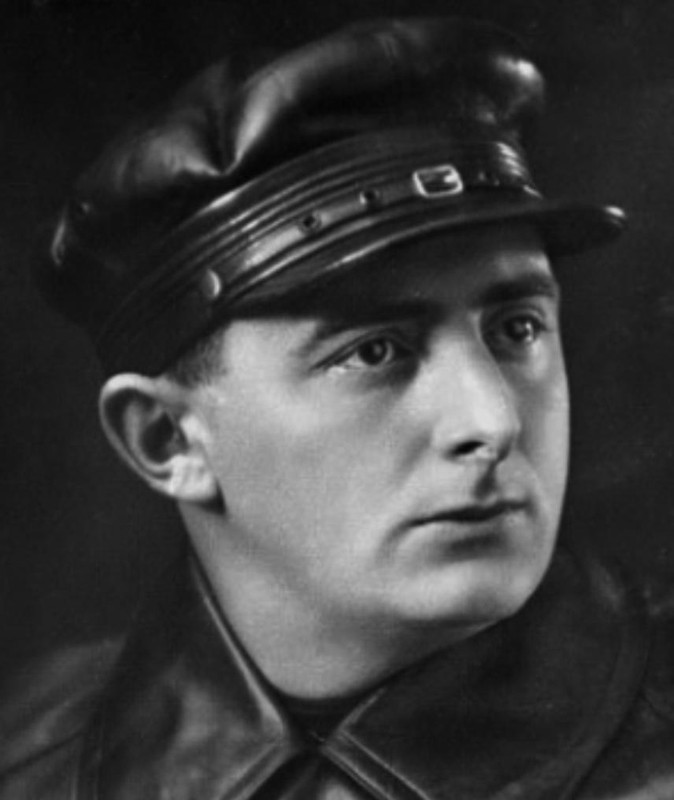
DZIGA VERTOV

Vertov (1896-1954, real name David Kaufman) worked with his cameraman brother Mikhail Kaufman (1897-1980), and edited by his wife Yelizaveta Svilova (1900-75). Vertov and his brother were part of a group of young Marxist documentary filmmakers who used documentary films to inspire the masses towards Revolution and rejected the very idea of non-fiction films as appropriate to tell such rousing real life stories. Like Derain and Mayer, Vertov started out in the 1910's as a writer of both fiction and non-fiction, including film and photography. After the Russian Revolution he was the editor of a film magazine who became fascinated about the possibilities of documentaries as a medium for spreading revolutionary consciousness. In this he was thinking along the same lines as Lenin and Trotsky who had long seen film as a propaganda tool. Although it is often not not fully recognized in Europe and America who when looking at the first generation (pre WW1) of film tend to focus almost exclusively on America, France and Italy, Tsarist Russia was an important centre of film production with a rich and popular catalogue of films covering a number of genres. Lenin (who in his pre-revolutionary career had been an aspiring pianist and writer) and Trotsky (another aspiring writer) quickly spotted the role film could take in reaching the masses with a dramatically presented message that would have more emotional impact than written the traditional pamphlets, newspapers and speeches, especially given that many of those masses were functionally illiterate and the sheer number of languages spoken in Russia. The resulting films were called "Agit-Prop" for "Agitate-Propagandize", itself a take on the Polish/German revolutionary Rosa Luxembourg's "Agitate, Educate, Organize" slogan. Film must not provide propaganda, it must also inspire and rouse the masses to action by portrayal of the regular man playing a role in creating the new workers state. As a film critic Vertog was disdainful of fictional films including those of Sergei Eisenstien whose "The Battleship Potemkin" he dismissed as phony and manipulative insisting only documentaries could present the truth. Starting in 1922 Vertov started a series called "Kino-Pravda" ("Film-Truth") which made a series of two dozen newsreel type shorts that showed aspects of Russian post-revolutionary society as one on the move, building a new world. He focused for the most part on workers and farmers rather than promoting a leadership cult to the extent that unlike later Soviet and Nazi films, although there would inevtably some focus on from Lenin paticularly after his death. Also unlike later Soviet and Fascist propaganda he even occasionally showed problems yet to be overcome including the poverty of the rural and urban poor albeit with the implication that such problems could and would be solved by hard work and the new leaders. A notable difference with the films of Ruttman, Charles Sheeler and Joris Ivens was that while they were focused on the form and function of machines, buildings, trains, boats etc, Vertov was more interested in the people or at least the society they represented. Vertov was also more willing to take the sort of flashy camera tricks used on occasion by Ruttman, Ivens and Derain and give them full rein for a more kinetic experience.

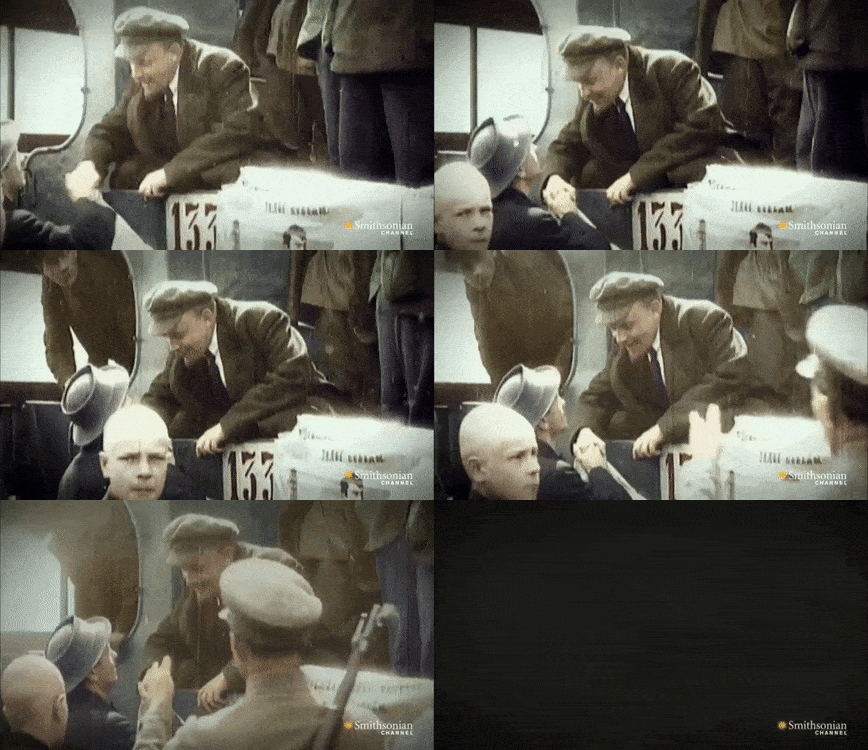
Ruttman was making a work of art while Vertrov on the other hand was making newsreels designed to promote the Revolution and specifically the Bolshevik faction of Lenin. His "Kino-Pravda" series of 23 shorts starting in 1922 were named after the Russian words for "Film-Truth" as well as not coincidentally using the name of the Bolshevik's official paper "Pravda" which had been published since 1911. These shorts used mostly authentic footage along with some staged scenes to tell the story of the successful revolution, a hopeful new society rebuilding, threats from within being crushed (in the form of the rival Socialist Revolutionary Party who are shown on trial), Lenin as a dynamic leader and later after his death as a beloved father figure.

Beneficial-Vengeful-Boar-max-1mb

These newsreels viewed in total show how Vertov devloped the kinetic and essentially humanist style that would animate his full length "Man With A Movie Camera". In this they are notably different from the rather bland newsreels made in America, France or the UK by the likes of Pathe at the same time with their stodgy posed shots of various political, military, sports or entertainment figures and flat location shots shot in predictable angles and edited in conventional ways. Unlike the mostly annonymous makers of western newsreels and educational films who were assembly line professionals and who worked to a standard template as quickly and efficiently as possible Vertov was a theorist with a willingness to experiment with his ideas for a more kinetic and involving style. Ironically for a time Vertov who worked under an authoritarian system had, at least for a time, more freedom to experiment than newsreel makers in the West who worked under the assembly line studio system.

299-e645f

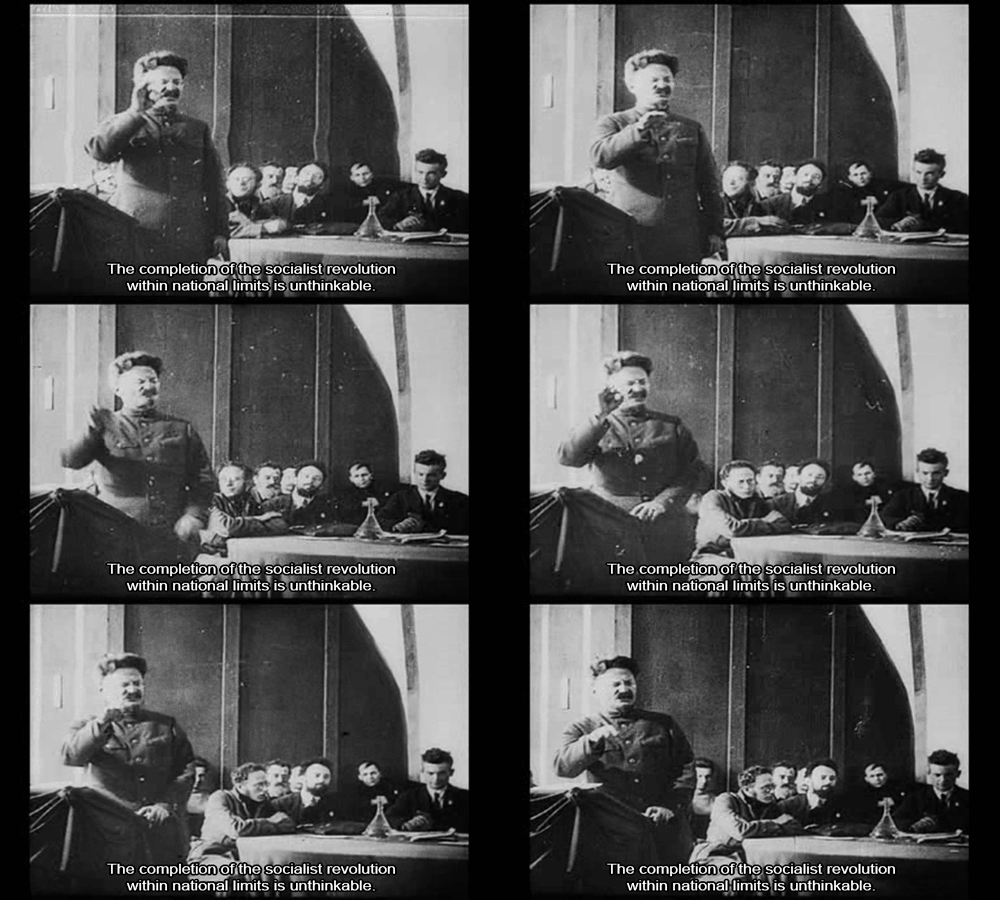
The Kino-Pravda series of 24 newsreels ran from 1922 to 1925 at irregular intervals showing a mixture of political events along with a few more human interest stories. The time period began with the ending of the Russian Civil War, the war with Poland and the post war famine, continued through infighting with the Communist rivals the Socialist Revolutionary Party, their attempt to stage a coup and assassinate Lenin leading to the first Soviet Show trials which the series covers frequently. The series continues along to the death of Lenin and it's aftermath. The newsreels range in length from several minutes to a full reel although it's possible some episodes may be missing a few minutes. Episode 12 is missing completely. Due to the highly topical nature of some of the subjects the films are full of obscure political figures that nobody who hasn't made a detailed study of Revolutionary Soviet history could possibly expect to know.

============================================

Episode 1. June 1922; The opening episode was shot when the USSR was still suffering under a devastating famine which Vertov shows with harshly realistic shots of starving children with the haunted, hopeless look we have become used to but which was still shocking in 1922. Not because major famines hadn't happened before because of course they had, but because there wasn't normally a film crew around. Vertov and his camera does not flinch but he does not dwell overly long either before moving to the next sequence where the riches of the Orthodox Church are shown being handed over, broken up and sold off to feed the hungry children who are then shown well fed and happy. Even religious Christians would find it hard to dismiss the imagery. There is also a Church official present to hand over the treasures. Next we have a flight of a transport plane which brings in some food then takes some officials on a flight over Moscow which gives Vertov and excuse for some fine arial shots of the city which indidentally looks pretty quiet. Note that the plane is clearly a German Junkers transport plane. The USSR actually had a civil relationship with their recent Great War foes Weimar Germany and post Ottoman Turkey who were among the first to recognize the USSR and maintain diplomatic and economic relations while their former Western allies refused to do either. This extended to cultural activities including film with films beiong exported back and forth and director Robert Weine ("The Cabinet Of Dr Caligari") directing his version of "Crime & Punishment" there. Finally we see a parade of pro-government workers.

2. 1922


Starts with a Party rally. A parade of officials, speeches being given to an open air meeting afterwards, food is served, a band plays and people dance, kids in costume dance, there are carnival rides. These happy scenes contrast vividly with the scenes of starvation and poverty in the first episode. The major political event of the year was the attempt by rivals the Socialist Revolutionary Party (AKA the SR's) to stage a coup against the Bolsheviks and assassinate Lenin which failed resulting in a series of trials. Here we see various SR members arrive in court surrounded by armed militia along with various officials, charges are read out.

3. June 1922

The trial of the SR's begins with more reading of charges, various officials mill about, a rally is held outside with more speeches and marches.

4. July 1 1922

The trials continue with more speeches. We shift gears, literally with a new fast car in Moscow that uses an aeroplane engine with a giant propeller that looks distinctly unsafe. Reportedly there were two of them and this was the start of a race to Sevastapol. After this bit of futuristic technology we see grain being delivered by run-down trucks and horse drawn wagons to be loaded on to barges. The grain is stored in locked warehouses protected by armed guards so while the famine is being dealt with it is evidently not over, at least outside the cities. Finally we journey to the Caucasus and Georgia to visit the vacation resorts with their crumbling castles and sub-tropical trees and sidewalk cafes.

5. July 7 1922

Vertov starts to become more inventive and playful with the title cards as this one opens with the title being shown on a newspaper being read by a man on a balcony. In another advance in editing this motif will also be used during the short to introduce different subjects. We start with showing Vasilij Jakovenko, the Commissar for Agriculture then we see plowing being done first with old horse drawn plows then heavy mechanical equipment. Progress! Next we are back in the Georgian resorts which include sanitoriums including for children which again contrasts with the images of child poverty and famine from episode one. More progress! Finally we are back in Moscow for a well attended harness horse race known as the first Red Derby. Still more progress! Peace & Prosperity awaits! Note that Jakovenko seems to have been a victim of the Stalin Purges of a decade later when scapegoats were needed to explain the later famines Stalin caused.  

6. July 18 1922

The opening goes further in breaking the fourth wall as a box containing a film reel labeled as being "Kino-Pravda 6" is opened and the reel is spooled into a projector and shown. Note that Vertov would make aggressive use of this framing device in his later full length "Man With A Movie Camera". We see a street scene with traffic and the aftermath of an accident with an overturned streetcar, factory workers at work, a bicycle race that turns into a motorcycle race and back again and finally units of the Red Army on maneuvers with new tanks all of which BTW are clearly direct copies of the hulking British Mark V and smaller French Renault tanks from the Great War. Note that while previously the Tsarist and Red Armies had armoured cars these were their first tanks. We also get a fly-over from a fairly ricketty biplane which already looks several years obsolete by Western standards. We also see an armoured train of the sort that saw action during the Russian Civil Wars.

7. July 25 1922

Back to the pro-forma title cards and more trial footage. Then we head out to the provinces with stops at a farm village in Siberia with a large house under construction, a train ride to scrounge in a mica pit mine, then down to Sochi in Crimea and another health spa with people enjoying the rocky beaches. Then we leave the USSR for the first time for a trip to Kabul with silk traders and a parade of elephants. After that rather medieval spectacle we move forward to contrast with a Mark V tank being used to assist in farming, then back to the mountains of the Caucasus with a rugged mountain road and tunnel and a small chapel. The timeline on this one is a little scattered.

8. August 15 1922;

To start we get a cold open with two men in a cafe placing a wager on the SR's trial. Then after the usual titlecard more trial footage including the verdict. Vertov shows the passage of time by using a montage with a manually sped up clock and pages torn from a calendar while people read the newspapers and doze off. The verdict is guilty BTW in case you were placing bets. In a nicely done transition we see men reading about the verdict while in a car and on a streetcar which allows for a change of topic to the more prosaic working on the streetcar tracks. We also see the remains of a crashed plane which seems more advanced than the one we saw flying overhead in episode 6. We close off with another tank being used in farming. Likewise this tank is a more modern model than the clunky monsters we saw in episode 6.

9. August 25 1922;

We return to the opening motif of showing a film projector. We see a conference of Orthodox Church Priests and Bishops. This is actually the first time we have seen any religious leaders since they handed over their valuables in episode one. More street scenes showing the interiors and engines of a streetcar along with various cars and trucks. We attend a horse race that includes betting including some obvious losers. A new movie camera is displayed. Machine shop workers are seen at work. An especially bulky projector with a generator is set up outside in the street as another party parade marches by.

10. September 3 1922;

A gathering for International Youth Day with parades, speeches and street theatre. Delegates gather for a group photo. A plane lands. We see some athletic events; A tennis match, various track & field events featuring men and women. These were the Soviet response to the Olympic Games as the USSR was barred from competing in those games until 1952. More street scenes and another streetcar accident. Mechanics work on a large engine for a new truck. We see a cross country motorcycle race.

11. October 5 1922;


The All Russian Congress Of Trade Unions meets. Various officials and delegates arrive. Cossacks do a ride-by and a military band marches. Actually a little surprising that this is the first time we've seen Cossacks. A confectionary factory is shown at work. A building catches fire and a fire brigade arrives. More factory scenes from a heavy machine shop. Komosol Day, a Party rally for kids happens with the usual marches and speeches. Troops are shown on maneuvers including infantry, cavalry, armoured cars and planes.          

13. October 1922 (Episode 12 is missing);


This episode is more than twice as long as usual as it's the fifth anniversary of the October Revolution celebrations with plenty of the usual marches and speeches, including one Trotsky but not from Lenin who by this point was incapacitated by a stroke. In fact we see Trotsky a few times here giving speeches, shaking hands and handing out medals apparently acting as Lenin's surrogate. Lenin is seen in some older footage. There are also the usual military parades, maneuvers, ride-bys and fly-bys which leads to more aerial shots of Moscow. There seems to be an exercise involving the use of gas. Much of the footage for this episode was clearly recycled from earlier episodes.      

14. 1923;


After some creative title cards that use Alexander Calder or Marcel Duchamp style mobiles we see a ship being launched and Kino-Pravda goes to America. We have the streets of New York, crowded restaurants, some dancers in a club, a spinning globe then back to the USSR and Petrograd where yet another Party Congress as the Comintern meets. You know what that means; more speeches by Trotsky, Radek, etc. More spinning garphics, another Party Congress, more speeches, more graphics one of which uses a swastika although to be fair in 1922 even though the Nazi Party existed in Germany it's unlikely Vertov knew who they were and it's almost certainly just a coincidental use of a graphic he liked the look of. We also get some footage of Lenin speaking although it's probably old footage as he had been incapacitated by a stroke by this point. More troops being reviewed, farmers at work, trains, factories, belching smokestacks and steel plants with happy workers and happy children. More Lenin, this is actually the first time we have really seen much of him but as we know he was seriously ill by this point the film is really covering for him. We also see Vertov using as a framing device the image of a cameraman busily cranking away. This is a device he would make use of in the later "Man With A Movie Camera".

15. 1923;


Delegates meet to discuss world peace. One of them appears to be Stalin and if so this is the first time we've seen him. Religious figures are mocked and icons are removed, see episode one again. More parades and speeches along with statues. Propaganda papers are fired out of a cannon. Winter sports with ice hockey and cross country ski racing. Sailors perform maneuvers on the ice. Troops parade on skis. Cavalry on maneuvers.  

16. 1923;


This one has an opening title card that was clearly added many years later. After some street scenes we have a scale model of the Red Square Palace and an arts & crafts exhibition. Next we have some sort of lottery and some artsy camera angles. The famine still hasn't been eliminated in the provinces as we see more suffering children although this time in a hospital getting care unlike in the first episode. Later we see them happily at play looking fit. More progress! More marching Red Army soldiers. Out of the blue we get footage from a film being shot by Sergei Eisenstein, "Dnevnik Glumova" with a nattily dressed cat burglar scales the walls of a castle, then jumps off and harlequin figures mug for the camera, scamper over a tank and engage in some dissolving camera tricks. We also see another large swastika for some reason. Vertova and Eisenstein would later came to dislike and criticize each other with Vertov dismissing the feature filmmaker's work as "artificial" and this George Melies style sequence is indeed rather jarring compared to the gritty realistic content of the rest of Vertov's work. We see a meeting of the Young Pioneers youth group well fed and busy at work and on parade. It's May Day so we get a flyover from a twin engine bi-plane and some more aerial footage and more parade footage including some elaborate floats. Somewhat more surprisingly we also get a fashion show, albeit a rather staid one.

17. Feb. 1924;


Opening of women working in the fields and waves of grain, no crop shortages here. Lev Kamanvev visits and is once again greeted by happy children and gives a speech. Working on a busy open pit mine. Trains and wagons full of produce. Men work on a lumber yard, more miners and farmers. Lenin dies.

18. 1924;


After a title card that uses a little Ruttman style animation we are in France where ascend the Eiffel Tower and see some birds eye views of Paris before our bird races back to Russia as the farmland of Ukraine rush by. Looking a little parched actually but that may be due to being in black & white. Next we get another auto roadrace and street scenes with people at a street market, riding a streetcar and reading the papers which are sold by cigarette smoking newsboys. More factory workers, miners and construction workers and more aerial shots. Reaction to Lenin's death with some speeches. A young couple with a newborn get some free clothes and food. More progress benefitting the workers in the new state! Finally some increasingly artsy shots of those happy workers among grinding factory wheels.

19. 1924;


We are on a train ride through the countryside which starts in the apparent summer then suddenly turns to winter as we cross a trestle bridge. We are in a resort probably in Northern Karelia (near Finland) where people are taking dips in the icy water, speed skating, cross country skiing, running dog and reindeer sleds and seal and bear hunting. We meet some traditional Inuit people. Back to a city where some sort of election is going on. Some winter street scenes. Since this is Russia it's actually a little surprising this is really the first time Vertov has actually shown us any winter scenes. Another cross country train ride and scenes of women at work at various jobs; farming, factory and office jobs. They work hard but they also get a say as they are shown having political meetings. More progress! Lenin is still dead and shown in his coffin followed by older footage of him speaking and greeting workers. We also see his widow Vera. Another woman is shown editing film. This is probably Vertov's wife Yelizaveta Svilova who would later be shown in much the same way in "Man With A Movie Camera".

20. 1924;


A Young Pioneers parade. A young mother shows off her baby and children all wearing Pioneers uniforms. More shots of the countryside and women working the farm. These farms are relatively prosperous, the people healthy and a far cry from the struggling desperate ones from earlier episodes. A celebration with folk dancing and more Pioneers parades. Another train ride showing the cultivated fields. People are hard at work sawing wood rails and plowing the fields when the Young pioneers march up and pitch in to help. Then a collective dinner is served and magazines are read. The Pioneers visit a zoo where they see a parade of various animals; elephants, bears, kangaroos, monkeys, seals, wolves, etc.

21. Feb. 1925;


On the first anniversary of his death this is the Lenin memorial episode with plenty of shots of Lenin giving speeches and meeting people and red Army troops on maneuvers to portray the Russian Civil War. We see happy people across the USSR, not only Russians but people from the Caucuses and Central Asian Muslim areas including a girl who happily throws off her headscarf. Mass rallies and parades along with modern farming and industry and trains recycling some footage we have already seen including as contrast the early scenes of famine and starvation. In the new Russia we have farms getting electricity for the first time. Moving on we are at Lenin's funeral as crowds pass by his coffin along with various officials including his widow Nadezhda Krupskaya, Trotsky, Kamenev and Stalin who we clearly see for the first time and who is also mentioned by name for the first time. Once again we see people from across the regions and ethnic groups of the USSR as we are told that hundreds of thousands of people attended the funeral. In an animated sequence we see a plutocrat laugh over Lenin's death only to be horrified as he is told the USSR is recognized by various nations, and the masses join the Communist Party. For some reason the animated plutocrat looks oddly like Lenin himself which is a little confusing and poor planning on Vertov's part. We get more parades and emotional crowds as a motange of Lenin speaking is superimposed over his tomb in Red Square. Finally we get more speeches from young and old and a train rides into the future.

22. 1925;


Another tribute to Lenin. More people file past his coffin. More parades and speeches including from his widow. A group of peasants come to Moscow for the first time by train for the funeral. They are fed in a soup kitchen and see red Square with Lenin's Tomb. They tour a display of agricultural improvements under Lenin. Trotsky speaking about world revolution and we see activists in India, China and Africa. Activists sing the "Internationale".

23. 1925;


Special episode about the new technology. A villager buys a new radio receiver and a tree is cut down to erect an antenna. After a charming little animated scene showing a cut-away building to show a radio transmitter set we get a longer series of schematics then scenes of technicians assembling and operating the radios sets some of which are quite large. As a program is broadcast we see various singers and musicians perform while people listen intently on earphones. Later we see a store selling radios and radios being mass produced.

24. 1926;


One of the later episodes of the series, assembled after Lenin's death serves as a compilation of "Kino-Pravda" episodes.The Soviet government was not slow to see the value of films as agit-propaganda and not only for domestic but also foreign audiences and that would certainly include the films of Vertov. Accordingly excerpts of the "Kino-Pravda" series would be edited together with added subtitles in different languages for export. This last one was made for English speakers and includes excerpts about; Repairing the Moscow Trolley line, using tanks for construction and farm work, the trials of the Socialist Revolutionaries, more street scenes, peasants joining communes, a children's hospital, combatting famine in the rural areas, setting up portable movie projectors.

++++++++++++++++++++++++++++++++++++++


Although the Kino-Pravda series is better known as it can be used to show Vertov trying out some visual themes he would later use in "Man With A Movie Camera" this was actually his second newsreel series with his first starting in 1918 just after the Bolsheviks seized power. This series was called "Kino Week" thus also debuting Vertov's use of the name "Kino". Of the original twenty four shorts in the series only eight remain.

Week 1 - Mar 20 1918;


Marching wokers, Lenin, Trotsky reviews Red Army troops, cavalry and sailors. Soviet and German troops and officals are shown on the border as peace negotions are carried out to end Russia's involvement in WW1. More speeches from now forgotten figures. A street scene showing market day with various vendors.

Week 3 - June 3 1918 (week two is missing);


A collection of unrelated scenes with various officials, women working on a farm, a soup kitchen distibutes food, a naval officer, wounded soldiers return from the front, a train station, a tug of war contest.

Week 4 - June 25 1918;


More obscure officials, construction workers restoring an old building, new recruits get physicals, St Petersburg city scenes, people, apparently once respectable are now selling possesions on the street.

Week 5 - July 2 1918;


Still more officials, street scenes with beggars and lineups, ships at the docks, more dispossed people milling about.

Week 21 - October 22 1918 (weeks 6 - 20 are missing);


A Moscow street scene with people milling about a government building, officials outside a train try out a new automobile which is designed to run along the train tracks although it drives pretty slowly, a river bank in a rural area with an old rope & pully ferry, a larger river paddlewheeler, some cavalry ride in review, army officers arrive by train.

Week 22 - October 29 1918;


Moscow, footage of revolutionaires Lenin and Balbanov, street scenes, with people lining up for food and a busy market, at the train station with troops gathering to be reviewed and hear a speech from Trotsky. At a different city (probably in Ukraine) German troops are shown marching in the street as they leave occupied territory.

Week 23 - November 5 1918;


Street scene; Officials and troops mill about smoking, another speech from an unknown official, troops march by along with a funeral cortage, newspapers are handed out to men lined up outside a train, we see the outside of some sort of cabaret theatre advertising a show but we do not go inside, nurses gather outside a rural hospital.

Week 24 - November 19 1918;


Moscow, troops and civilians mill about in the street, the troops gaather for review and speeches by various officials including Yakov Sverdlov (one of Lenin's most trusted lieutenants and possible sucessor if he hadn't died in the 1919 Pandemic) and Lev Kamenev (another top leader and possible successor, later killed by Stalin), statues are unveiled, we see Russian and German troops fraternizing at what appears to be a POW camp.

Week 25 - November 26 1918;


Moscow; More statues are unveiled, another speech from Kamenev, more troops marching, more speeches.

++++++++++++++++++++++++++++++++++++++++++

These newsreels show that for his first efforts Vertov is a competent but conventional newsreel filmmaker but lacks any of the flair, playfulness and willingness to experiment that begins to emerge in the "Kino-Pravda" series. He had not yet found his own style. They also may show the limitations of propaganda filmmaking as there are really only a few themes and visuals shown over the course of the series that are simply repeated but which are not inherently very interesting visually; there are plenty of parades, troops on review, statues and speeches given mostly by now forgotten officials along with some street scenes. Unlike the later work of Vertov (and Ruttmann) the subjects are fully aware of the camera and often stand around awkwardly staring at the camera. This entire series could probably have been edited down to two reels, at least what we have left, although the missing episodes are probably little different. It's possible that Vertov's choices in subject matter were dictated by the regime who also wanted the repetition to drive home it's message. It's also evident that if you live in an authoritarian system you had better enjoy parades, rallies, flags and speeches because you are going to be seeing a lot of them.

Finally we have another short possibly filmed by Vertov several years later.

"MAXIM GORKY";


We know they were filmed later as this one features the writer and poet Maxim Gorky who spent the twenties in exile in Europe after siding with the Socialist Revolutionaries, opposing their trials and criticizing Lenin and Trotsky. Highly popular he would be invited back the USSR by Stalin in 1931 after he reconciled and he would become a public supporter of the regime until he died in 1936 so this footage must have been shot within that fairly narrow window. Additionally for a few reasons the USSR was slow in making the changeover to talkies and were still making silent films by the mid thirties.

++++++++++++++++++++++++++++++++++++

Speaking of playfulness and experimentation, Vertov also used animation for a couple of propaganda shorts. Unlike Walter Ruttman's animation experiments which came out of the Dada art scene and were abstract, dreamlike and surreal, Vertov's were conventional and realistic animation of the time done with some skill albeit not quite up to the level of American animators like Winsor MCay (already well known as the first to make full use of animation), and the just starting out Walt Disney and the Fleischer Brothers, lacking their fluidity of motion and expressive faces. It is unknown who did the actual animation for these as Vertov himself simply did the production and possibly some editing.  


Parts of this one had appeared in Kino-Pravda episode 21 and are about the international success and growth of Communist Party even in the aftermath of Lenin's death while the second longer part is specifically about early farm collective and worker collective programs.

"SOVIET TOYS";


Vertov considered himself a good Socialist Realist and rejected any of the abstract art schools such as Expressionism, Dada or Surrealism but there is no other way to describe this weird cartoon than Surreal. It starts out conventionally enough with a group of children's toys under the Christmas tree acting out political stereotypes. A greedy Capitalist stuffing his face at dinner, his shifty eyes making him look even more creepy. The Capitalist becomes so bloated that he throws up then falls over and can't get up. Still he calls for women to amuse him and one duly arrives and dances for him but then things become more hallucianatory as the prostitute also gets consumed by his ever growing stomach. Then a Worker arrives and laughs as the Capitalist briefly turns into a pig. Two church bishops arrive but instead of chiding the Capitalist for his decadence they bow to him and bicker with each other. The Worker, finding no support from the Church attempts to get the Capitalist to give up some of the money fail as he literally tries to carve it out of him with giant scissors but he is not strong enough. Then a Farmer arrives and after suggesting they work together against the Capitalist the two join together (literally) to break the Capitalist open like a pinata and money leaks out and into the people's bank. Eventually the Red Army arrives (along with a cameraman from Vertov's studio) and several soldiers join together (again literally) to form and tree upon witch the Capitalist, Bishops and Prostitute are strung up, although she is merely punished while the men are lynched. The tree then turns into a Christmas tree (it's Christmas remember) and the strip ends with and ad for Vertov's studio. If this was made with kids in mind they must have been very confused. These were the only experiments of this type attempted by Vertov and he thereafter stuck with his Realist documentary style that would lead to "Man With A Movie Camera" by the end of the decade.

+++++++++++++++++++++++++++++++++++

If we are going to take into account Ruttmann's later work for the Nazis in judging his work then we must also do the same with Vertov. Just as hindsight places Ruttmann's "Berlin" in the context of a society on the brink of collapse, praise for the vibrant and energetic society and happy workers Vertov's films show can not be seen without the hindsight that we are seeing a society heading into a complete totalitarian police state, something Vertov is an active cheerleader for. To be fair to Vertov these films were made from 1922 to 1925 or 26 with "Man With A Movie Camera" being made in 1929 and at that time the full repression of Stalin had not yet happened. In the 1920's one could still believe that the worst excesses of the Revolution were over. 1922 had seen eight years of war, revolution, civil war, terror and famine but by 1929 it was just possible to believe that the future was indeed bright; there was peace, the economy had picked up and Soviet society was visibly on the move. That was indeed the sincere position most (but certainly not all) Marxists took at the time both in the Soviet Union and abroad. Lenin had died in 1924 and Stalin had taken over but he had done so peacefully and his power was not yet absolute. The horrors of Stalinism, the purges and show trials, more famines, the Holodomor in Ukraine, ethnic cleansing of Tartars and other groups, mass arrests and terror, were still in a future few could yet see. Vertov's films do actually show a few muted criticisms of the Soviet government with scenes of extreme poverty and famine in some of the "Kino-Pravda" shorts and a few fleeting views of what seem to be homeless men in "Man With A Movie" camera albeit this is done within that larger context of the theme that the dynamic new Soviet government and it's bold leader Lenin are fixing the problems. Lenin was actually not opposed to all criticism and debate as long as it was deemed "constructive" and "positive" and would probably not have minded this, but under Stalin any such critiques, however veiled, would not be allowed. Vertov can be somewhat excused from predicting, much less showing any of the horrors of the regime but only somewhat, he was still an enthusiastic propagandist for a regime that even under Lenin was hardly free and had committed many crimes and atrocities which Vertov ignores and there is nothing to indicate that even privately he expressed any doubts. Under Stalin he would later make films like "Enthusiasm" that showed he is still a cheerleader for the by now clearly Stalinist regime. Like Rutmann under the Nazis he would have had little choice in the matter whatever their private thoughts but if the dark shadow of the Nazi regime is in hindsight seen to hang over "Berlin" and if Ruttmann's later propaganda work is to be counted against him than Vertov must be held to the same standard. After this film Vertov and his brother had a falling out and did not work together again although Vertov would continue to make films for a while until his flashy style fell afoul to the increasingly stodgy censors of the Stalinist era and he ended up back where he started as a low profile editor of newsreels dying in 1954 aged only 58, outliving Stalin by a year. His brother Mikhail dropped out of film and became a photographer, dying in 1980. Vertov's wife and editor Yelizaveta Svilova continued to work with Vertov but retired from film after his death to concentrate on assembling his various writings. She died in 1975.

vladimir-lenin-lenin