Essays & reviews about the classic (mostly black and white) era of film and TV. Especially Silents, Horror, Sci-Fi, Film Noirs, Cartoons, Dada & Experimental Films. Member of the Classic Movie Blog Association (CMBA).
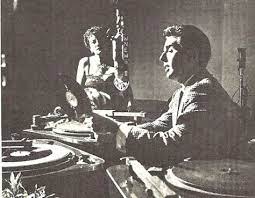
The first decade or so of American network television (approx 1949 to 1960) are also the last Golden Era of Jazz. At the start of era the Swing Bands were on the way out but there were still plenty around, more importantly there was BeBop on the East Coast, Cool Jazz on the West and various Jump Blues, Latin Jazz, Post Bop and Avant Garde Jazz and by the sixties we had Free Jazz. Yet surprisingly little of this made it's way on to TV. Still less has survived. A notable exception is "Art Ford's Jazz Party".
"ART FORD'S JAZZ PARTY" (w/guests Roy Eldridge, Buck Clayton & Stuff Smith);
Buster Bailey ~ Clarinet
Buck Clayton ~ Trumpet
Roy Eldridge ~ Trumpet
Herbie Green ~ Trombonist
Johnny Guarnieri ~ Pianist
Bill Henderson ~ Vocalist
Stuff Smith ~ Violin
Osie Johnson ~ Drums
Harry Sheppard ~ Vibes Player
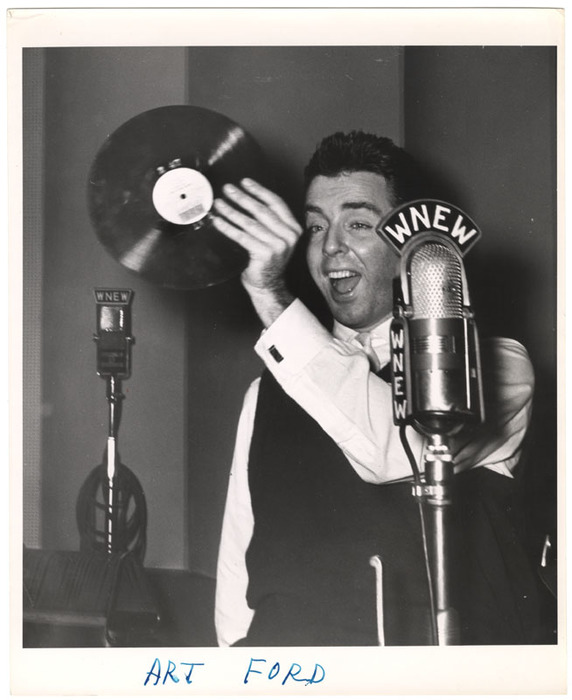
Art Ford was a New York radio DJ who also had a minor career hosting various TV shows in the 1950's such as "Art Ford On Broadway", "Country Music Holiday", "Who's Whose" (a game show) and "The Art Ford Show". Unlike some other music show hosts of the time (looking at you Dick Clark) Ford had a genuine interest in and knowledge of music. "Art Ford's Dance Party" was his brief 1958 attempt to bring real Jazz to the masses.
"ART FORD'S JAZZ PARTY" (w/Coleman Hawkins and a guest appearance by actor Jackie Cooper on drums);
Coleman Hawkins ~ Tenor Saxophone
Mary Osborne ~ Guitar
Maxine Sullivan ~ Vocals
Alec Templeton ~ Piano
Teddy Charles ~ Vibes
Hank D'Amico ~ Clarinetist
Morey Field ~ Drummer
Tyree Glenn ~ Trombonist
Johnny Windhurst ~ Trumpet
Art Goldberg ~ Bass Player
Roland Hanna ~ Pianist
Jackie Cooper ~ Drums
The format was barebones simple; a plain stage with simple lighting with a collection of notable jazz figures playing music. And that's it. The show was hosted by Art Ford who was smoothly affable if a little stiff. "Jazz Party" would boast such luminaries as Coleman Hawkins, Kenny Burrell, Teddy Charles, Buck Clayton, Roy Eldridge, Roland Hanna, Billie Holiday, Dick Hyman, Abby Lincoln, Ben Webster, Stuff Smith, George Lewis and Lester Young. Many of these artists made their only known TV appearance on this show which makes it a valuable resource.
"ART FORD'S JAZZ PARTY" IN NEW ORLEANS;
Cast;
George Lewis ~ Clarinet
Punch Miller ~ Trumpet
Alphonse Picou ~ Clarinet
Sweet Emma Barrett ~ Piano
Peter Bocage ~ Violin
Louis Nelson ~ Banjo
Slow Drag Pavageau ~ Bass
Paul Barbarin ~ Drummer
The data on the show is contradictory. Apparently only six episodes were shot, of which three survive. It's listed as being ninety minutes long but two of the three surviving full episodes are a half hour long and the other is fifty minutes. It's possible the episodes were put together for some airings. Wikipedia claims the show was produced by the DuMont Network which is impossible since the show was produced in 1958 and 1959 and DuMont went off the air in 1955. The order the shows went out is also contradictory depending on the source. The "Complete Guide To Network Television" by Tim Brooks does not list the show at all which suggests that it was purely a syndicated show which was probably run late at night and only in certain areas, ie not in the Jim Crow South. Everyone does agree that the show was also broadcast on the Armed Forces Network, both radio and TV. Art Ford died in 2006.
Edgar Allan Poe was one of the most influential writers of the Victorian Era and it is no surprise that early film makers would take inspiration from his stories. As early as 1909 DW Griffith made a short film simply called "Edgar Allen Poe", (spelling mistake included) which showed Poe writing "The Raven" and trying desperately to sell it to support his sick wife. It is mostly notable for the actor's amazing resemblance to Poe. Starring Barry O'Moore as Edgar Allan Poe and Linda Arvidson as Virginia Poe. Arvidson was also Griffith's wife at the time.
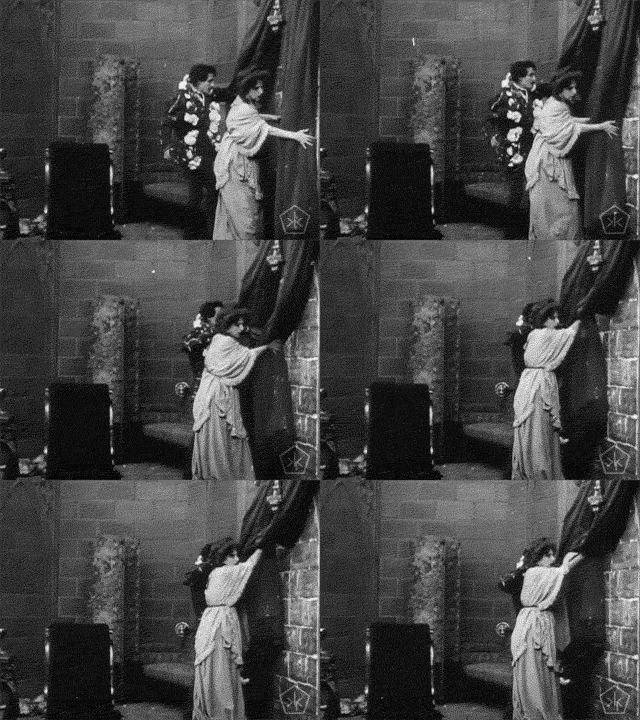
Later in 1909 Griffith was ready to make a stab at an actual Poe story with a film called "The Sealed Room", which while not directly a Poe story, was obviously based on Poe's well known "The Cask Of Amontillado" as well as "The Black Cat", and a Balzac story "La Grande Breteche"
"THE SEALED ROOM" ~ 1909;
CAST;
Arthur V. Johnson ~ The King
Marion Leonard ~ The Queen
Henry B. Walthall ~ The Minstrel
Linda Arvidson ~ Lady In Waiting
Mary Pickford ~ Lady In Waiting
Gertrude Robinson ~ Lady In Waiting
William J. Butler ~ Nobleman
Vernon Charles ~ Nobleman
Owen Moore ~ Nobleman
George Siegmann ~ Nobleman?
Mack Sennett ~ Soldier?
George Nichols ~ Workman
Anthony O'Sullivan ~ Workman
DIRECTED BY D.W. GRIFFITH
PLOT SYNOPSIS (SPOILER ALERT);
In early 18th Century Europe a King is holding court in his castle with his wife who is having an affair with the court Minstrel. The King has recently had built a new private room for his wife which he proudly shows off. It is luxuriously furnished but has only one door. The Count is becoming suspicious of his wife. A Nobleman bursts in and summons the Count over some sort of emergency. The Count and most of the court hurriedly depart leaving the two lovers alone. They retreat to frolic in the private room. The King returns and spots them without their knowledge. He is enraged and is about to charge into the room sword drawn when he instead orders his workmen to seal up the door with heavy bricks. Inside the room the couple continue to happily kiss and lounge about unawares. After the wall is finished they try to leave and discover they are trapped, they panic and trash about until they suffocate and die while the King stands outside and gloats. Finis.
This was a typical one reeler quickie of the era, one of hundreds Griffith made between 1908 and 1913 for Biograph Studios. Obviously he worked fast and this was probably done in a couple of weeks. The Biograph films were shot in an indoor studio in New York and the set looks typically stage bound with some of the backgrounds obviously being painted backdrops. However the sets and especially the costumes are quite detailed.
The cast contains several Griffith veterans including Poe lookalike Walthall, Leonard, Johnson, Gertrude Robinson and George Siegmann but is noteworthy for some of the small roles including Griffith's first wife Linda Arvidson as well as cameos by future stars Mack Sennett and Mary Pickford along with Pickford's husband Owen Moore. Biograph films did not list cast or directors (which is one of the reasons Griffith and most actors eventually left) so the cast list may not be entirely accurate. For example; Sennett is listed as a "Soldier" but none of the soldiers resemble the stocky, pug-nosed comedian, however he could easily be one of the workmen. Ditto for the hulking Siegmann. It is certain that all these major names listed above were filming with Griffith at the time however. Arvidson was probably not happy being regulated to a minor supporting role, especially as she was already an experienced stage actor, although never a star. Griffith insisted on keeping their marriage a secret and he never in fact gave her a decent starring role. This was not surprisingly a source of friction between them and was a factor in their eventual divorce.
In 1914 Griffith quit Biograph unhappy over low pay, lack of credit and Biograph's refusal to let him do larger projects. He would head to California and take much of his actors with him.

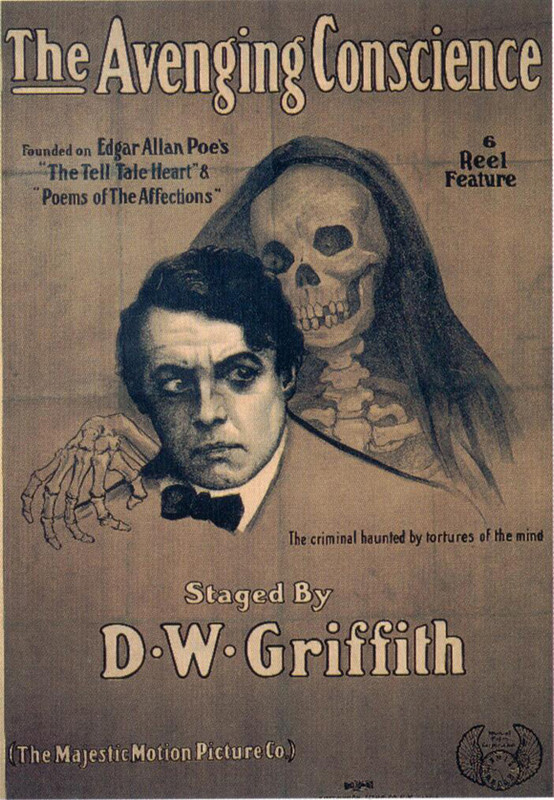
Two years later Giffith would use one of Poe's best known, and most filmable, stories; "The Tell Tale Heart" as inspiration for a full length movie "The Avenging Conscious". For good measure Griffith also combined the Poe story with one of his poems "Annabelle Lee" for what would be Griffth's only full length horror film. It would also appear to be the first full-length horror film in America. There had previously been film versions of "Frankenstein" in 1910 and two versions of "Dr Jekyll And Mr Hyde" in 1914 and 1915 as well as the afore mentioned "Sealed Room", but those were short one reel versions. In Europe some early full length horror films were made, among those which have survived include the 1911 Italian film "L'Inferno" based on Dante's "Inferno" which has some spectacular scenes of demons and devils but no real plot or characters. Much better were the German films of Expressionist pioneer actor/director Paul Wegener; "Der Golem" and "The Student Of Prague" in 1913-14. Both films would be remade in better known versions in the 1920's; "Der Golem" by Wegener himself in 1920 and "The Student Of Prague" in 1926 by Henrick Galeen with the great actor Conrad Veidt. There are other European films of the era which have been lost which have titles using words like "Vampire", "Monster" or "Phantom" but that may not have been meant literally. For example most of the "vampires" of the titles actually refer to "vampish" women like Theda Bara or the thieves as in the 1916 French serial "Les Vampires". Oddly for some reason the Americans seemed to have shown little initial interest in horror as a genre other than the three shorts mentioned above. The influence of various censor happy religious groups and even governments may have been a factor in this. The notorious and powerful censor official Anthony Comstock had only died in 1915 and it would not take much to get a film banned. Films that had an obvious literary basis such as "Frankenstein", "Mr Hyde" or Poe's stories would be pretty easy to defend though.
The Nephew ~ Henry B. Walthall
His Sweetheart ~ Blanche Sweet
The Uncle ~ Spottiswoodie Aiken
The Italian ~ George Seigmann
The Detective ~ Ralph Lewis
The Maid ~ Mae Marsh
DIRECTED BY D.W. GRIFFITH
PLOT SYNOPSIS (SPOILER ALERT);
A young man works for his uncle, they live in a large gloomy house. He is in love with a neighbor girl who he calls Annabelle Lee after the Edgar Allan Poe poem. He is an avid reader of Poe's stories especially "The Tell Tale Heart" and dreams of becoming a writer. The Uncle refuses to allow them to wed on the grounds that he has supported his nephew and is owed "a few years of service". Annabell visits and the Uncle insults her and orders her away. She leaves followed by the Nephew after an argument with the Uncle who then trails them. The couple go to a garden party where they briefly meet a mysterious stranger. Also at the party are another couple, a Maid and a Grocer's Delivery Boy. The party includes a full orchestra and a routine with a Roman dancing girl and a bored toga wearing Nero figure. The Maid is tempted by a male party guests but finally agrees to marry the Delivery Boy. They leave together. The Uncle arrives and witnesses the Maid and Delivery Boy's happiness, he feels guilty and leaves. On his way home he sees a family in their yard playing with their baby. The baby waves at him and he waves back. He feels more remorse.
Annabelle and the Nephew also leave the party. They discuss the situation and decide they can not see each other again. Depressed, they go home separately. The unhappy Nephew sits and watches a spider catch and devour a fly and ants swarm a beetle. He decides to kill his Uncle. Meanwhile the Uncle has arrived home, he is also depressed. Feeling guilty over his treatment of his nephew he prays for guidance. He falls asleep at his desk. The Nephew arrives home after meeting a passing large Italian handyman who is looking for work. The Nephew sends him away.
The Nephew arranges to have a note delivered to the Uncle luring him to meet a man who owes the Uncle money. The Uncle leaves alone and goes off on foot into the countryside passing by some friends at the general store. The Nephew follows at a distance making sure to stop by the General Store and draw attention to the Uncle's walking over a hill in the distance, then he joins the men in the store to give himself an alibi. The Uncle arrives at the house of the man from the note but he is puzzled to find him not home. The Uncle returns home, this time unseen since the men from the General Store are now gone. When he arrives home he is tired and falls asleep at his desk. The Nephew arrives home and decides to kill the Uncle, he considers shooting him but after thinking about it he backs down as the Uncle awakes. The Nephew demands money so he and Annabell can leave. The Uncle indignantly refuses and a fight breaks out. The Nephew strangles the Uncle to death. Unbeknownst to the Nephew the Italian has returned in time to see the murder through the window. The Italian blackmails the Nephew who agrees to pay. After the Italian leaves the Nephew decides to hide the Uncle's body by bricking him up in the fireplace. The Nephew then goes out and pretends to search for his missing Uncle, one of the Uncle's friends is suspicious and warns a Detective, who turns out to be the mysterious stranger the couple met at the party. The Detective agrees to stakeout the Nephew's house.

Annabelle Lee arrives and visits the Nephew who has received his inheritance. While they are kissing the Uncle's ghost rises from the fireplace and points an accusing finger at the Nephew. The Nephew is upset but Annabell can not see the Ghost, the Ghost disappears. She is worried that he is losing his mind and she leaves. Once he is alone the Nephew laughs off the Ghost and goes to sleep. The Ghost returns and haunts the Nephew who is distraught and believes he is losing his mind. The Nephew has himself sent to a sanitarium.
The Nephew returns home while the Detective watches from a distance. The Nephew pays off the Italian and he then hires him to spy on the Detective. The Nephew has become paranoid and shows the Italian how he has made the barn into a fortress with guns and an escape tunnel. The Italian leaves. The Nephew visits Annabell, he convinces her that he is cured and they kiss. However he is struck by more visions and flees home. He has religious visions where he is confronted by Moses holding the Ten Commandments and Jesus on the cross. He prays for guidance.
The Detective arrives to question the Nephew. As he does he has brought a posse who search the area, including the barn where one discovers the hideout and trapdoor escape, which he nails shut. Meanwhile the Nephew warily invites the Detective in and agrees to talk. As they talk the Nephew begins to get nervous and imagines he hears the Uncle's beating heart in the ticking of a grandfather clock, the Detective's pencil drumming and toe tapping. The Nephew get increasingly fidgety and distraught as the Ghost returns and re-enacts his death. Once again only the Nephew can see the Ghost. The Nephew hears noises from inside a cupboard and opens the door. Inside he sees a vision of Hell with Demonic figures surrounded by Hellfire. He sees a vision of himself bound to a chair and accused by a figure of death. He confesses to the murder. He struggles with the Detective and flees chased by the posse led by the Italian. The Nephew runs to the barn hideout where he barricades himself in and a shootout ensues with the posse until he runs out of bullets. The Nephew tries to pry open the trap door to his escape hatch but can not. He decides to hang himself. The posse breaks down the door and takes him into custody. Annabelle has heard of the standoff and runs to the barn in time to see him dragged off. She kills herself by jumping off a cliff over the seashore.
We are back in the Uncle's study where the Nephew awakes from his sleep, he has been dreaming. The Uncle enters, he is alive. The Nephew is shocked and relieved, he confesses his dream to the Uncle. They reconcile and embrace. Annabell arrives, the Uncle gives them his blessing, they will be married.
Annabell and the Nephew are seen sitting together on the cliffs overlooking the sea. He has announces he will become a writer, and he reads from Poe's poem "Annabelle Lee". As he does they dream about a sylvan forest with the Greek God Pan playing on his pipes while nymphs and cupids dance. Fade out.
~~~~~~~~~~~~~~~~~~~~~~~~~~~~~~~~~~~~~~~~~~~~~~
Plot-wise the film is a sprawling mess. Characters appear and disappear without explanation whenever the plot needs them such as The Detective & The Italian. Others exist solely to provide some sort of moral counter-point as with the Maid and the Delivery Boy who also appear then disappear without explanation and have no other purpose to the story, nor do they have any actual interaction with any other characters. These characters have no existence outside being plot contrivances. Who is that Detective for example, and why is he even in town at all? Is he an official policeman or a private eye? Why does he seem suspicious of the Nephew the first time he sees him even though he hasn't actually done anything wrong yet? Why does the Italian switch from being a blackmailer to posse leader? Why does the Nephew go from fearing the Italian to trusting him?
There are also a number of glaring plot holes, some quite jarring. Take the Nephew's trip to the sanitarium; in one minute he leaves, then in the very next scene he returns home "cured"! How long was he gone? A weekend? A month? And what about that detective who was staking out his house while he was gone? Did he stay there the whole time? Why didn't he just take the opportunity to break in and have a look around? What about that posse member who finds the Nephew's hideout and nails the trapdoor shut? Why doesn't he tell anybody what he found? The final reconciliation between the Uncle and Nephew is particularly silly. It's one thing for the Nephew to be relieved to discover that the he dreamed the whole thing and the Uncle is still alive. But is quite another matter for the Uncle to be overjoyed to hear that the Nephew has dreamed about murdering him and hiding his body. That's really being an awfully good sport.
Some of these problems may be blamed on the no doubt too rapid shooting schedule. Griffith shot this film in 1914, that same year he shot four other full length films and he was also making preparations for his major opus "Birth Of A Nation". Granted Griffith was always in a hurry, but by even by his standards that is a full plate to carry. Perhaps some plot details got left behind in the rush to finish. It can also be pointed out that since the most of the film is a dream, plot loopholes and lapses in logic can thus be explained away. That argument has also been use for such other dream sequence horror movies as "The Cabinet Of Dr Caligari" (1919), "Genuine" (1920), "Waxworks" (1924), "Invaders From Mars" (1953) and even "Robot Monster" (1953). Considering Griffith's well established taste for cheap melodrama and cheaper sentimentality this is probably too generous a reading but if the film is simply taken by itself it's not a totally unreasonable argument.
Some thought that Griffth was misguided to take two Poe stories that had nothing whatever to do with each other and try to connect them in the first place. In addition he fundamentally misunderstood the "Tell Tale Heart" by making it into a love story while the original character had no such motivations and was clearly an insane paranoid who killed without motive. On the other hand while it is true that the story is clearly influenced by Poe's "Tell Tale Heart" it is not really a recreation of that story. Instead the main character is obsessed with Poe and dreams of being a writer himself. He is shown reading the original story so it's plausible that he might fixate on the story and have a dream about it. Note that it is he that names the girl after Annabell Lee, we don't know her actual name. Incidentally while modern audiences might find it odd that none of the characters have actual names and are instead referred to by their roles such as "The Uncle" and "The Italian", 1914 audiences would not have found this unusual. This was normal with Griffith at this time when character's were presented as archetypes rather than fully fleshed out people. This made it easier to tell stories with no dialogue by letting the audience know who a characters was and keep track of them with a minimum of explanation. Later audiences would come to accept and expect more complexity.
The film does show many of Griffith's weaknesses; his simplistic view of the world and his reliance on Victorian morality and sentimentality and his choppy storytelling method. This is shown in the characters of The Maid and Delivery Boy. Besides providing a good example for the Uncle they only exist to contrast their wholesome courting with the decadence of the garden party with it's salacious Roman dancing girl and it's fat, bored Nero character. This sort of moralizing appealed to the small town, Protestant and urban immigrant working class America that provided the backbone for Griffith's audience. This audience enjoyed a view of the upper crust as being decadent and frivolous, thus over the top drunken parties were a common feature in films of the era. It's worth noting that the guests at the party are well dressed and presumably well off, by contrast as the Uncle returns home he passes a wholesome all-American family in their yard playing with their wholesome all-American baby which leads to his real change of heart. It's also worth pointing out that as is also usual in such pictures Griffith lingers lovingly over the decadence, just to show how wrong it was of course. Victorian morality left plenty of room for such prurience, provided there was a lesson involved at the end and either the bad characters would repent or get their just deserts. Cecile B. DeMile would later specialize in this sort of thing.

In spite of these caveats the film has plenty of strong points to make it worth seeing, besides being the first American full length horror film. The ghost sequences are particularly well done, with the dead Uncle's first appearance as a ghostly hand reaching out of the fireplace an immediate attention grabber. This was obviously done using a basic double exposure which was not actually a new trick having already been around for a few years and been done by the German filmmakers. However Griffith made excellent use of it here and audiences of the day must have been suitably impressed. They must have been even more impressed with the scenes of a dark, burning Hell populated by animal headed demons and animated skeletons, a scene that still looks stunning. The religious imagery of the guilty conscience scene is also effective if a little overheated to non-Christians. Even the garden party with it's Roman dancing girl is oddly attractive if out of place. The scene with the spider and the fly and the swarming ants is also well done. The climactic shootout however is oddly perfunctory for a director who about to film the dramatic battle scenes for "Birth Of A Nation". As for the closing Garden of Eden scene; that is just plain weird and even more out of place than that bored Nero at the party.
The best sequence by far is the long interrogation between the Nephew and the Detective. Griffith is often accused of lacking subtlety (with good reason) but here he is masterful. The scene builds slowly with the Nephew first seeming wary but casual then steadily becoming more nervous. He fidgets and his eyes dart as he begins to imagine that the ticking of a grandfather clock sounds like the beating of a heart. Then he begins to fixate on the Detective's pencil drumming on the table, then the Detective's toe tapping. The Nephew gets more fidgety and agitated even before the ghost returns. The editing become more fast paced. Then he hears a noise behind a cupboard door and opens it to find a portal to Hell. By the time the dead Uncle shows up to accuse him he is ready to snap. Considering that this is a silent film Griffth's ability to evoke the sound of the beating heart with rapid fire cross cutting is impressively done.
Some of acting is worth pointing out, especially Spottswoodie Aiken as the Uncle. Tall, stoop-shouldered and craggy with flyaway hair, full mustache and eyepatch he easily dominates the screen. He also possesses the subtlety to show his character's ambivalence. He may be a foul tempered, crotchety old bastard but he is not at heart a bad man and his change of heart as he sees other happy couples and realizes how unfair he has been is plausible. Henry Walthal as the Nephew has some good moments as he becomes more unhinged. Walthall was a veteran of the Biograph Studio films (including "The Sealed Room") and Griffith would later use him as the noble Confederate Colonel in "Birth Of A Nation". Annabell is played by Blanche Sweet, an actress used by Griffith in other films to play a girl next door type, she would go on to a long career that would stretch into the 1950's. The rest of the cast is made up of Griffith regulars such as Mae Marsh who would go on to the classic films "Birth Of A Nation" and "Intolerance". George Siegmann was another Biograph vet who had also appeared in "The Sealed Room" in a small role.
After 1914 Griffith would focus on his epic films "Birth Of A Nation" and "Intolerance". After the commercial failure of the latter film he spent the rest of his active life trying to restart his career but financial losses and changing tastes made him seem like a quaint dinosaur. His small town Victorian morality and sentimentality, simplistic characters and creaky storytelling seemed dangerously out of touch to the more sophisticated audiences in the 1920's. In the comming of the sound era he had one last success with a bio of Lincoln which was a hit at the time but is regarded today as simplistic and wildly inaccurate. It was all downhill after that. He developed a drinking problem and eventually became unemployable. He died in 1948.
Alice Guay Blache was not only a pioneering female film-maker, she's a pioneering film-maker period. Starting in France in 1896 before moving to the USA in 1910 she was one of the first to make proper films that lasted longer than a few minutes and told a proper story. She was an early innovator with using closeups, double-exposures, running a film backwards, using various editing techniques, and even early sound experiments. She also shot the first film with an all black cast. Among her films were the first version of "The Hunchback Of Notre Dame" (1905, now lost), one of the first films of at least a half hour in length, "The Life Of Christ" (1906), the charming "Falling Leaves" (1912) and "The Vampire" (1915) starring Olga Petrova as the Vamp, a sexual predator. She also shot a version of "The Pit & The Pendulum" in 1913.
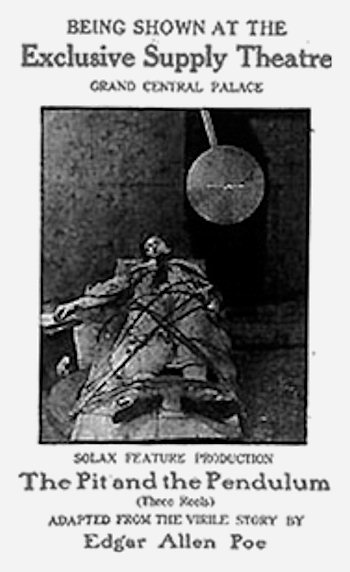
While the story is one of Poe's classics it is easy to forget it is actually only a short story with very little plot or back story. The intent of the story is to portray the horror of the nameless protagonist's ordeal which it does in great detail. Poe doesn't really explain how the hero got put into the dungeon other than referencing the Spanish Inquisition. To film the story however Blache decided to extend the back story to include a prologue where the hero (now given a name) is shown as being framed as the victim of a jealous rival who has joined the Inquisition. Thereafter he is put through various tortures as laid out in Poe's story including being strapped to a board covered by a horde of real rats as the pendulum descends. Accounts of the time rated the film's effects as gruesome and horrifyingly realistic but unfortunately we will likely never get to see it as the film has been mostly lost except for a seven minute fragment from the beginning of the film that has survived.
THE PIT & THE PENDULUM (1913)
Directed by Alice Guay Blache
CAST;
Alonso ~ Darwin Karr
Pedro The Inquisitor ~ Fraunie Fraunholz
The Girl ~ Blanche Cornwall
Aside from the short fragment all we have are some film stills and lobby crads. What we have left is not enough to really judge the film by, which is a shame because the sets were praised and what we can see shows more detail than the Griffith film "The Sealed Room" and one still of the actual pedulum looks promising enough for it's time. The cast are made up of regulars from her studio none of whom would become famous. They are merely servicable enough with Fraunholz being a suitably conniving villian although Karr as Alonzo looks too old and bulky to be playing a character described in the film as a "medical student". Also Guay changed the timeline of the story which Poe put during the Napoleanic Wars and instead seems to place the story in the early 1600's. This is not really a problem though as others have pointed out Poe was in error to place his story almost a hundred years later when the Inquisition was over.
Blache herself continued to make movies until 1919 when she was struck by the Spanish Flu pandemic and while she survived her recovery was slow. She was divorced by her husband and business partner, went bankrupt and had to sell the studio and equipment. In 1922 she returned to France, never made another film and was largely forgotten until historians started to take an interest in her life and works in the 1940's fortunately she lived to see this dying in 1968 aged 94.
========================================================
"THE RAVEN";
Plot Summary (spoiler alert);
Directed by Charles Brabin
CAST;
Henry B. Walthall ~ Edgar Allan Poe
Warda Howard ~ Virginia Clemm/Helen Whitman/The Lost Lenore
Ernest Maupain as John Allan
Eleanor Thompson as Mrs. Allan
Marian Skinner as Mrs. Clemm (credited as Marion Skinner)
Harry Dunkinson as Tony
Bert Weston as Slave
The film opens with a montage of Edgar Allan Poe's ancestors from the time they arived in America up to his parents who were actors. His father having died when Poe was a child Poe is adopted by John Allan and takes his name. Skip ahead fifteen years and the young adult Poe is a drunken gambler who has squandered his inheritance in a card game. He challeneges another player (who looks exactly like him) to a duel and shoots him before the duel is revealed to be a nightmare vision. Poe is expelled from West Point Academy and John Allen refuses to pay off Poe's debts. Poe is competeing for the affections of Virginia Clemm with Tony, a friend and drinking buddy. While courting Poe tells her a story about a romance with a Robin Hood type character and a forest girl who are brought together by a Pan type figure. Walking home Poe and Virginia witness a man beating a slve and Poe intervenes and buys the slave using an IOU which an angry Mr Allan has to pay. Poe and Tony are both still courting Virginia but eventually she chooses Poe and Tony graciously backs out and they remain friends. Mr Allan kicks Poe out of the house over his debts. Virginia goes with him as does the former slave. Poe and Viginia move in with her mother as he tries to make a living as a writer but he is unable to sell any of his stories and they live in poverty. Virginia's health suffers and she develops consumption. The former slave, who has remained with them, goes out into a winter night for firewood and does not return. Virginia dies leaving Poe grieving in which he is visited by visions of Virginia. Helen Whitman is a wealthy woman who looks after an older relative who dies. She visits the cemetary where Poe remains at Virginia's graveside where she meets him. Poe mistakes her for one of his visions of Virginia and follows her home. Poe falls in love with her but then realizing his mistake he flees. At home he passes out and has a vision of being visited by a great black raven, the spirit of Virginia who implores him to stop drinking and the Pearly gates closing on him. Poe resolves to quit drinking and is inspired to begin composing the poem "The Raven" and the entire poem is recited in the inter-titles. As he finishes he falls to the floor dead. Finis.
++++++++++++++++++++++++++++++++++++++++++++++
In spite of it's title this film is not actually a dramatization of the classic poem but instead is a fanciful biopic of Poe which climaxes with him composing his most famous ode. The version of Poes life does feature some actual historical figures including his family, wife Virginia and Helen Whitman who Poe was romantically linked with after Virginia's early death. However few if any of the details here are true with one notable point being the potrayal of Virginia who was in fact only thirteen (and Poe's second cousin) when they married and not the mature, flirtatious twenty-something we see here. It may be that the filmmakers were conscious of this and purposely decided that making Virginia an actual childbride would be too creepy for modern audiences although it was perfectly legal (if uncommon) during Poe's day. Then there is the scene where Poe intervenes to stop a slave from being whipped then buys him from his abusive master, going into debt to do so. Needless to say none of that was even remotely true. Poe's attitudes towards slavery are a little hazy. As a Whig from the slave state of Maryland he was a moderate who thought that slavery was on balance a bad thing but also detested abolitionists as dangerous fanatics who might provoke a civil war. He certainly was not going around freeing slaves even if he could have afforded to do so which he could not have. The rest of the story is more convetionally fanciful, exagerating his lack of success as he trudges to a publishers offices only to get brushed off and composes "The Raven" under the influence of a ghostly bird then dies upon completion. There are is also an extended secene where Poe recites stories which are acted out as flashbacks. It would have probably been impossible to make a film based on the actual "Raven" anyway as it's a poem not a story and has only a thread of a plot. much of the direction is strictly rote with intertitles informing us of the next scene which is then potrayed in a straightforward manner. Too much time is spent on running through a perfuctory gallery of Poe's ancestors to further pad out the time. However amongst these very conventional scenes are a few more imaginative shots starting with a weird scene where Poe has a dream where he plays cards with himself, loses to himself and challenges himself to a duel before waking up. Even Poe himself might have approved of this. There are even a couple of nicely done artistic scenes including a shot of Poe as a shadow profile looking like a magic lantern shot, a shot of Poe at Virginia's grave that looks as if it were from a Bergman film and another graveshot shot that looks like a Pre-Rapaelite painting. The scenes of Poe being visited by Virginia's ghost and the ghostly Raven are competently done with conventional double exposures. However the early scenes of Poes ancesters are pointless, the clumsy attempts at comedy during Poe's courtship of Virginia fall flat and at odds with the rest of the film and the choice to have Virginia and Helen Whitmore played by the same actress (Warda Howard) is odd and distracting. The film is too rambling and diffuse and the plot too simplistic to be considered a success but it has enough oddities to be interesting.
Poe is played by Henry B Walthall, from "The Avenging Conscience" and best known for starring on DW Griffith's "Birth Of A Nation". He does naturally resemble Poe so was probably an obvious choice and he does a credible job as the older depressed grieving Poe. Virginia is played by Warda Howard who was probably in her early thirties and over a decade older than the actual Virginia. Note that the (entirely fictitious) Slave character is clearly played by a white actor in blackface and he plays him as a stereotypical shuffling, loyal Uncle Tom but none of this was unusual at the time and while certainly patronizing it is not nearly as hateful and racist as in "Birth Of A Nation". The director was Charles Brabin who would also make "The Mask Of Fu Manchu" (1932) but is probably better remembered if at all for marrying Theda Bara.
ANNABEL LEE (1920);
This American film from 1920 is far more obscure than the Griffith film and it's only due to the vagueries of time and unknown film collectors that it survives at all. As a Poe adaptation it hardly qualifies instead using Poe's 1849 ballad poem as a framing device to introduce a story that has more in common with Robert Louis Stevenson, Joseph Conrad or Herman Melville.
ANNABEL LEE;
Directed by William J Scully
CAST;
David Martin ~ John O' Brien
Annabel Lee ~ Lorraine Harding
Colonel Lee ~ Louis Stern
Mother Martin ~ Florida Kingsley
Happy McGurt ~ Ben Ross
Donald Grainger ~ Ernest Hilliard
PLOT SYNOPSIS (spoiler alert);
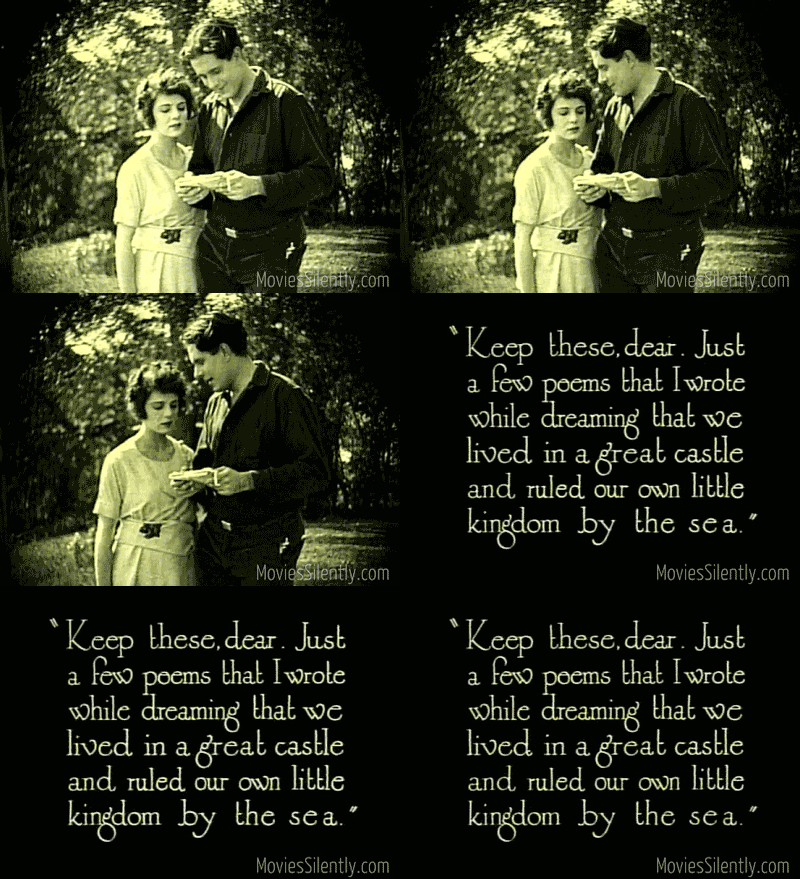
David Martin is a young fisherman and aspiring poet living in Martha's Vineyard with his widowed mother. Annabel Lee is a wealthy heiress who lives with her father, Colonel Lee in a mansion overlooking the sea. David and Annabel are in love but Colonel Lee objects to a marriage. Colonel Lee insists that David and Annabel spend a year apart before he will consent to their wedding. They agree. David decides to chart a ship and search for treasure lost when his father, a ship's captain, went down with his ship in the Pacific. Before leaving David leaves Annabel a copy of poems he has written. While he is gone Colonel Lee tries to encourage Annabel to marry Donald Grainger, a wealthy publisher. Annabel convinces Grainger to publish David's book of poems one of which is the ballad "Annabel Lee".
David's ship is a schooner whose crew includes first mate Happy McGurt, and Joe Ling, a Chinese cook and about a dozen sailors. McGurt is a burly, bad tempered, hard drinking bully who constantly picks on the happy-go-lucky Ling. David stops McGurt from beating up Ling and threatens to have him tossed in the brig. McGurt warns David that the crew is weary of the fruitless treasure hunt and want to return home. Meanwhile back in Martha's Vineyard Annabel and Mather Martin continue to wait for David's return. Each night Annabel leaves leaves a light in her window. Annabel begins having nightmare premonitions. After several months at sea, led by McGurt, David's crew mutinies and sends David and Joe Ling adrift in a lifeboat. They wash-up on a deserted desert island and are stranded. Ling eventually dies of jungle fever, presumably malaria.
Back in Martha's Vinyard Annabel and Mother Martin continue to wait for David's return. Colonel Lee continues to encourage Grainger to woo his daughter. One day a telegram arrives from Chile informing Mother Martin that David's ship has been lost at sea with all hands. McGurt had been rescued and survived long enough to lie and report that David had died at sea. Annabel is grief stricken and retreats to her house with Mother Martin who becomes her adopted mother figure. Annabel spends her days walking the dunes along the shore pining for David. Colonel Lee and Mother Martin are concerned for her mental state. After an unknown number of months a passing ship rescues David and he returns home without informing anyone. David returns home to be greeted by Mother Martin and Annabel. Colonel Lee welcomes him as well as David and Annabel are reunited.
~~~~~~~~~~~~~~~~~~~~~~~~~~~~~~~~~~~~~~~~~~~~~~~~~~~~~~
As stated the movie has little or nothing to do with Poe's poem which is too short to be adapted into a film anyway. One particularly glaring change is giving the story A HAPPY ENDING! Pretty sure that's not what Poe had in mind. As we have seen Griffith had previously used "Annabel Lee" in much the same way in "The Avenging Conscience" and it's a pretty safe bet director William Scully and screenwriter Arthur Brilliant were well aware of this earlier better known film. The actual plot owes more to "Robinson Caruso" than anything by Poe. The direction is competent but nothing more and other than a couple nice of shots of Colonel Lee's shadow lurking over David and Annabel and some later shots of Annabel waking in a stormy night among billowing curtains there is little flair for atmosphere although there are some pretty outdoor scenes. The inter-title cards are well illustrated in the melodramatic style of many American films of the era as opposed to European films. More distracting are scenes with the Joe Ling character of the Chinese cook who exists mostly for comic relief and to make David look noble. He is shown as a racist stereotype Chinaman, cringing, servile and stupid (albeit loyal) who speaks in pidgin English. Note that the unknown actor playing Joe Ling is clearly not Chinese although that sort of Minstrel Show portrayal of non-white characters by white actors was not unusual in American films of this era. Similarly McGurt is a Irish stereotype, drunken and brutish. There are also some odd plot loopholes; the Martins are described as "poor" but their house is well furnished and he clearly has enough money to outfit a schooner to fund his treasure hunt. Characters disappear without explanation such as Grainger. However audiences at the time may not have cared about such details as the films of Griffith and DeMille show.
The cast are obscure and were not even big names at the time. Leading man John O'Brien actually had a long career stretching back to 1910 but with no notable films to his credit and mostly as a support player in comedy shorts. Similarly Louis Stern as Colonel Lee was another journeyman actor going back to 1916 with a small role in the 1924 Paul Leni/Conrad Veidt Gothic Horror classic "The Man Who Laughs" and a Tarzan film as his only notable film credits. Both actors saw their careers end around the time sound films came in. Lorraine Harding had only three more films to her credit, none notable, although this might mean she spent the bulk of her career as a stage actress. She is the only actor here who leaves any sort of impression. Harding is noticeably different than the usual heroines of DW Griffith such as Mary Pickford, Florence La Badie, Blanche Sweet and the Gish Sisters. They were petite, spunky, girl-next-door types with long blonde ringlets and china doll faces, while Harding is curvier with dark hair, a sculpted face and and dreamy air. She looks somewhat like a moodier version of Olive Thomas. Director William Scully directed only three more films but he did have a long career as a journeyman assistant director into the 1940's with no important films to list.
The film itself is decent enough on it's own merits but is no lost classic and adds little to the Poe canon.
"THE FALL OF THE HOUSE OF USHER" ~ (TWO VERSIONS) 1928 & 1929;
Poe had been popular with the literati in France for years after being championed by Charles Beaudelaire and his symbolist successors like Arthur Rimbuad and Paul Verlaine. At the turn of the century the great composer Claude Debussey had made fitful attempts to put Poe's works to music but failed to finish the project before his death in 1918. Therefore it was fitting that French Impressionist filmmaker Jean Epstein would make a version of "The Fall Of The House Of Usher" in 1928. By this time sound had been introduced the previous year but there would be a couple of years before the transition would take full effect and even longer to make the unwieldy new sound equipment more portable to allow for moving camera-work so Epstein's decision to make a silent version was understandable. The film mostly follows the plot of the original Poe short story;
"THE FALL OF THE HOUSE OF USHER" ~ 1929 (FRENCH VERSION);
CAST;
Jean Debucourt ~ Roderick Usher
Margaritte Gance ~ Madeline Usher
Charles Lamy ~ Allan
Fournez-Goffard ~ The Doctor
Abel Gance ~ Inn Keeper (?)
DIRECTED BY JEAN EPSTEIN
PLOT SYNOPSIS (spoiler alert);
A nameless young man arrives at a run down castle owned by an old friend, Rodrick Usher, and his sister, Lady Madeline. The castle is gloomy and rundown, the Ushers are pale, neurotic, depressed and frail. They are also the last of their line in a once powerful and noble family. One night while the young man (who also acts as Narrator) seeks to comfort his ill friend, Roderick reveals that Madeline has died and been interred in the basement crypt. The distraught Roderick is haunted by visions and sounds of his ghostly sister. The Narrator at first assumes Roderick is hallucinating until he begins to hear sounds as well. Roderick becomes convinced that Madeline is not dead and was interred while still alive. As Roderick runs down to open her crypt she reaches out and pulls him inside. As the Narrator flees the castle suddenly begins to crumble and collapse falling into a pile of rubble. The Narrator sadly rides away. Finis.
The story, while short on plot, is rich in atmosphere with long, detailed descriptions of the furnishings and appearances of Roderick and the crumbling castle. Poe draws comparisons between the portraits of Usher's noble ancestors and the weak Roderick and the now rundown and decadent state of the castle. There are also passages of heroic poetry that the Young Man reads to the decidely unheroic Roderick. The story was inherently filmatic and resulted in two versions done in rapid succession, both done in the Expressionist style. While not normally thought of as an Expressionist director, Epstein had obviously been paying close attention to such directors as the Germans F.W. Murnau ("Nosferatu" "Faust" and "The Haunted Castle"), Robert Weine ("The Cabinet Of Dr Caligari", "Genuine", "Crime And Punishment" and "Orlock's Hands") and Paul Leni ("Waxworks", "The Man Who Laughs" and "The Cat And The Canary") as well as the Scandinavians Victor Seastrom ("The Phantom Carriage" and "The Outlaw And His Wife"), Benjamin Christenson ("Haxan") and Carl Dreyer ("Witch Woman"). The film looks much more German than French.
Epstein conveys an atmosphere of decadence and gloom by making expert use of the full arsenal of Expressionist film-making. The castle is even more dismal and oppressive than Count Orlock's from "Nosferatu", which is quite a feat. It sits in the middle of a desolate moor, shrouded in dense fog. The shots of the moor are quite beautiful while the castle is obviously a model. The use of such studio models was common in German films like "Faust", "Metropolis" and "Caligari". The jagged camera angles, jarring closeups and wandering cameras show the influence of Murnau. There are also usual expressionist motifs such as the heavy use of shadows, frequent close-ups of Roderick's nervous clutching hands, staircases that lead into (and from) the darkness and inanimate objects appearing to come to life. Note the mass of candles dripping wax tendrils and the vines creeping spider-like up the walls. The Doctor character is a classic Expressionist heavy with his long tight black coat and stiff collar and his bald head, thin lipped glower and eyes hidden behind impassive glasses.
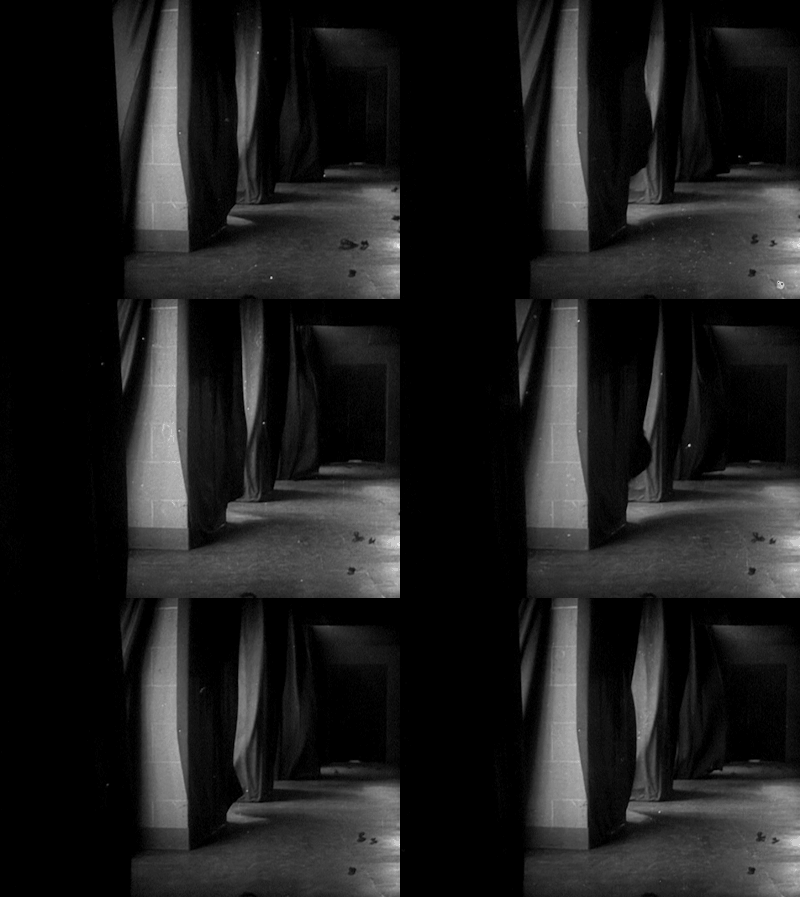

There some stunning scenes; the long sequence where Roderick plays guitar and sings a sad ballad is inter-cut with scenes of a long hallway and it's billowing curtains, books cascading slowly from their case while leaves blow across the floor. It's a scene that would right at home in Stanley Kubrick's "The Shining". Then there is the funeral scene of the internment of Lady Madeline's coffin, with a long march across a misty moor while her veil trails out behind while a superimposed image of burning candles hovers over all. This scene is probably too psychedelic even for Kubrick and is more in David Lynch territory. One reason Epstein probably chose to film as a silent was that the cameras in 1929 were not mobile enough to make an Expressionist film which is also one reason why the Germans, Swedes and Danes stopped making them. In fact this film is really the last great Silent Expressionist Horror film. Two years later Carl Meyer would make the cult classic "Vampyr", which was not technically silent, but it has so little dialog, and what little dialog that remains is so muffled, that it might as well be silent.
While this film probably best captures the atmosphere Poe evoked there are a couple of notable changes Epstein made to the story. Firstly there is the character of the Narrator. In Poe's original story he is a fairly young man roughly the same age as Roderick and Madeline whom he grew up with. For some reason Epstein changed him to an old man with stooped shoulders and hard of hearing (he is constantly shown cupping his hand to his ear and asking Usher to repeat himself). There is no particular reason for this change and it alters the dynamic between the characters. In the Poe story the character is nameless (as were many of Poe's characters) while here he is given Poe's own name. More glaring is the ending which has the Ushers escaping the house as it collapses. In the Poe story Roderick and his sister are claimed by the house, in fact the title of the story, "The Fall Of The House Of Usher" has a double meaning, referring both to the physical building as well as the Usher dynasty, or "house". Poe makes clear that Roderick and Madeline are the last of their once powerful line. Poe draws attention to the portraits of the ancestors; noble and impressive, compared to the current generation; weak, decadent, effete and hopeless. The Ushers are a symbol of the declining aristocracy. In the film Madeline confronts Roderick then faints and he carries her from the crumbling castle as it collapses. By having them survive Epstein undermines the entire point of the story. Is it possible that the Frenchman did not understand the full meaning of the title? Or did he chose to change it himself for some unknown reason? There are plenty of examples of movies having their endings changed and made more positive ("The Cabinet Of Dr Caligari" and "The Last Laugh" being the most notorious) but there is no evidence that Epstein was forced to do so for such a non-commercial film. Note that the great French director Abel Gance (already famous for his epic "Napoleon") is included in the cast but the role is not listed, presumably he plays one of the guests at the Inn or the Coachman since there are no other roles.
Although this film has long been considered a classic there is some argument as to what school this film should belong to. Epstein was associated with the French Impressionists while the Expressionists were associated with Germany and Scandinavia. However as pointed out this film has all the hallmarks of Expressionism in both theme and style. The film is dark, moody and claustrophobic and deals with themes of madness, obsession, death, decadence and implied incest, as indeed does Poe's story. Whereas Impressionism is light, airy, and ethereal, even when Impressionist painters dealt with topics of decadence (such as subjects like Degas' "Absinthe Drinkers" or Manet's "Bar At The Folies Bergeres") the treatment still finds the ethereal beauty. This film however is as black as anything in "Nosferatu" or "Caligari". It is probably a better example of Expressionism than Fritz Lang's sprawling and erratic "Metropolis", which has at least as much Futurist elements to it as Expressionist. In the end for some the distinction between Expressionist and Impressionist is more about country of origin, if it's French then it's Impressionist, if it's German or Scandinavian then it's Expressionist. The same is true of Dada vs Surrealism, the first is mainly German while the second is French, but what does one do with the Frenchman Marcel Duchamp who is much more the former than the latter?
Around the same time that Epstein was filming his version in France another Expressionist version was being filmed in America.
"THE FALL OF THE HOUSE OF USHER" ~ 1929 (AMERICAN VERSION);
Cast;
Herbert Stern ~ Roderick Usher
Hidergarde Watson ~ Madeline Usher
Melville Webber ~ A Visitor
DIRECTED BY JAMES SIBLEY WATSON
Plot-wise this film is also stays faithful to the Poe story. Style-wise it is Expressionism to excess, perhaps the only true American example of this quintessentially European genre. This version is basically all shadows and fog, jagged lighting and camera angles and stark Art Deco/Gothic sets that seem to be simplified versions of those used by German director Robert Wiene in his classics "The Cabinet Of Dr Caligari", "Genuine" and "Crime And Punishment". The sets are made to come to life at times to accentuate Poe's claustrophobic atmosphere. Watson also makes good use of camera tricks used by German Dadist director Hans Richter like double exposures to portray the nightmarish state of Usher's mind. The actors rely on the usual stagy emoting style along with some over-the-top makeup. All this riot of art-damaged stagecraft comes at the expense of plot or character, the character of the nameless visitor, fairly important in the story, barely shows up at all. In fact is fair to say that any viewer not already familiar with the original Poe story would find it impossible to make any sense of this film. Luckily it's also fair to say that Watson was safe in assuming that most contemporary viewers had indeed read the story already.
James Sibley Watson was a unique character in film history. He was in fact a respected doctor from a wealthy family with no film or theatre background. His mother was a noted arts patron and Watson would have a serious interest in literature becoming an editor of "The Harvard Monthly" in 1916 and later an avant garde arts magazine "The Dial" in 1918 where he would champion the works of poet e.e. cummings who he would also befriend. By the 1920's "The Dial"y was winding down but Watson had developed an interest in film and met another amateur film enthusiast, Melvile Webber, with whom he began to collaborate. After making a short documentary about Indians in Canada they made their version of "House Of Usher" in 1928, coincidentally at the same time that Jean Epstien was making his version in France, although it is not clear if Watson and Webber were aware of Epstein's film. Watson's wife Hildergarde appeared in the film as Madeline with Webber as the nameless visitor. Another partner in the film was composer Alec Wilder who wrote a score for the film. The trio would make another avant garde film; "Lot In Sodom" in 1932, also as a silent. Hildergarde would again appear. This film was another exercise in Expressionism along with an influence from "Salome", the notoriously decadent 1923 Art-Nouveau film of Alla Nazimova and Natacha Rambova. Watson and Webber would make a couple of short industrial films that experimented with different types of film stock and lenses and then Watson abandoned film altogether to experiment with the development of X Rays on film where made several important discoveries. During World War Two he returned to medicine. In later years he would retire from medicine to return to literature and would start his own publishing house called The Sigma Foundation. He died in 1982.
=============================================================
THE TELL TALE HEART (1928);
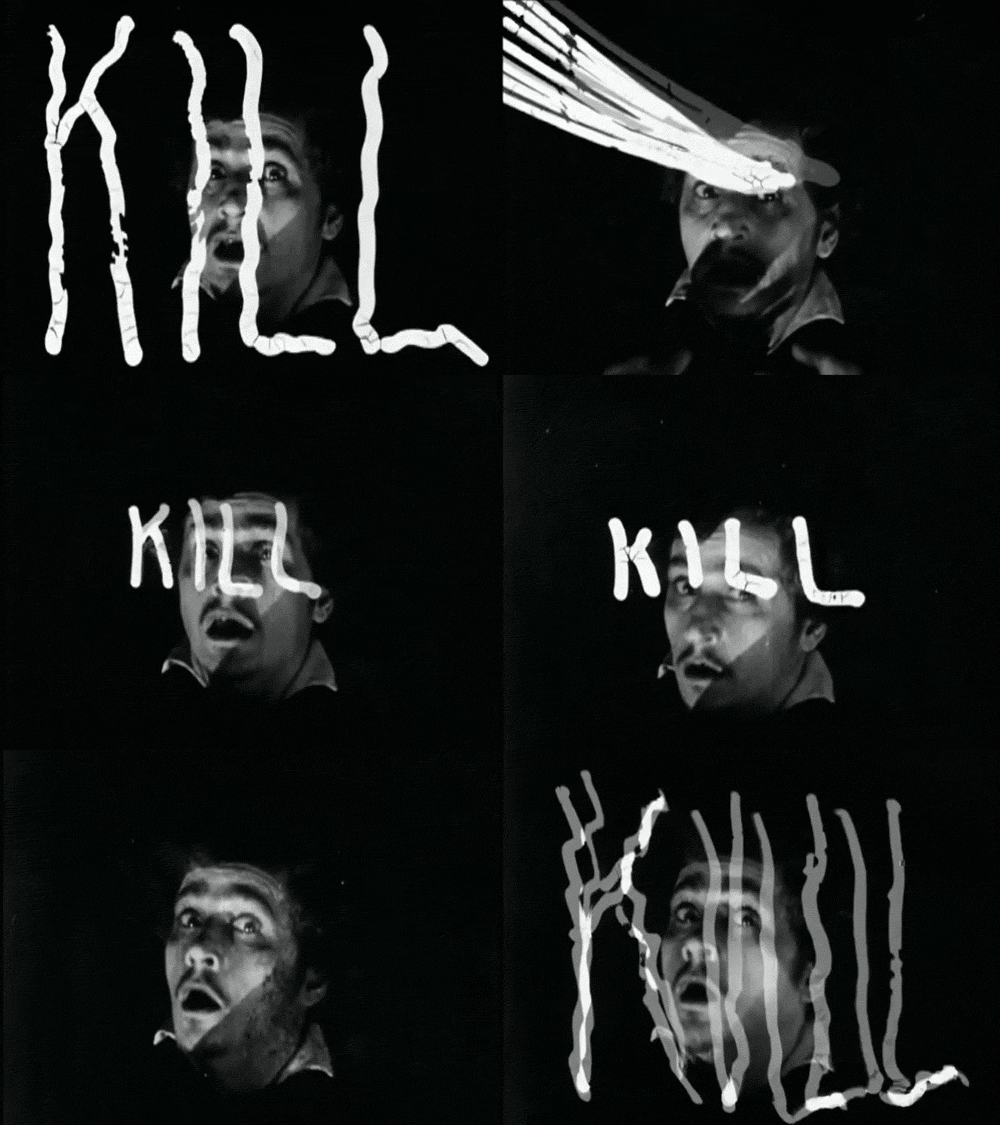
This American short is another art film done in the Expressionist style and is and even more obvious tribute to the classic German film "The Cabinet Of Dr Caligari" from the start of the decade. There is no need to sumarize the plot as it follows the original Poe story quite faithfully including using some of the dialogue from the story. The film's distinction lies in it's recreation of the look and feel of German Expressionism and "Dr Caligari" in paticular. To call it a tribute hardly does justice to it's stalkerish devotion to the master. Every detail is obsessively note-perfect from the sets to the camera effects. We even have Caligari's iconic jagged angled doors and furniture, painted-on backdrops, and skyline made of ramshakle plywood rooftops. In fact some shots are lifted straight from Robert Wiene's film. Note the shot of the narrator strangling to old man and the shot afterwards of him sitting on the floor which copies the scene of the criminal sitting in his jail cell. The montage scenes of floating eyeballs and disembodied words copy the Dada films of Hans Richter. The only notable difference between this film and the earlier German film is in it's costumes which are quite conventional. All this done to excellent effect as German style Expressionism is not surprisingly the perfect medium for Poe's story of a disordered mind and one wonders how using a similar approach would have might have worked with some of his other tales. This film is almost German than most German films of the of the twenties since the heyday of unrestrained Expressionist imagry in German film had peaked by the mid twenties. However while this film was made in America it comes by it's affection for German films honestly enough as it's director Charles Klein was in fact German with a fairly short career in both America and Germany making a few features and some shorts. The leading man playing the mad killer/narrator was a Danish actor Otto Matieson who bares a not coincidentally resemblance to a distraught Poe himself leading us to both have greater confidence in (as we recognize him) and yet question the reliability of the narrator as we obviously know Poe was not actually a killer. Matieson already had a long career in Denmark and would also appear in a supporting role in "The Maltese Falcon" dying in 1932.
This short film is an odd curio. First of all it is not even listed on IMDB, which normally includes even hopelessly out of print films. Even odder it is a silent film apparently made in the early 1930's, long after sound films were standardized everywhere, at least in the western world. The answer seems to be in the credits where it states that it was produced by The Department Of Cinematography at The University Of Southern California. It would appear that the film was made either as a teaching aid or a class project to illustrate the use of film, lighting and editing to tell a story without dialogue.
"THE OVAL PORTRAIT" (circa 1934);
CAST;
Evan Shaw ~ A Young Artist
Isabel Vecki ~ His Wife
Richard Salisian ~ An Old Man
Ray K. Immel ~ The Butler
DIRECTED BY RICHARD BARR
PLOT SYNOPSIS (spoiler alert);
It's a dark and stormy night as an Old Man returns to his desolate mansion on an isolated hill. He goes to bed reading by candle-light, he stares longingly at a portrait of a young girl as he falls asleep. He dreams about a young artist who sits in a meadow painting. A pretty Girl rides up on horseback, it is the girl from the portrait, he is smitten and they marry. The artist learns of a painting contest and decides to enter a portrait of his wife. He sets obsessively to work while she sits for him. Weeks pass as he paints, his wife becomes sickly and weakens. He takes no notice and paints on. As he finishes in a rush she dies. We are back in the Old Man's bedroom as he wakes and stares once again at the portrait of the girl. He slumps over dead.
The film closely follows the plot of Poe's original short story, which is actually one of his shortest, covering only a couple of pages. Such a short story wouldn't normally be thought of as good film material however this is a short film and the story was noteworthy as an obvious influence of Oscar Wilde's "The Portrait Of Dorian Grey" as the painting sucks the life out of the young life as it is painted.
The film may not have been intended for general release but it is perfectly professional and even displays some textbook examples of restrained Expressionist film making in the opening segments featuring some effective shots of lightning and shadows. While later we also see some French style Impressionism in the dream sequence with it's brightly lit meadows. One weakness is the melodramatic music which is not that unusual in films (and radio shows) of the early 1930's, although here it is especially overbearing, probably to over-compensate for the lack of dialog. Accordingly for this video I replaced the blaring organ with a moodier electronic soundtrack. The cast and director do not appear to have any other film credits except for Isabel Vecki who made a few more minor films in the 1930's. Actually if this film had been made a decade earlier in the silent era it could have easily been given a general release, assuming there was enough material to be found in Poe's very short story that is.
"THE MASQUE OF THE RED DEATH";
A few ringers; These modern amateur short films do a surprisingly effective job of capturing the feel of a silent era gothic horror film.
Winsor McCay (1867? ~ 1934) is known as the Father Of Animation. He did not actually invent animation, experiments in bringing drawings to life had been done since the days of magic lanterns in the 17th century and wasted little time once the film era began. By 1906 the British film-maker and illustrator J. Stuart Blackburn, the Frenchman Emile Cohl and the Spaniard (working in France) Segundo de Chomon had made some rudimentary animated shorts. They were very crude with halting and jerky movements that would barely qualify as animation at all by later standards and it would take a serious cartoonist to bring the new art form to life.
Winsor McCay's background was a mystery even to himself; he gave various different dates and locations for his birth. His background is clear enough however. His family were of Scottish background and lived in Woodstock, Ontario, Canada and they immigrated to America around 1868. American census reports from 1870 and 1880 show a Zenas Winsor McCay (his full name) born in Canada in 1867, living in Spring Lake, Michigan. However no birth or baptism record has ever been found on either side of the border. He would later claim to have been born in 1871 in America, but that date (if not the location) is impossible according to the 1870 census report, and Winsor himself would admit that he didn't really know the truth.
FROM ILLUSTRATOR TO CARTOONIST;
At any rate the young Winsor (not surprisingly he quickly dropped the "Zenus") was drawn to art as a child and was encouraged by his parents to take art lessons which included illustration, etching and stained glass, all useful skills for a future animator. By 1889 he had moved to Chicago to further his art studies and become a commercial illustrator. He would then get a steady gig as cartoonist for Cincinnati newspapers while working a side gig as an entertainer drawing caricatures in rapid time in front of audiences. He would develop a distinct stamp moving past the dense Victorian look of Thomas Nast and Richard Outcault to a more open and flowing style more influenced by the newer Art Nouveau school out of Europe. By 1903 he had made enough of a name for himself that he got a high profile job with the "New York Herald" as an editorial cartoonist. Richard Outcault, who was the most succesful cartoonist in America also worked at the Herald. Outcault is considered the first modern cartoonist having developed the idea of using panels to tell a story instead if using a single stand-alone drawing as Thomas Nast had done. He also made use of dialog bubbles to better show which character was speaking. This enabled Outcault to have serial stories and introduce the first regular characters starting with the hugely popular "Yellow Kid" and later "Buster Brown" strips. Outcault and the younger McCay did not get along however and would become rivals as the younger artist became more popular. McCay would later move to William Randolph Hearst's "New York Journal" and "Evening Telegram". McCay would later have a contentious relationship with Hearst over the rest of his life.
Working for Hearst McCay started out as an editorial cartoonist but he also tried to develop a strip of his own. After several abortive experiments with names like "Sister Little's Sister's Beau" and "Phoolish Phunny Phrolics", McCay got a gig as illustrator for a comedic series called "Percival Slathers" about a meek, elderly gent and his hopeless attempts to make his way in high society. This was not an actual comic strip but a series of illustrated short stories. Little is known about this series including the identity of the writer but it is probably not McCay given that it's writing style is unlike anything McCay ever did. Nor did he ever mention it in later years and in fact copies were only recently discovered. The artwork for "Percival Slathers" is competent but not particularly noteworthy although it may have helped him finally get a strip of his own with "Mr. Goodenough" in 1904. "Mr. Goodenough" was variation on "Percival Slathers" with another upper-class twit, in this case an indolent millionaire, and his lackluster attempts to become sociable. The short run strip is largely forgettable although it does show flashes of a more individual visual style.
After these abortive attempts McCay developed a popular character strip called "Little Sammy Sneeze" in 1904. As a character "Sammy Sneeze" was simple in the extreme. Sammy was a small boy who in every strip would try to stifle a sneeze which would in the final frame explode with catastrophic results; bricks would fall from buildings, animals would stampede, crowds would flee in panic. And that was it, Sammy had no dialog or even a real personality, he was just a force of nature. But if the strip had little of substance it had a striking visual sense that surpassed Outcault's. McCay was an superior draftsman combining a very realistic view of human figures and the way they moved along with clean and uncluttered backgrounds. At a time when Victorian illustrators were fond of excessive detail McCay experimented with minimal backgrounds, including some that used only stark black or white, he also "broke the fourth wall" by having characters at times bust out of their panel. Even today some his "Sammy Sneeze" strips look much like the comics of the 1960's while Outcault's clearly belong to the Edwardian Era and Nast's to the Victorian.
"LITTLE SAMMY SNEEZE";
"Sammy Sneeze" was popular but it was aimed at kids and it's lack of a real story must have been somewhat limiting since McCay also developed another strip (under the pen name of Silas) called "A Pilgrim's Progress" which had a continuing story about a middle-class man forever trying to free himself of a briefcase embossed with the words "Dull Care" and live a carefree life on "Easy Street" only to have the case return in the last panel. The strip was an odd allegory named after John Bunyan's Puritan religious novel (the character was named Mister Bunion) that seems quite clunky to modern audiences but once again the artwork is excellent if less elaborate than "Sammy Sneeze". Around the same time McCay had developed another even more important strip called "The Dream Of A Rarebit Fiend". This strip was truly ground breaking both for it's subject matter and it's amazing visuals.
"PILGRIM'S PROGRESS";
"Rarebit Fiend" did not have a regular character and it's plot, such as it was, never changed. In every strip a character, after eating a "Welsh Rarebit" (a bun covered with melted fermented cheese) has a dream with bizarre and often terrifying hallucinations. These dreams could be incredibly complex, characters could find themselves shrinking to the size of ants or growing to such massive size that they strode through the city like King Kong, or caught in traffic which slices off various limbs, trapped in a museum chased by dinosaur bones come to life, chased by an army of their own doppelgangers, floating in space, climbing an endless staircase surrounded by inky blackness, or eaten by a giant snake while other jungle animals stroll the city streets wearing business suits. While some strips were bizarre slapsticks other were quite dark as one which showed the dreamer being buried alive in the best Edgar Allen Poe tradition while his widow flirted with his best friend. There had simply never been anything remotely like it and the strip was a sensation leading McCay to develop the idea more fully into his best known strip "Little Nemo In Slumberland".
"DREAM OF A RAREBIT FIEND";
"Little Nemo" was another small boy, who while he sleeps enters into a rich dream world through which he travels. "Slumberland" is a lush fantasy land with floating castles made of mirrors, mountains made of cake and ice-cream, armies of snowmen who come to life, flying cars and pirate ships, beds that sprout legs and run away and other dream sequences we have since seen repeated in more modern cartoons from Disney's "Fantasia" to Betty Boop and Bugs Bunny toons to the Simpsons.
"LITTLE NEMO IN SLUMBERLAND";
Besides Nemo the strip had other regular characters such as a Little Princes, an escaped African savage boy called "Imp" and a troublesome cigar chomping clown with a five-o'clock shadow called "Flip". The "Little Nemo" strips were the most elaborate ones yet done by McCay or anyone else. Eventually taking up an entire page in full colour, each panel was incredibly detailed and crammed with Art-Nouveau architecture and costumes. As always the characters looked realistic and showed a close attention to the human form and movement.
LITTLE NEMO"
In 1909 McCay would try one more straight forward strip aimed at adults called "Poor Jake" about a hapless (and once again speechless) working class jack-of-all-trades who is constantly over worked by his lazy millionaire boss who in turn takes all the credit. This was an obvious political allegory and shows how McCay's focus had changed from his earlier "Mr. Goodenough", in fact Poor Jake's boss looks like Mr. Goodenough which may not be a coincidence. Other than this point the strip was decidedly minor and lacked the imagination or visual flair of his other strips and it was short lived.
McCay's strips displayed a mastery of visuals as well as a vivid imagination but they also showed his one weakness; he had some wildly creative ideas but he was a poor writer. His dialog was full of long rambling run-on sentences that seemed to be crammed into the character's word bubbles as an after thought. Sometimes they were cut off in mid-sentence as if McCay tossed off the dialog after the artwork including word bubbles were already done, which was probably the case. While McCay could come up with a visual gag he simply could not write a punchline. McCay did in fact come up with some creative and quite advanced story ideas or at least concepts but he was only interested in exploring them visually. "Sammy Sneeze" and "Rarebit Fiend" did not have proper plots or stories at all and while "Pilgrims Progress" actually did have a fairly complex idea as it's basis, the stories were episodic and again basically identical. That left "Little Nemo" as the only major McCay strip which had proper stories although again McCay's dialog is still somewhat clunky.
This brings us to McCays second weakness; character development. Almost all of McCay's characters, from Sammy Sneeze to the various Rarebit Dreamers to Poor Jake were completely passive. They took no initiative nor did they even give much reaction to any of the plights they found themselves in. The Dreamers were subjects of their hallucinations following which they then made a bemused comment while Sammy Sneeze and Poor Jake were speechless. Mr Bunion and Mr Goodenough would make occasional and fitful attempts to take some sort of action only to fail leaving them to merely shrug and comment wryly. Even Little Nemo who seems at first glance to be an explorer in a fantastical world is mostly an observer rather than taking any initiative and he has no real personality, he is not mischievous or even really curious, he never displays any particular emotion. The same is largely true of his friend the Little Princess leaving only the irascible character of Flip The Clown, and to a lessor extent the playful African Imp (who is also speechless) as the only McCay characters to have a real personality.
CARTOONIST TO ANIMATOR;
Early on in his career Winsor McCay had performed in public by doing quick caricatures while narrating his work to an audience. By 1906 as his work became famous he was lured back to vaudeville to perform in an act in which he would do quick drawings and appear to make them move and age while an orchestra played. Sometimes he shared bills with acts like jugglers, dog acts, knife throwers, accordion players, yodelers and comics like W.C.Fields, Will Rogers, Charley Case, John Bunny and the Keaton Family (featuring a young Buster). This success led to attempts to turn "Little Nemo" into a stage show with a live cast as had been done earlier by his rival Richard Outcault with his "Buster Brown" strip. McCay's backers gave him a huge budget of $100,000 to play with which allowed for an elaborate set and a score by composer Victor Herbert. The play ran for two years as a touring show to sell-out shows while McCay continued to tour with his own vaudeville act. He also continued to somehow find time to do his regular newspaper strips. In 1906 director Edwin S. Porter did a short version of "Rarebit Fiend" which included some groundbreaking double exposure special effects.
"DREAM OF A RAREBIT FIEND"
In 1911 McCay started to experiment with film. There had been some earlier attempts with animation without much success, but McCay's unique skillset of exceptional draft work, attention to detail and rapid fire drawing ability along with a vivid imagination made him the perfect pioneer to make animation truely come alive. He chose as his subjects the characters from "Little Nemo". McCays first strips were really just experiments in trying to make the sort of flipbooks used by children come alive. McCay developed the method of using thousands of painstakingly drawn pictures drawn in sequence on rice paper to show incremental movement. This early strip doesn't have a story but it must be remembered that this cartoon was not intended to be shown in theatres but was instead part of McCay's vaudeville act. McCay would stand to the side of the stage and pretend to interact with the characters getting them to jump, dance and throw objects. As such it was still groundbreaking and contemporary audiences were spellbound by the new medium. Literally every animator since has used the same methods and the strip still looks modern. In fact in it's fluidity of movement McCay's strips are easily superior to those of Hanna-Barbara, Rankin-Bass, Krantz Studios or Cambria Studios fifty years later.
"LITTLE NEMO & FRIENDS" (1920's theatrical reissue with intro);
The next year McCay left the "Herald" in a dispute over money and was hired by William Randolph Hearst for his empire. The "Herald" tried to claim copyright over McCay's characters but McCay eventually sued successfully to keep them. Still in that year he made a more elaborate strip with it's own storyline but without Nemo called "How A Mosquito Operates" which had an amazingly lifelike sequence of a giant mosquito attacking a sleeping man until it gets so full it explodes. The film was based on one of McCay's "Rarebit Fiend" strips and shows an accuracy of movement and anatomy that is still stunning, and a little creepy. This toon was also added to McCay's vaudeville act, although unlike the previous film this one had enough of a story that it could stand alone.
"HOW A MOSQUITO OPERATES";
Following this artistic triumph McCay would develop his most famous animated character; "Gertie The Dinosaur" in 1914. McCay had drawn dinosaurs in earlier newspaper strips but by adding movement and facial expressions he was able to give Gertie a real personality, rather like a hugely overgrown but playful puppy. Once again this toon was designed to be part of McCay's vaudeville act wherein McCay would introduce the shy Gertie who would be coaxed into doing tricks, dancing and playing catch. At the end McCay would appear to walk into the screen and ride off on Gertie's back. Besides Gertie the toon is notable for having full backgrounds and depth perception unlike the earlier toons. The importance of Gertie to future animators can not be overstated. McCay had created a lovable and believable animal character which could move and even show emotion. Later animators like Nat Fleischer and Walt Disney would list Gertie as one of their greatest influences. Virtually all subsequent toons for the next half century would look and move essentially like Gertie.
"GERTIE THE DINOSAUR" (EXCERPTS);
Unfortunately McCay's days a vaudeville performer would suddenly come to an end when his employer William Randolph Hearst decided that McCay was spending too much time on his animation and his live show and not enough working on the newspaper and would ban McCay from vaudeville. Hearst did however give McCay a substantial raise to cover the loss of his performing revenue and McCay was allowed to do outside work illustrating advertisements and sheet music books. "Gertie" was later re-shot for the movie theatres with a lengthy prologue added to explain the process and take the place of McCay's in person interaction with Gertie. This filmed intro (which takes up almost half of the short) starred Winsor McCay as himself and included a cameo from vaudeville comedian John Bunny. Although largely forgotten today John Bunny was the first film comedy star and was internationally famous and a large influence on WC Fields, although he isn't given much to do here. Still this is one of the few chances to see Bunny since few of his films survive. It's also the only chance to see Winsor McCay, by this time in late middle age and balding. He bills himself as "The Inventor Of Animation" which is close enough to the truth to be excusable.
"GERTIE THE DINOSAUR" (full film short);
America's entrance into World War One in 1917 gave McCay a chance to make what would become his cartoon masterpiece; "The Sinking Of The Lusitania". This toon was a piece of anti-German war propaganda which Hearst could not object to. The Lusitania was a British passenger liner (and a rival to the Titanic) which was sunk by a German U-Boat in 1915 with a heavy loss of life including many Americans and which became a cause-celeb in the run up to America's declaring war. The cartoon shows the ship leaving New York then intercepted by a U-Boat which fires a torpedo causing a vivid explosion. The rest of the strip shows the ship's sinking, a side bar naming a few celebrities who died on board, the survivors splashing in the water, and it ends with a shot of a mother holding an infant sinking beneath the waves.
Starting in 1917 and finished in 1918 the entire strip took 25,000 individual drawings each done by hand by McCay himself with a couple of assistants using a new technique he developed, drawing on clear cellophane cells instead of rice paper as before. The strip shows McCay's usual attention to detail and careful observation of form and movement. Notice the undulating waves, each done individually. Then the billowing curtains as the ship passes the Statue Of Liberty. Next the strip gains menace with the arrival of the surface running across the surface with it's crew running to battle stations, a scene that looks so real it almost looks like an actual film. Then comes the spectacular explosion scene which again looks stunningly real rather than a cartoon explosion. The ship's slow motion sinking with it's smokestacks billowing out a thick oily cloud while the passengers and crew scramble down ropes or jump overboard has a brutal beauty that belies the term "cartoon". So to the final shot of the drowning mother and child, a scene actually taken from a well-known recruiting poster by American artist Fred Spear. The only discordant note (aside from the jingoist narration at the end) is the shot of a couple of cartoonish fish speeding out of the way of the speeding torpedo, not that the shot is badly done of course but it's cutesy look doesn't really fit with the serious nature of the rest of the strip. Even taking into account that this strip is in black and white the lush detail and realism of the strip would not be equaled until the full colour features done by Walt Disney and the Superman cartoons done by the Fleischer Brothers of the late 1930's
"THE SINKING OF THE LUSITANIA" ~ 1918;
With Mcay's reputation as "The Inventor Of Animation" secure he resumed making cartoons building on the new animation cell technique which allowed him to make more detailed strips based on his fantasy comic strips "Little Nemo" and "Rarebit Fiend". By 1921 he had released three complete strips; "Bug Vaudeville" which builds on the research done for "Mosquito" to create a fantasy vaudeville act made up of giant dancing bugs. There is also an intro featuring Flip The Clown from Little Nemo strip.
"BUG VAUDEVILLE" ~ 1921
"The Pet" featured an animal that eats so much that it grows to massive size and proceeds to stomp through a terrified city like King Kong until it is killed by the air-force. The unidentified pet in question looks like a cross between a puppy and a teddy bear but for some reason it meows like a cat.
"DREAM OF A RAREBIT FIEND; THE PET" ~ 1921;
"The Flying House" was the most psychedelic toon yet in which a man attaches wings to his house and flies away to escape from creditors.
"THE FLYING HOUSE" ~ 1921;
After his animation career was abruptly stopped there were a few unfinshed projects such as this lush fragment of some centaurs in a Art Nouveau forest.
"THE CENTAURS";
LATER CAREER:
In 1921 Hearst once again invoked his exclusive contract to ban McCay from further animation work. Since 1918 Hearst had allowed McCay to do animation presumably because of the increased publicity and prestige and on the assumption that since these cartoons were done to be shown in movie theatres rather than on the vaudeville stage they would still leave McCay to continue to do his work for Hearst's papers. However hand drawn animation is extremely time consuming, especially if it's done with McCay's painstaking attention to detail and so Hearst once again ordered McCay to drop his animation work and concentrate solely on his newspaper work which included his weekly strips as well as editorial cartoons. As before Hearst promised McCay a bonus which he apparently did not pay however and when McCay's contract ended in 1924 McCay quit and moved to a rival paper, taking Nemo with him. Hearst tried to continue the Nemo strip under a different name with artist Mel Cummin but was not successful and McCay was lured back in 1927. Besides his usual strip work on of the noteworty jobs done for Hearst in later years was sketching the scenes from the Lindburgh kidnapping in 1932. Winsor McCay suffered a massive stroke and died in 1934 aged about 55. After his death Hearst once again tried briefly to keep "Little Nemo" alive with the hapless Mel Cummin, with the same lack of result.
INFLUENCES AND LEGACY:
Besides being massively influential for their artwork, strips like "Little Nemo" and "Rarebit Fiend" are fascinating for their subject matter. In his exploration of dreams McCay seems to be channeling the theories of his contemporary Sigmund Freud although there is no evidence they were even aware of each other. McCay's fantasies also anticipate the French Symbolists and the later Surrealists and Beats although again there is no evidence they knew of his work. McCay seems to occupy his own unique space, reaching similar conclusions to the avant-garde without being in anyway a part of it. In this he resembles another American contemporary, the composer Charles Ives, who was experimenting with musical rule breaking at the same time Arnold Schoenberg was shocking Europe in spite of the two men being quite unaware of each other's work. When Schoenberg was much later exposed to Ives's work he was shocked to find there had been a like-thinking contemporary in conservative middle America. One wonders what Salvador Dali, Marcell Duchamp, Andre Breton or Man Ray would have made of this American newspaper cartoonist's work.
McCay himself never listed any influences leaving to much speculation as to where he took his ideas. Possible artistic influences include earlier newspaper cartoonists Thomas Nast, Joseph Keppler, and especially Fredrick Burr Opper, Gustave Verbeek, Ralph Barton, James Mongomery Flag, Charles Dana Gibson and Richard Outcault. Impressionists Alfonse Mucha and Toulouse-Lautrec, Art Nouveau illustrators Aubrey Beardsley and especially Arthur Rackham. French Symbolist painter Gusatve Moreau, European artists Gustave Dore and eccentric French fanatsy illustrators Isadore Grandville and Albert Robida. A later influence may have been the dream-like films of George Melies.
As for the thematic ideas behind McCay's fantasy strips like "Rarebit Fiend" and "Little Nemo" with their explorations of dreams and the subconscious influences aside from Freud (who McCay never mentioned as having read) included Lewis Carroll ("Alice In Wonderland"), J.M. Barrie ("Peter Pan"), Washington Irving ("Rip Van Winkle"), Oscar Wilde, Edward Lear, Charles Baudelaire, Robert Louis Stevenson ("Dr.Jekyll & Mr Hyde"), Arthur Conan Doyle ("The Devil's Paw"), H.G.Wells, Jules Verne, Bram Stoker, William Blake, Mark Twain ("A Connecticut Yankee In King Arthur's Court"), Ambrose Bierce, O.Henry and of course Edgar Allen Poe. Another obvious but lesser known writer was Harle Oren Cummins who wrote a series of short stories called "Welsh Rarebit Tales" in 1902 which involved characters having hallucinations after eating Welsh Rarebit. An even more obscure known writer was Edward S. Ellis a popular author of dime novels who wrote "The Steam Man Of The Prairies" about a giant robot (with appropriately striking cover art by an unknown illustrator) in 1865. Although not especially well educated formally McCay was quite well read and known to be a fan of Shakespeare, Yeats and the Romantic Poets Shelly, Keats and Byron who he could quote from memory, along with the Bible.
As an animator McCay's importance simply can not be overestimated. McCay did not actually "invent animation" but he developed, or at least perfected the basic technique of drawing on layers of clear cellophane cells which gave him the ability to make his cartoons far more elaborate, multi-layered and lifelike as well as longer than was possible using the older rice paper flipbook method. It is no exaggeration to say that all subsequent animation used the cell method until computer animation was invented. Unfortunately it turned out that while McCay himself did get the credit he deserved he not get the money he should have from his invention of cell animation. McCay had a lackadaisical attitude towards money and business and did not bother to patent his invention even when urged to do so. He was at first happy to let other share his invention for free until a rival cartoonist named John Randolph Bray went behind McCay's back and filed patents himself on McCay's various animation and camera inventions and then had the colossal gall to turn around and sue McCay for copyright infringement! The no doubt outraged McCay counter-sued and eventually won a settlement which forced Bray to pay royalties to McCay.
Artists and animators who have paid tribute to McCay's influence have included Walt Disney, Nat and Dave Fleischer ("Betty Boop" & "Popeye"), Tex Avery ("Droopy"), Chuck Jones & Friz Freling (Warner Brothers cartoons including Bugs Bunny & Daffy Duck), Ub Iwerks ("Flip The Frog"), Walter Lantz ("Woody Woodpecker"), Ralph Bakshi ("Fritz The Cat", "Spiderman" & "Rocket Robin Hood"), Peter Max ("Sgt.Pepper") and Matt Groening ("The Simpsons").
Cartoonists and Comic Artists include George Harriman ("Krazy Kat"), Al Capp ("Lil Abner"), Nick Cardy ("Tarzan"), Hal Foster ("Prince Valiant"), Chester Gould ("Dick Tracy"), Bud Fishe ("Mutt & Jeff"), George McManus ("Bringing Up Father" & "Rosie's Beau"), Joe Shuster ("Superman"), Bob Kane & Jerry Robinson ("Batman") and of course Dr. Seuss. Modern comic artists include Art Spiegelman and R.Crumb. Non comic artists include Muarice Sendak ("Where The Wild Things Are") and Scf-Fi illustrator Frank Paul. Film makers include Fredrico Fellini, Terry Gilliam and Tim Burton.
Perhaps the greatest tribute came from Walt Disney who in 1955 did a TV special on the history of animation which included a section on Winsor McCay. Disney invited McCay's son Bob (also an artist) down to Disney Studios and told him "Bob; All this should have been your dad's".