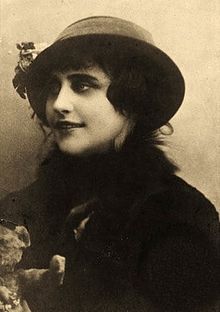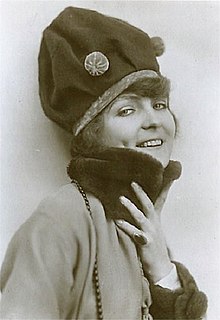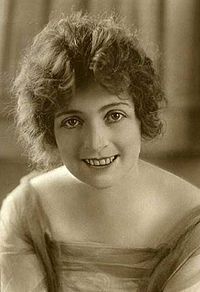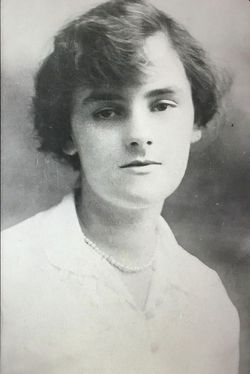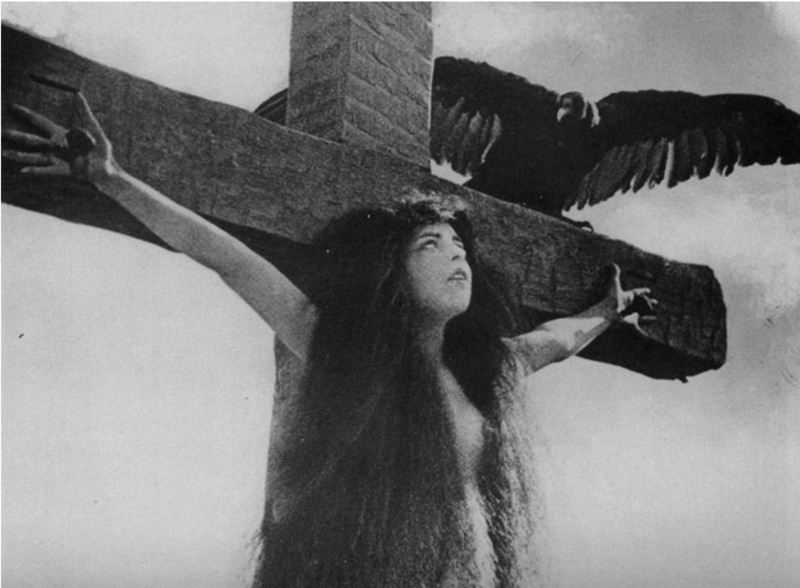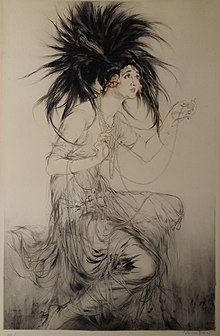
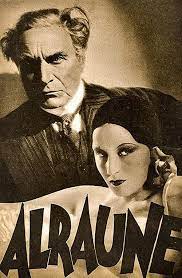
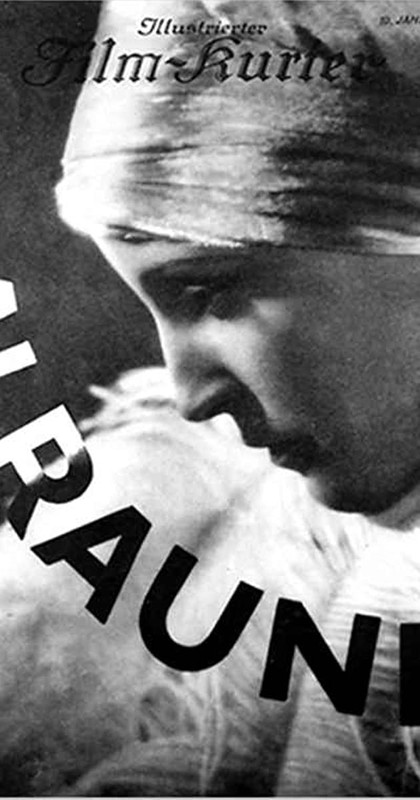
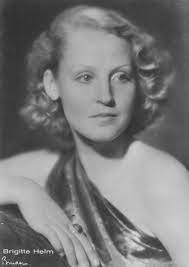
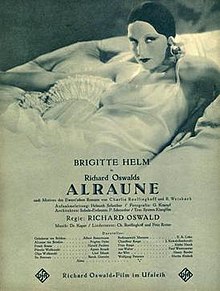
March was the 124th birthday of Brigitte Helm, star of the classic 1927 sci-fi epic "Metropolis". In the twin roles of sweet, innocent Maria and cold, rabble-rousing Robot Girl she remains one of the most iconic idols of film, recognizable even to people who have never actually seen the movie or know her name. Like her German silent films sisters Lil Dagover ("Nosferatu") and Gretta Schroeder ("Cabinet Of Dr Caligari") it's easy to forget she actually did do other films. The best known of Helm's non-Metroplis films was a lesser known but still worthy horror film "Alraune". In fact this film was so successful that she would actually make it twice, one as a silent in 1928 and again as a talkie in 1930 and would cement her image, much to her later annoyance, as a coldly, unobtainable muse who leads men to their ruin.
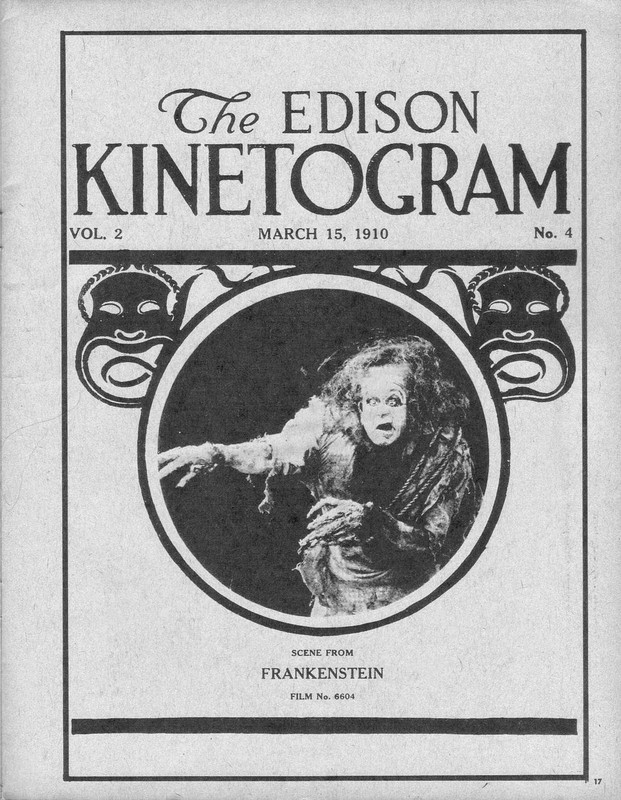
The story of "Alraune" was adapted from a 1911 novel written by Hanns Heinz Ewers, a German writer heavily influenced by Edgar Allen Poe and who would himself be cited as an influence by HP Lovecraft and Alister Crowley. The plot which also shows an obvious debt to Mary Shelley's "Frankenstein" concerns a scientist who creates a girl using artificial means. This girl grows into a beautiful but soulless woman who seduces men and leads them to ruin. In "Alraune" Helm plays the title character, like the Robot Girl in "Metropolis", a beautiful, artificially created woman who leaves destruction in her wake so comparisons to the Robot Maria are obvious but the more obvious comparison would be Frankenstein's Monster who really as much a tragic victim as a monster.
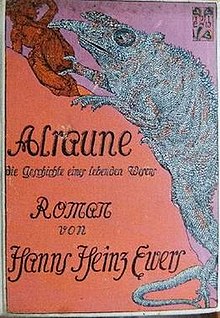
This was not actually the first film adaptation of this novel but actually the third with a Hungarian version in 1918 directed by Micheal Curtiz (now lost) and a German film in the same year with a no-name cast and director which was however successful enough to make its way to America, not an easy task so soon after the War, where it was billed under the title "Sacrifice". A copy of this film does actually survive in America but is not currently available. It did however lead to a remake with a proper budget and big name cast including involvement from other important figures of 1920's German Expressionist film including director & screenwriter Henrick Galeen and actor Paul Wegner.
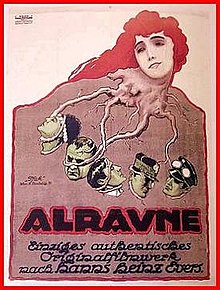
"ALRAUNE" (1928)
Directed by Henrick Galeen
Cast;
Brigitte Helm ~ Alraune ten Brinken
Paul Wegener ~ Prof Jakob ten Brinken
Ivan Petrovich ~ Franz Braun
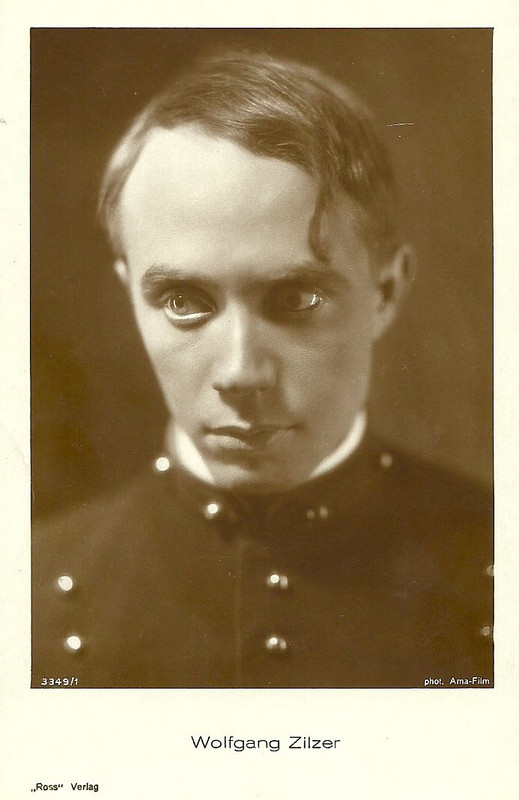
Wolfgang Zilzer ~ Wolfchen
Louis Ralph ~ Der Zauberkunstler (Magician)
Hans Trauner ~ Der Dompteur (Lion Trainer)
John Loder ~ Der Vicomte (Viscount)
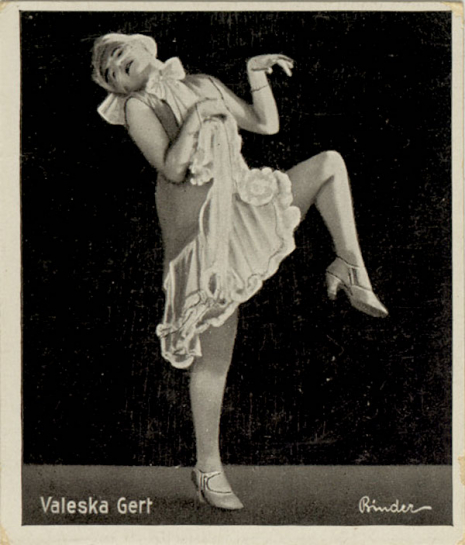
Valeska Gert ~ Machden von der Gasse (Prostitute)
Georg John ~ Der Morder
PLOT SUMMARY (spoilers alert);
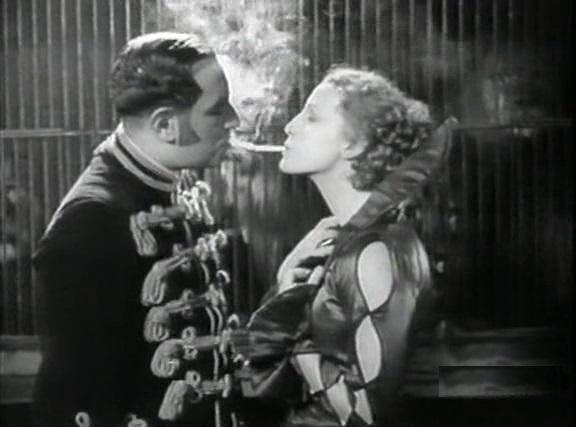
Prof. Jakob Brinken (Paul Wegener) is conducting an experiment to create a person by means of artificially inseminating a prostitute with the seamen of a hanged murderer mixed with mandrake root, also known as alraune, a plant believed to have magical powers in European witchcraft and alchemy. He sends his nephew, over his objections, out to find a prostitute (Valeska Gert) who agrees. Fast forward approximately seventeen years and the child (who believes the Professor to be her father as she has been given his last name) of the experiment is a girl, also named Alraune (Brigitte Helm) who has been brought up in a private school run by nuns. She is rebellious, playing tricks on the nuns and sneaking out to be with her boyfriend Wolfchen (Wolfgang Zitzer) who she convinces to steal money from his father (Georg John) so they can run away, which they do. They escape on a train which also has as passengers a circus troupe including a magician (Louis Ralph) who spots Alraune. She flirts with him and he performs tricks for here in front of Wolfchen provoking a fight between the two men which she is at first frightened of but soon enjoys. She abandons Wolfchen and joins the circus as the magician's assistant. Wolfchen follows to be near here and takes a job as an usher. She openly flirts with a lion tamer (Georg John) causing more jealousy. Prof Blinken has spotted her picture on a circus poster and attends a show. One of the magic tricks involves Alraune appearing and disappearing in a giant cage. After a confrontation with the Magician she walks into the lion cage and stares at the lions who do not attack her. After the show Prof Blinken confronts her and demands she leave with him which she reluctantly does leaving Wolfchen in tears. The Professor and Alraune move into a luxury hotel where she flirts with a wealthy older Viscount over Blinke's objections. He becomes more suspicious while keeping a secret journal. She asks about her mother and he lies to her suggesting she is dead. The Viscount proposes to Alroune and she accepts. However when the Viscount asks Blinken for her hand he refuses permission so she decides to elope. Before leaving she discovers the journal and reads it discovering the truth of her birth. She becomes angry and considers killing Blinken in his sleep but does not decide instead to stay and take revenge at a later date. She tells the Viscount she will not be leaving with him but does not say why. Later at a party she flirts with many men in front of Blinken making him more jealous. Meanwhile Blinken's nephew Franz has arrived looking for her and concerned, she tells him that she has learned the truth about her birth. She receives a necklace from an admirer and a jealous Blinken insists they must leave. She begins flirting with him. They attend a party where he proceeds to get drunk while she only pretends to drink. They go back to their suite where she openly flirts some more and tempts him into bed where she then tells him she knows the truth about her birth and that he's not really her father. As he leans over to kiss her she bolts from the room mocking him and locking the door. She signals to Franz using a light through the window in the courtyard below. Blinken writes in his journal saying he will have her or die before passing out. At yet another dinner party Alraune meets with Blinken who begs her to join him at the casino table where he says she will bring him luck. She agrees and at first he wins large sums but when she sneaks away he loses all of his money. He goes off in search of her. He finds her packing to leave and he begs her to go away with him saying that her jewels will be enough to make a fresh start. She tears off her necklace and laughs saying she intends to do just that but not with him. He pulls out a knife and chases her outside. Franz runs up and wrestles the knife away from Blinken who slinks back. Alraune and Franz walk away together leaving Blinken alone and beaten. A inter-title coda states that Alraune and Franz will marry while Blinken, driven by madness, will die broke and alone.
~~~~~~~~~~~~~~~~~~~~~~~~~~~~~~~~~~~~~~~~~~~~~~~~~~~~~~~~~~~~~~
The similarities with "Frankenstein" are obvious; a person is created through a combination of mad science, alchemy and black magic and that person turns out to be lacking in human emotions and empathy while desperately seeking to belong. Eventually the scientist responsible is destroyed by his creation. Other previous folktales from Central Europe of artificially created humans including the homunculus and the golem would also make their way into German films in the 1910's. The obvious difference with Alraune being that making the creation a beautiful woman adds a layer of sexual tension between the creator and creation which the film explores.
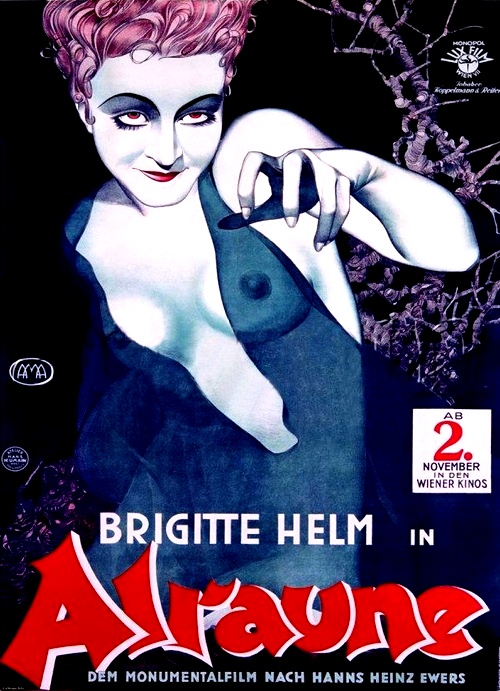
Alraune is presented in the film (and especially in the posters) as a cold temptress, like the screen vamps of an earlier era played by the likes of Theda Bara and Asta Neilsen, and from the start she is shown with clinical detachment as she drowns a fly in a bowl of soup, she pranks the Mother Superior by slipping a frighteningly large beetle in her cassock, she smokes, drinks champagne, sneaks out with her boyfriend who she manipulates into stealing money. So far though she has not really done more than any rebellious teen might do. In fact unlike the worldly characters played by Theda Bara, Asta Neilsen, Pola Negri or Alla Namizova there is an adolescent quality to Alraune as she reacts with childish joy to the simple sleight-of-hand and card tricks performed by the Magician on the train. Minutes later, in a revealing scene, as Wolfchen and the Magician start fighting she reacts with fear which then changes to a look of feral glee as she decides she is enjoying having two men fighting over her. This essentially adolescent quality reminds one not of a sophisticated temptress like Theda Bara or Alla Namizova but instead the German films of Louise Brooks. In "Pandora's Box" and "Diary Of A Lost Girl" we do not learn the details of Brooks' characters' childhoods but they are both alone and seem without a family. Brooks is used by men but in she learns to manipulate them as well by using her beauty and sex as does Alraune. In most of her surviving films (which include the French films "Miss Europe" and the American "Canary Murder Case" and "A Girl In Every Port") while Brooks always uses her sensuality and is fully aware of the effect her looks have on men (especially older ones) as does Alraune, she always maintains a pleasure both in sex and manipulating these men. Alraune is rarely shown in with such nakedly carnal desires however, she is always more calculating. That look that Alraune gives as she watches two men fighting over and that she enjoys it is somewhat echoed in a similar scene in "Pandora's Box" as Lulu gives an amused smirk when she is found cheating with a married man. Neither woman is actually sadistic however, they are using their sex as a tool (and occasionally a weapon) to make their way in a world of predatory men who either see them a sex objects to be used or who have an unhealthy and possibly dangerous desire to control them. That they do not trust men (or women for that matter) is entirely reasonable given how they have been treated their entire lives. In another common theme which may not be a coincidence; when Alraune runs away from the convent school she takes a job as a circus performer while in "Pandora's Box" Lulu works as a showgirl. Both are the sort of glamorous and exiting but essentially seedy jobs an adventure and attention seeking adolescent runaway girl might fantasize about. Unlike the cynical Theda-type vamps Alraune and Lulu are at least partly still a lonely child trying to make her way in a hostile world and find herself. It is small wonder she lashes out.

There is a difference in the way Brooks and Helm are presented however. In all her films Brooks is always presented as essentially a very American party girl-next-door; open, fun loving, impulsive, which matches Brooks' actual personality. Brooks herself always said that she didn't really act so much as reacted and basically played herself. By contrast Helm in most of her films with similar Ice Queen characters, is a much more remote figure, cooly self-aware with more self-restraint than the often reckless Brooks. Alraune considers killing Blinken but instead stops herself and plots revenge with a cold malice that no Brooks character could match. A Brooks character might feel a twinge of guilt over using and dumping the devoted Woelfchen or the loyal Viscount while Alraune doesn't give them a second glance. At the end of "Pandora's Box" Louise's Lulu, now reduced to prostitution, goes off with a broke but handsome man (who will kill her) simply because she is lonley and desires him. Alraune would probably not have been tempted by a man with nothing to offer. This is in spite of the fact that Alraune is actually far less worldly than Lulu being both younger and having literally grown up in a sheltered convent. In the end most of the similar Brooks characters (with the exception of Thymian in "Diary Of A Lost Girl") end up dead. Alraune does not.
These differences are played out in their looks. Both women have a timeless beauty but Louise Brooks always looks like a fresh faced adolescent with her trademark bobbed hair, open smile, sparkling eyes and a trace of freckles. Brigette Helm looks like a European sophisticate; lean, statuesque, blonde with a finely sculpted face, slightly crooked mouth and piercing stare. Louise Brooks radiates bouncy energy and charm which is highly attractive while Brigitte Helm projects cool poise which is charismatic but a little intimidating.
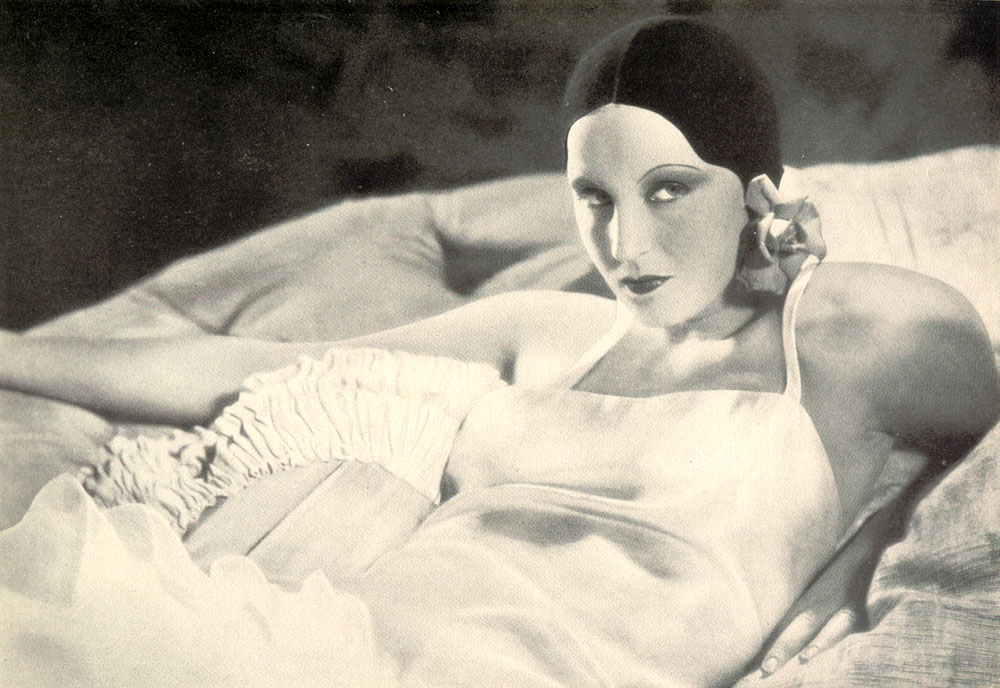
It is hard to feel sorry for the various men in her Alraune's life, most of whom get better than they deserve. The Magician and Lion Tamer are predatory older men who are clearly lusting after a much younger woman barely out of school (the film never states her age but she must be around 17) and the fact that she encourages their advances does not mean they are not sleazy. They know exactly what they are doing. The hapless Wolfchen is a somewhat different matter as he is no older than she and considerably less clever and he has actually sacrificed his family and broken the law for her and unlike the other two carnies (who take an easy-come-easy-go attitude) he takes her loss hard so the audience has some sympathy for him. At the same time he is a clingey, possessive, sap and they obviously do not belong together. The Viscount is a cypher who looks respectable enough but we don't really learn anything about him and he is a stock character, noble if ineffectual.
Although Alraune is manipulative from the start the audience is also quite aware that she has also been the plaything of her "father" Professor Blinken and he is clearly the real villain of the film. From the start he is even more arrogant than the similarly minded Dr Frankenstein or Dr Jekyll or the Chief Rabbi in "Der Golem" who at least start with some sense of wanting to do something helpful for mankind unlike the egotistical and controlling Blinken who never regards her as anything but first an experiment then later a possession and finally a sex object. Even the name he gives her "Alraune" symbolizes her a his creation as alraune is another name for the mandrake root he used in creating her. By giving her his last name he is further showing his possession of her. He is also smugly dismissive of his nephew Franz's feelings or opinions. When Blinken catches up with Alraune he seems more annoyed and offended by her reckless behavior than actually caring unlike Franz who is actually concerned for her. Later he becomes smotheringly possessive even before he becomes downright dangerous.
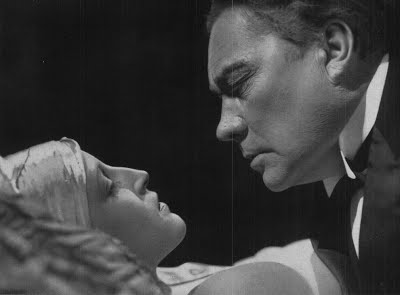
Sex itself is not subtext in the film; it being too upfront to be subtext as Alraune is openly toying with the affections of virtually every man in the film from the start. However by the time she is flirting with Blinken we have added an incest subtext as well which is still shocking and would probably never have been alowed in a British or American film, unless it was directed by Erich Von Stroheim. Technically it's not actually incest as they are not really releated which he and the audience knows but as far as she knows the relationship has always been presented as being one of father and daughter, he had given him his last name and she always refers to him as Papa even when obviously flirting. The film provides for some disturbing moments beyond even the scandalous "Pandora's Box" or "Diary Of A Lost Girl" as she lounges on the bed seductively in front of her "Pappa" beckoning him or stroking his arm and whispers in his ear in what are obvious suggestive ways. The audience seriously wonders how far she will take things or how he will react.
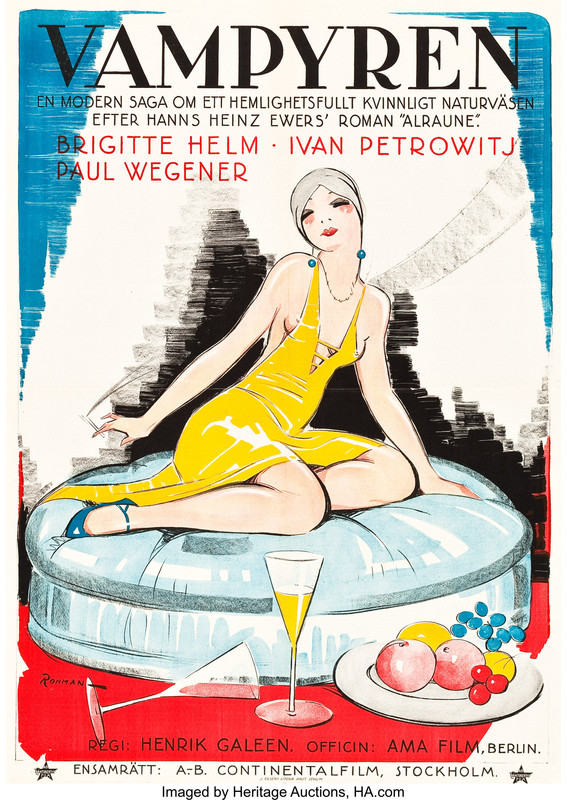
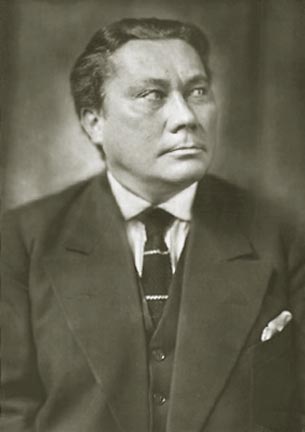
Brigitte Helm dominates the screen and the movie succeeds or fails on her slender shoulders but Paul Wegener is also an intimidating presence. Wegener was a leading figure of German film and theatre going back to before World War One as a leading figure of the new Expressionist movement. He was already a star from playing the lead roles in classic horror expressionist films "Der Golem", "The Student Of Prague" and "Svengali". Originally having trained as a lawyer he dropped out of law school and went into theatre and by 1906 had joined the theatre troupe of pioneering Expressionist director and producer Max Reinhardt, that would include such towering figures of the next generation of German Expressionist film as FW Murnau, Conrad Veidt, Henrick Galeen, Ernst Lubitsch, Emil Jannings, Max Schreck and Werner Krause. He was one of the first to move into films in 1913 with a series of movies that would be hugely influential on post WW1 German films including the "Golem" trilogy (of which only one film and a few minutes of another survive), a fantasy trilogy involving "The Pied Piper Of Hamelin" (of which one film survives) and the still extant "Student Of Prague". These films helped establish the central themes of German Expressionism; alienation, dehumanization, betrayal, sexual temptation, dreams and hallutions, dark magical forces and manipulation by charismatic figures who lead the protagonists, and sometimes themselves, to destruction. This played out not in the stories but also the visuals with plenty of shadows and fog, stairways that lead to darkness, windows that open out to storm clouds or cast an unforgiving light outside and sets with coldly imperious rooms and furniture that dwarfs the characters. The acting style placed an emphasis on a tense emotionalism where everybody seems ill at ease and covering for insecurities even at the best of times. All this was shot with mobile cameras that made the most of closeups, sharp lighting and tracking and panning shots.
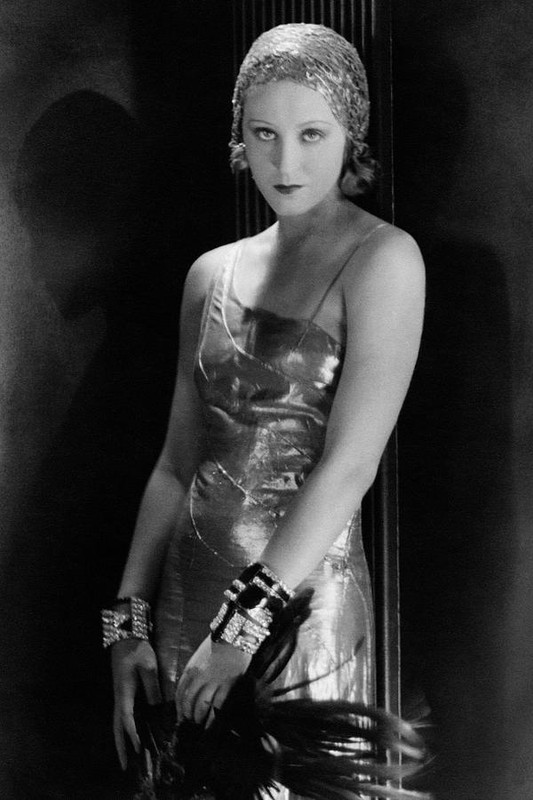
By 1928 Wegener, by then in his sixties, was a large, stocky barrel-chested man with high cheekbones, beady eyes and a tight-lipped glower and he made a menacing villain. In "Student Of Prague" he was miscast (albeit by himself as it was his movie) as a young, ambitious student but he is a natural as a heavy as in the beginning he projects the arrogance of of the mad scientist playing God, later on the annoyance of a stern parent dealing with a rebellious teen and finally the unhealthy obsession of a controlling stalker. The scenes between Blinken and Alraune get progressively creepier as the increasingly sexual nature of his possessiveness becomes clear and as does her awareness of it and willingness to exploit it. The audience can not help but be both attracted and repelled by her behavior as she circles him in her slinky dresses with her beautiful blank face and penetrating stare. We also wonder just how far either of them is prepared to take their dangerous obsession. The characters are complicated. He is a smug, controlling bastard but until near the end he has actually treated her well and his warnings about her behavior are not unreasonable, she clearly IS being reckless and irresponsible and putting herself into unhealthy relationships and dangerous situations. Alraune herself is too cold and manipulative to be likable exactly but she is charismatic and basically a sympathetic character as more the victim than the protagonist of the equally manipulative actions of others, first Blinken then various lovers, Only two of those lovers, Wolfchen and Franz (and possibly the Viscount) actually care about her at all and even they are flawed. Wolfchen is callow and possessive and for much of the film is Franz who meekly complies with Blinken's schemes despite his misgivings and only shows some spine at the end which is at least better than never. For that matter the relationship between Alraune and Franz is also fairly creepy as he is Blinken's nephew and while he has always known her secret she has not and as far she has ever known Franz is her cousin. In fact while the film adds in a Happily Ever After coda at the end I wonder how she will react when she figures out that Franz has actually known her secret her entire life but never told her. Maybe she forgives him although she doesn't seem like the easily forgiving type. The audience can at least be secure that he seems genuinely devoted to her and not exploitative and while having her go off with a man might seem to somewhat dilute the message of her ganing her independence by instead chosing a tradtional marriage there is no doubt she is doing so on her terms. As for the Viscount, he seems like a gentleman but we don't really learn much about him however his willingness to marry and even elope with a beautiful and much younger girl are a little suspect, he does however take no for an answer. It's doubtful that she really saw him as other than an attractive means of escape from her gilded cage anyway which makes him little different than the weak, easily led Wolfchen. He may actually be weaker in that at least Wolfchen was prepared to fight for her however ineffectively. Wolfchen is played by Wolfgang Zilzer, a former child actor as pale, wide-eyed and hapless naif and also does a good job here. Ivan Petrovich and John Loder as are basically bland but competant stock figures.
Director Henrick Galeen also had a career almost as long as Wegener's by 1928 having had worked as director or writer on such classics as "Der Golem", "Nosferatu", "The Student of Prague" (the 1926 remake with Conrad Veidt, not the 1913 Wegener version) and "Waxworks". He was thus well acquainted with Expressionist themes which this film obviously shares. Like "Der Golem" or the "Homunculus" (or Frankenstein) the main character is an artificially created person who may be lacking basic humanity. Brigitte Helm herself had of course played the Robot Girl in "Metropolis", in what was amazingly her first film role. The previous year she had appeared in a supporting role in another sexually charged role in "The Love Of Jeanne Ney", directed by none other than future "Pandora's Box" director GW Pabst. This time however she played a much more vulnerable blind girl who is victimized by her father. Unlike those films Alraune is fully self aware, at least by the halfway point, can take effective action and survives albeit not without exposing herself to serious danger. Carrying on with the Expressionist themes; Like "The Cabinet Of Dr Caligari", "The Pied Piper Of Hamelin", "The Student Of Prague" and "Dr Mabuse" the film also has an evil mastermind who controls others and manipulates them to his will. Unlike some of those films (except Dr Mabuse) he ends up destroyed by his creation as she (and Franz who he has also been controlling) turns on him. Another slight difference in earlier films is the nature of Blinken's power. The mastermind characters in "Der Golem" or "The Student Of Prague" work with magic while Blinken is presented (mostly) as a man of science. Dr Caligari uses hypnotism while Blinken simply has a bullying, controlling personality. Late period Expressionist horror was giving way to somewhat more naturalistic themes that would play out in the sound era horror films with science gone awry like "Frankenstein", "The Invisible Man" and "The Island Of Dr Moreau".
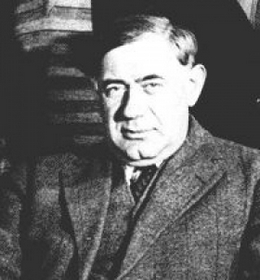
HENRICK GALEEN
While Galeen has an interesting take in Expressionist themes in terms of plot, visually the film is more restrained than earlier films with few of the typical Expressionist cues of shadows & fog. There are still some scenes that expertly conjure up classic Expressionism notably when Alraune reads Blinken's journal and collapses in an emotional heap clutching her heart (a typical Expressionist gesture) then begins to stalk the sleeping Blinken with her shadowy clutching hands moving slowly to his neck in a scene obviously lifted straight out of "Nosferatu" but no less effective for doing so. The sets are mostly realistic but the symbolism of Alraune in the gilded cage during the magic show and again in the lion cage is obvious and reminds one of other characters in previous films shown peering out from behind window panes, latticeworks, broken mirrors, or other symbols of imprisonment. The difference being that Alraune escapes her cage.
This film was a success both with audiences and critics, especially the performance of Helm who shows far more depth and a slinky seductiveness than she was able to do in the more simplistic and bombastic "Metropolis" so when sound films came in a sequel was quickly made however with Helm being the only holdover from the original cast and also without Henrik Galleen. Replacing him would be journeyman director Richard Oswald fresh off of a well regarded silent version of the Sherlock Holmes "Hound Of The Baskervilles". Oswald would completely rework the script and change the story in ways that were ill advised.
~~~~~~~~~~~~~~~~~~~~~~~~~~~~~~~~~~~~~~~~~~~~~~~~~~~~~~~~~~~~~~~~~~~~~~~~~~~~~~~~~~~~~~~
"ALRAUNE" (1930);
Brigitte Helm ~ Alraune ten Blinken and Alma The Singer
Albert Bassermann ~ Privy Councillor Prof ten Brinken
Harald Paulsen ~ Frank Braun
Adolf E. Licho ~ Attorney-at-law Manasse
Agnes Straub ~ Princess Fuerstin Wolkonski
Bernhard Goetzke ~ Dr. Wolfgang Petersen
Martin Kosleck ~ Wolfchen Petersen
Käthe Haack as Frau Raspe
Ivan Koval-Samborsky ~ Kurt Raspe
Liselotte Schaak as Olga Wolkonski
Paul Westermeier as Von Walter
Henry Bender as The innkeeper
Plot Synopsis (SPOILER ALERT);
Dr Blinken (Albert Basserman), a scientist and Privy Counsellor to the Prince, has arranged for the birth of a daughter for the Prince & Princess via artificial insemination. In return the Prince has paid Blinken a million marks and given access to funds for the child's education which he has been scimming money from. His colleagues, Franz Braun, also Blinken's nephew (Harald Paulsen), Princess Dr Peterson (Martin Kosleck) and financial backer Princess Wolkonski (Agnes Straub) are aware that Blinken has used unethical experiments using the semen of an executed murderer mixed with mandrake root to create another child and attempts to blackmail Blinken but he refuses and Peterson backs down. Franz is disturbed by Blinken's experiment but goes along with it. Alma Brigitte Helm) a prostitute and a singer in a cabaret the doctors frequent, is gotten drunk and agrees to be the surrogate signing away her rights. Seventeen years later the resulting child is a daughter named Alraune (Brigitte Helm) who Blinken has passed off as his niece. After having been sent to boarding school for an education, Alraune has returned home where the maid Frau Raspe (Käthe Haack) is afraid of her and offended at her influence over men including her husband Kurt the chauffer, announces they are quitting. Alraune convinces Kurt, (Ivan Koval-Samborsky) to take her for a drive during which they make out. Driving home she insists he drive at a reckless speed causing an car wreck which kills Kurt. Alraune is dazed but unharmed and Frau Raspe denounces her as a murderess. Peterson confronts Blinken and announces he is quitting and again demands money but Blinken again refuses and Peterson slinks away. At a fancy dress ball to celebrate the marriage of Wolkonski's daughter and Von Walter, Alraune flirts with all the men including Von Walter causing a scene in which the Wolkonsi's storm out breaking the daughter's engagement which Alraune and Blinken find amusing. Dr Peterson's son Wolfchen, a suitor of Alraune, begs her for a dance and she tells him to fetch her a fresh flower from a mill pond and then she leaves him. Returning to the suite they share Alraune flirts with Blinken but when he tries to kiss her she rejects him. Blinken's lawyer warns him that due to their high living he is running out of money and the police are looking into his finances. Franz Braun, who has been living in Africa since the girl's birth returns home but Blinken refuses to see him. As he is leaving Alraune sees him and introduces herself. Braun instantly knows her secret birth but does not tell her and hurries away. Dr Peterson has been arrested on financial charges and is pressed for information on Blinken's fraud. Alraune discovers that Wolfchen while trying to fetch a flower for her fell in to the lilypond and drowned. She is upset and Peterson blames her and turns evidence against Blinken. An arrest warrant issued against Blinken who tries to flee to America with Alraune but she refuses to leave. The police come for Blinken and he shoots himself after making a will leaving his estate to Alraune with Braun as guardian although he also leaves an entry blaming Alraune for all the deaths including his own. He also adds Braun's name to the list of her victims. Wolkonski was also defrauded by Blinken and attempts to regain her fortune by demanding it from Alraune who is staying with Braun, they are making plans to return his estate in Africa. After Braun leaves Wolkonski confronts Alraune and reveals to her the secret of birth and threatens blackmail. Alraune confronts Blinken's lawyer who gives her a copy of Blinken's journal. Upon reading it she discovers his list of her victims including Frank's name. Guilt ridden and believing herself cursed, Alraune drowns herself in the lily pond. Finis.
~~~~~~~~~~~~~~~~~~~~~~~~~~~~~~~~~~~~~~~~~~~~~~~~~~~~~~~~~~~~~~~~~~~~~~~~~~~~~
The plot of this movie is so obviously different from the 1928 film that it can not really be called a remake and it's clearly not a sequel or a prequel either. This film is not only radically different from the 1928 version, it's also inferior in every way so what went wrong?
For a start the film has the problems of most films of the early sound era; unimaginative camera-work (partly forced by the need to film the action around the bulky microphones as well as the cameras themselves which were also kept in soundproof booths), poor sound which tends to make evrybody's voice sound sharp or shrill and stiff line-readings. To be fair the surviving print is also of inferior quality compared to the 1928 version. Oswald's direction is unimaginative (more on him in a bit), much the acting is also clearly inferior including Brigitte Helm herself who is oddly muted here. Finally the plot is a mess. If anything the movie is wildly over-plotted with additional characters such as Wolkonski and Dr Peterson who add layers of unnecessary confusion to what had been a fairly straight forward plot. Instead this film adds subplots about blackmail and embezzlement. Essentially this film changed what was a film with a simple plot but hidden layers of subtext about identity and sexual obsession and control and changed it into a film with a more complicated plot but for less subtext for what is ultimately a less engaging and less intelligent film that gives Helm in particular less complex characters to work with, even though she plays two roles as both Alraune and Alma.
To explore why this might be we must consider the different directors. Henrick Galeen had a history with Expressionism as both a film and theatre from the 1910's, as did Paul Wegener, and understood it as a medium to explore the dark reaches of the psyche. Richard Oswald's history was more checkered. He also had a long career starting in the 1910's but as a journeyman professional who could make any genre of film quickly, competently, on time and on budget rather than as part of a more self-conscious art scene. By the time this movie had been made he had literally dozens of feature films to his credit, most long forgotten. Oddly he had made a name for himself during World War One when the German health department commissioned him to make three films about prostitution and venerial disease and instead of the expected dry instructional films he delivered three potboiler mellodramas which were financially successful but provoked outrage from conservative authorities and calls for his arrest. One of the films he made after the war was another sex themed film "Different From The Others" (starring Conrad Veidt from "The Cabinet Of Dr Caligari") which openely dealt with homosexuality in a sensitive way and is considered a classic of the genre (later banned by the Nazis of course). It would be wrong however to imply that he was merely, or even mostly, a maker of sexploitation films. Among other notable films were "Eerie Tales" (also with Veidt) a respected horror anthology. He also had a Louise Brooks connection, albeit once removed as he directed an early 1918 version of "Diary Of A Lost Girl" with Erna Morean and the great Conrad Viedt (now lost) and produced a 1923 version of "Pandora's Box" starring Asta Neilsen and Oswald would also make a popular version of the Sherlock Holmes novel "The Hound Of The Baskervilles" (1914) which he also remade with a different cast in 1928. This difference between these last two films show both his strengths and weaknesses. The first Holmes film is shot in a competent if not especially stylish manner but is marred by the script going wildly off canon and adding a number of confusing subplots involving multiple costume changes which are hard to keep track of and which undermine the entire premise of the Holmes character. By the time of his 1928 remake more than a decade had passed and he had learned some Expressionist techniques which show in some evocative shadows & fog sequences and an active camera. He also sticks closely to the original novel at least until the final third when he again goes off canon for a gimmicky ending. We see the same fondness for extra subplots which distract from the core story and indeed take time away from Alraune herself, who is not only the title character but obviously the most interesting one, especially given the sexual tension inherent in the character. Instead we actually spend more time with Prof Blinken who is both less interesting as well as being unlikable. Given that Oswald had made his name with films with even more explicit sexual themes than "Alraune" his reluctance to do so here is puzzling. Perhaps he was ordered to do so by the studio (the script was not his although he probably had input) or perhaps he was wary of courting controversy in the more conservative atmosphere of late period Weimar Germany, or perhaps he just saw the film as a more conventional crime pot-boiler for a mass audience to be fired off quickly rather than a dark psychological thriller.
Oswald's direction here is strictly conventional and shows little of the flair he had shown just the year before in the "Hound Of The Baskervilles" remake. One holdover from that film was a fondness for panning shots although they are less noticeable this time and Shadows & Fog are nowhere to be seen. Presumably to take advantage of the audience's demand for the relatively new sound technology Oswald includes not one but three scenes with music; the opening with Blinken's students singing in a beerhall then serenading him, the scene with Alma singing in a cabaret and a scene with Alraune dancing at the engagement ball. In another continuing theme from Oswald's first Holmes movie; two of the characters in that film wear disguises as each other, which is confusing and clearly off canon from the original story, while in the 1930 "Alraune" he has Brigitte Helm playing two roles, as Alraune and her mother Alma. The scene with Alma singing is presumably meant to invoke Marlene Dietrich in "The Blue Angel" and is acceptable as well as giving Helm a flashier role and the party scene is fine however the opening goes on too long, adds nothing to the plot (we never see those students again nor is any reference again made to Blinken even having students) and should have been been cut.
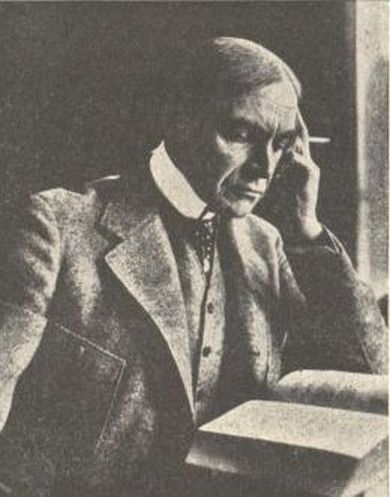
Besides lacking in eye catching visuals the film is also noticeably lacking in the strong performances of the Henrick Galeen film. In place of the domineering presence of Paul Wegener's Prof Blinken, Albert Basserman is merely conniving and greedy and leaves little impact. The difference between the two goes beyond merely a matter of Wegener having more charisma. Wegener's Blinken actually evolves; in the begining he is arrogant, domineering and unlikable, however his behavior towards Alraune seems little diffferent from that of a stern father as he chastises her. Only later does he give way to his sexual obsession and become both more threatening and erratic. Basserman however actually has few interactions with Alraune and shows little real intrest in her. He is instead a greedy, manipulative fraudster which Wegener is not, whatever his flaws Wegener is at first motivated by a sincere, if misguided intrest in science while Basserman is motivated by greed. Wegener is a stern father figure but he does at seem at first like a reasonably responsible one. In the 1930 film when Alraune disrupts Wolkowski's engagment ball with her behavior both she and Basserman/Blinken are ammused and he makes no attempt to chide her. Thus when Wegener's obsession becomes more clear it is a slower process which the viewer has witnessed while with Basserman it is merely a brief moment after the party done with no real build-up or payoff. Ironically Basserman had actually starred in the 1923 film "Erdgiest" (with Asta Neilsen) which was an earlier (and inferior) version of "Pandora's Box" in which he played Lulu's possessive older lover.
ALBERT BASSERMAN
The character of Woelfchen is killed off so quickly we barely see him, even the Franz Braun character has less presence and depth than the already fairly wan 1928 version. The one exception to this is the character of Alma the prostitute where Helm is given more to do, namely doing a solid enough, if obvious Marlene Dietrich impression. The actress who played the role in the 1928 film, Valeska Gert, was given little to do by comparison. Ironically, Gert actually led quite an interesting life and was a notorious figure in the Berlin cabaret and Dada art scene and had appeared in the 1929 Pabst/Louise Brooks film "Diary Of A Lost Girl" as the cruel matron and the Pabst/Garbo film "The Joyless Street" as a manipulative owner of a bawdy house.
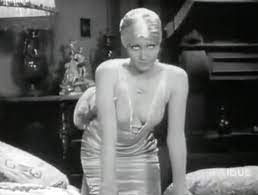
Instead Oswald has added more characters but none of them are interesting either and merely take up more screen time that should be spent with Alraune herself. Given palid direction, bland costars and less screen time than before Brigitte Helm is left with little chance to make her impact. She seems largely passive much of the time, in the car crash scene she seems merely childish and in her all-too brief scenes with Wolfchen or another man she is mostly bored. Only in her scene where she toys with Blinken does she get a chance to be seductive as she lounges about in a slinky, backless gown and reclines in a lounge chair staring invitingly at him with her blank, slightly mocking face. However the scene is shot from a distance instead of Galeen's lingering close-up and Basserman lacks entirely Wegener's increasingly desperate menace. More importantly at this point in the Galeen film she had learned her secret and the audience knows she is toying with him without knowing how far she will take things which gives the entire scene a layer of both sexual tension and danger keeping the audience on edge. By contrast in the Oswald film she knows nothing, her motives, if any, are unknown (as are his) making her seem merely capricious and robbing the scene of most of its meaning compared to the creepy tension of the original. Ultimately Galeen is focused on the characters of Alraune, Blinken (and to a lesser extent Wolfchen and Franz) and their motivations and developements while Oswald is focused on his plot twists. Galeen's characters are real, if unattractive and disturbing, while Oswald's characters are mere plot contrivances who are also unlikable to boot.
The biggest change in the two films is of course the ending. In the 1928 version she destroys Blinken and escapes both his control and presumably her own temptations to get a chance at a normal life. In the 1930 version Blinken is brought down by Dr Peterson's confession to the police of his financial embezzlement and he then kills himself, not because of anything she directly did but simply to avoid jail. Worse, rather than escaping his control she then kills herself because of the guilt caused by the vindictiveness of Blinken and Wolkoski as well as to spare Franz of a curse that she has only just learned of. In the first film she frees herself and becomes a more mature woman. In the second she is supposedly sacrificing herself both for guilt and the love of Franz. However they only death that is really her fault is that of Raspe the chauffer and that was more of adolecent recklessness than malice while the death of Wolfchen was truly an accident. Also on the list is Alma but we are not told what happened to her. Presumably she died in childbirth but this would hardly be Alraune's fault. She knows nothing of the crimes of Blinken and his cronies and their fall is certainly not her fault either. She is not the villian in this film that also contains not only the obviously villainous Blinken but also Wolkowski. Meanwhile Franz (who she barely really knows) is too bland a character for the audience to really care about, let alone die for. She dies at the end either to give the film a tacked-on moral about the fallen woman getting her comeuppance which she does not actually deserve or to leave a sad ending which the character has not been developed enough to indentify with unlike Lulu in "Pandora's Box". The ending of the 1928 film may be simplistic but it is a satisfying ending to a clever, well made and well acted film. The ending of the 1930 film is a simplistic and unsatisfying ending to a mediocre film. If the 1928 film had not been made the 1930 version might still have been made (there were two previous versions remember) but there would be no paticualr reason to remember it, Brigitte Helm or not.
~~~~~~~~~~~~~~~~~~~~~~~~~~~~~~~~~~~~~~~~~~~~~~~~~~~~~~~~~~~~~~~~~~~~~~~~~
The later careers of the principals would be tied up in the fates of so many others once the Nazis came to power.
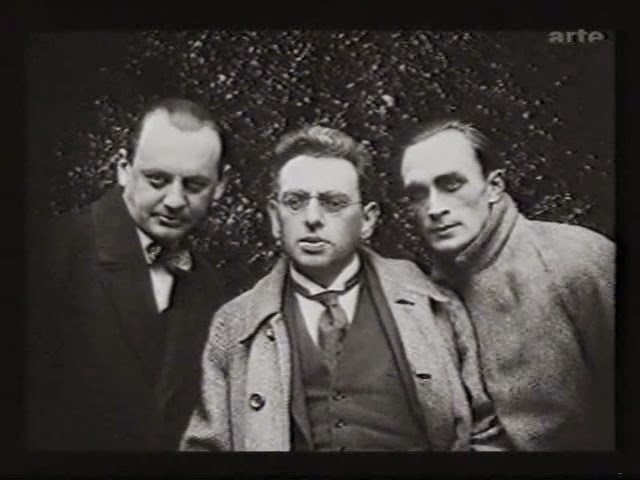
RICHARD OSWALD (center) & CONRAD VEIDT (right)
Henrick Galeen and Richard Oswald would both flee Germany but would have different lives. Galeen would move from Sweden to Britain and finally America but found no work in Hollywood dying in 1949 aged 68. Richard Oswald did work in Hollywood albeit in a lower profile. After the war he returned to Germany and died in 1963 aged 82.
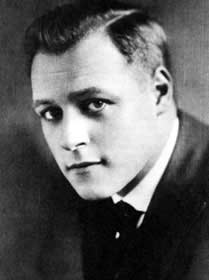
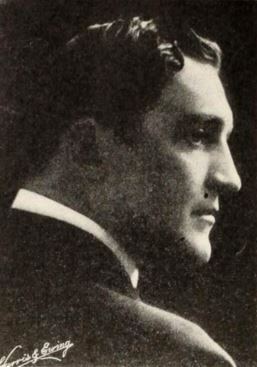
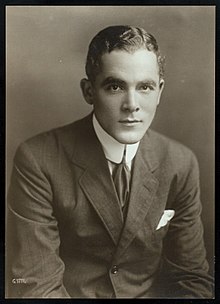
Of the 1928 film; Ivan Petrovich (Franz Braun in 1928) was actually a Serbian actor who worked in a number of European countries through the 1920's during the war he moved to Hungary where he continued to work moving back to Germany after the war and continuing his long career dying in 962 aged 68. Wolfgang Zilzer (Woelfchen in 1928) being Jewish fled to Hollywood where he made propaganda films during the war and moving back to post war Germany continuing his even longer career into the 1980's dying in 1991 aged 91. John Loder (The Viscount) was an English actor and had already returned to Britain when sound films arrived. He was married to Hedy Lamar from 1943 to 1947 and continued acting into the 1970's, dying in 1988 aged 90. Valeska Gert (Alma) was Jewish and fled to Britain once the Nazis took power and then America where she continued her eccentric career opening a cabaret that somehow employed both Jackson Pollock and Tennessee Williams. She moved back to post-war Germany where she opened up another cabaret and she would be cast by Werner Herzog to appear in his 1978 remake of "Nosferatu" but died before filming began aged 77. Georg John, who played a minor role in the silent film, had played supporting roles in several films by FW Murnau and Fritz Lang including "Metropolis", "The Last Laugh" and later "M". Being Jewish he fled Germany for Poland but after the German invasion he was rounded up and sent to the Lodz Ghetto where he died in 1941 aged 62. Of the 1930 film; Albert Basserman (Blinken) was a respected stage actor married to a Jewish actress who moved to America where he appeared in the Alfred Hitchcock film "Foreign Correspondent" for which he was nominated for an Oscar. He died in 1952 aged 84.
PAUL WEGENER
Not all actors and filmmakers would flee however. Paul Wegener would stay in Germany and continue to make films including appearing in the notorious Nazi propaganda epic "Kolberg" in 1945 but otherwise avoided politics. Marrying six times he died in 1948 aged 73. Writer Hanns Heinz Ewers had a more ambivlant relationship with the regeime, joining the Nazi Party even by 1931 being a crony of SA storm trooper Horst Wessel who he wrote a bio for which was made into a movie. He would and support their nationalism but not endorsing their anti-Semitism, some of his books even having had Jewish characters. Ewers was also openly gay and soon fell out of favour with many of his books being banned. He died of tuberculosis in 1943 aged 82.
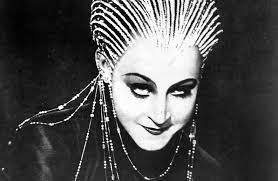
BRIGITTE HELM ARRIVES IN PARIS 1928;
As for Brigitte Helm; Among her other noteworthy films was the silent film "Abwege" (1928), a drama about a bored housewife who turns to crime and "The Love Of Jeanne Ney", both directed by GW Pabst who had directed Louise Brooks in her two German films, and sound films "The Mistress Of Atlantis" (1932 also directed by Pabst) and "The Countess Of Monte Cristo" (1932), in both films she plays a remote Ice Queen character. Eventually she would come to resent being typecast in such roles and she loathed the Nazis and their escapist films. In 1935 with her contract up she walked away and married a Jewish banker which was a violation of German law as she was not herself Jewish. She was apparently a reckless driver (ironic given how Alraune survived a car wreck in the 1930 film) and was involved in a few car crashes including one that resulted in a death for which she was charged with manslaughter, these charges being dismissed reportedly after Hitler or Goebbels interceded on her behalf. Although Helm was herself certainly no Nazi supporter the Nazis saw the tall, blonde, beautiful Helm as the perfect Ayran ideal woman and offered her a new contract but she brushed them off and quickly fled to Switzerkand with her husband and never worked in film again. In later years she worked in fashion but refused to give any interviews except for once when she would only consent to talk about a fashion line she was promoting and under strict conditions that no questions about film would be asked lest the interview be abrupty ended. She died in Switzerland in 1996 aged 88, outliving the rest of the cast. In fact living long enough to have not only seen a 1952 German remake of "Alraune" but the 1984 and 1987 rereleases of the restored "Metropolis" as the last surviving member of that cast as well, but if she actually went to see it she never said so.